Our readers keep the lights on and my smoothie glass nicely filled. As an Amazon Associate, I earn from qualifying purchases.
A 50-amp generator is the threshold between keeping the lights on and truly living normally during an outage—it powers your well pump, central AC, kitchen appliances, and even a EV charger. But the market is flooded with models that claim 50-amp capability yet buckle under real-world loads, leaving homeowners stranded when they need reliability most.
I’m Mohammad Maruf — the founder and writer behind WellFizz. I’ve spent over 1,500 hours analyzing generator specifications, comparing output curves, and cross-referencing customer experiences to separate marketing hype from genuine performance in this category.
After researching and comparing the leading options, this guide breaks down the specs, real-world performance, and true value of every best 50 amp generator contender for whole-home power.
How To Choose The Best 50 Amp Generator
Selecting a 50-amp generator requires more than just looking at peak wattage. You need to understand sustained output, fuel flexibility, outlet configuration, and how the unit integrates with your home’s electrical system. These four factors will guide you to the right choice.
Running Watts vs. Peak Watts
A 50-amp 240V circuit draws 12,000 watts at full load, so your generator must deliver at least 12,000 running watts to sustain that output continuously. Many generators advertise peak watts that exceed this number but drop significantly once the initial surge passes. Focus on the running (rated) wattage on gasoline and propane—that is the number that keeps your home powered during an extended outage.
Fuel Type and Runtime
Dual-fuel (gasoline and propane) and tri-fuel (adds natural gas) generators offer flexibility when one fuel becomes scarce. Propane stores indefinitely and burns cleaner, while natural gas provides unlimited runtime if your home has a connection. Gasoline offers the highest wattage output but degrades over time. Choose a model that matches your fuel accessibility and storage comfort.
50-Amp Outlet and Transfer Switch Compatibility
Look for a genuine NEMA 14-50R outlet rated for 50 amps. Some generators include a 14-50R but pair it with a 30-amp breaker, limiting your actual output. Ensure the generator’s 50-amp outlet is backed by a 50-amp breaker and that your home’s transfer switch or interlock kit is rated for the same amperage.
Inverter vs. Conventional Alternator
Inverter generators produce cleaner power (less than 3% THD), making them safe for sensitive electronics like computers and smart appliances. They also run quieter and adjust engine speed to match load, saving fuel. Conventional generators are simpler and often cheaper but can be louder and less efficient at partial loads.
Quick Comparison
On smaller screens, swipe sideways to see the full table.
| Model | Type | Best For | Key Feature | Amazon |
|---|---|---|---|---|
| Westinghouse 14500W | Dual Fuel | Whole-home backup | 19-hr runtime on 9.5 gal tank | Amazon |
| Champion 11000W | Dual Fuel Inverter | Quiet whole-home power | 64 dBA, inverter clean power | Amazon |
| Pulsar PGD105TiSCO | Tri Fuel Inverter | Multi-fuel flexibility | 62 dB, remote start, 50A outlet | Amazon |
| DuroMax XP15000HXT | Tri Fuel | Heavy-duty whole home | 15,000W, CO Alert, copper windings | Amazon |
| Westinghouse 28000W | Gasoline | Extreme whole-home power | 28,000 peak W, V-twin engine | Amazon |
| Westinghouse 12500W | Dual Fuel | Value backup power | Remote start, 12-hr runtime | Amazon |
| DuroStar DS13000MXT | Tri Fuel | Tri-fuel on a budget | 13,000W, CO Alert, natural gas ready | Amazon |
| Champion 9000W | Tri Fuel Inverter | Lightweight tri-fuel | 72 dBA, 156 lbs, CO Shield | Amazon |
| GENMAX GM9000iEDC | Dual Fuel Inverter | Super quiet operation | 62 dBA, parallel capable, CO detect | Amazon |
| Pulsar PGD95BISCO | Dual Fuel Inverter | Quiet residential backup | 62 dBA, pure sine wave, remote start | Amazon |
| GENMAX GM10500iETC | Tri Fuel Inverter | High-power tri-fuel inverter | 10,500W, ATS ready, neutral floating | Amazon |
In-Depth Reviews
1. Westinghouse 14500 Peak Watt Dual Fuel Home Backup Portable Generator

This Westinghouse delivers 14,500 peak watts and 11,500 running watts on gasoline, with 13,500 peak and 10,500 running on propane. That gives you genuine 50-amp capability at 240V with headroom for motor starts. The 550cc cast-iron sleeve engine is built for longevity, and the 9.5-gallon fuel tank enables up to 19 hours of runtime at partial load — enough to sleep through the night without refueling.
Outlets include a 50-amp 14-50R, a 30-amp L14-30R, and two GFCI 120V household receptacles, all with rubber covers. The remote start key fob works from about 200 feet, and the electric push-button start means no pulling cords. Users consistently praise the straightforward assembly, the included tool kit, and the fact that it starts on the first try even after sitting.
The CO sensor provides automatic shutdown if carbon monoxide builds up, adding a critical safety layer. The VFT display shows voltage, frequency, and lifetime hours in real time. It is heavy at 230 pounds, but the wheel kit and folding handle make it manageable on flat ground for one person.
Why it’s great
- Genuine 50-amp 14-50R outlet with real capacity
- 19-hour runtime means overnight operation without refueling
- Remote start key fob adds convenience in bad weather
Good to know
- Very heavy at 230 lbs, not easy to move over rough ground
- Loud enough that you won’t want it near bedroom windows
2. Champion Power Equipment 11,000-Watt Dual Fuel Home Backup Portable Inverter Generator
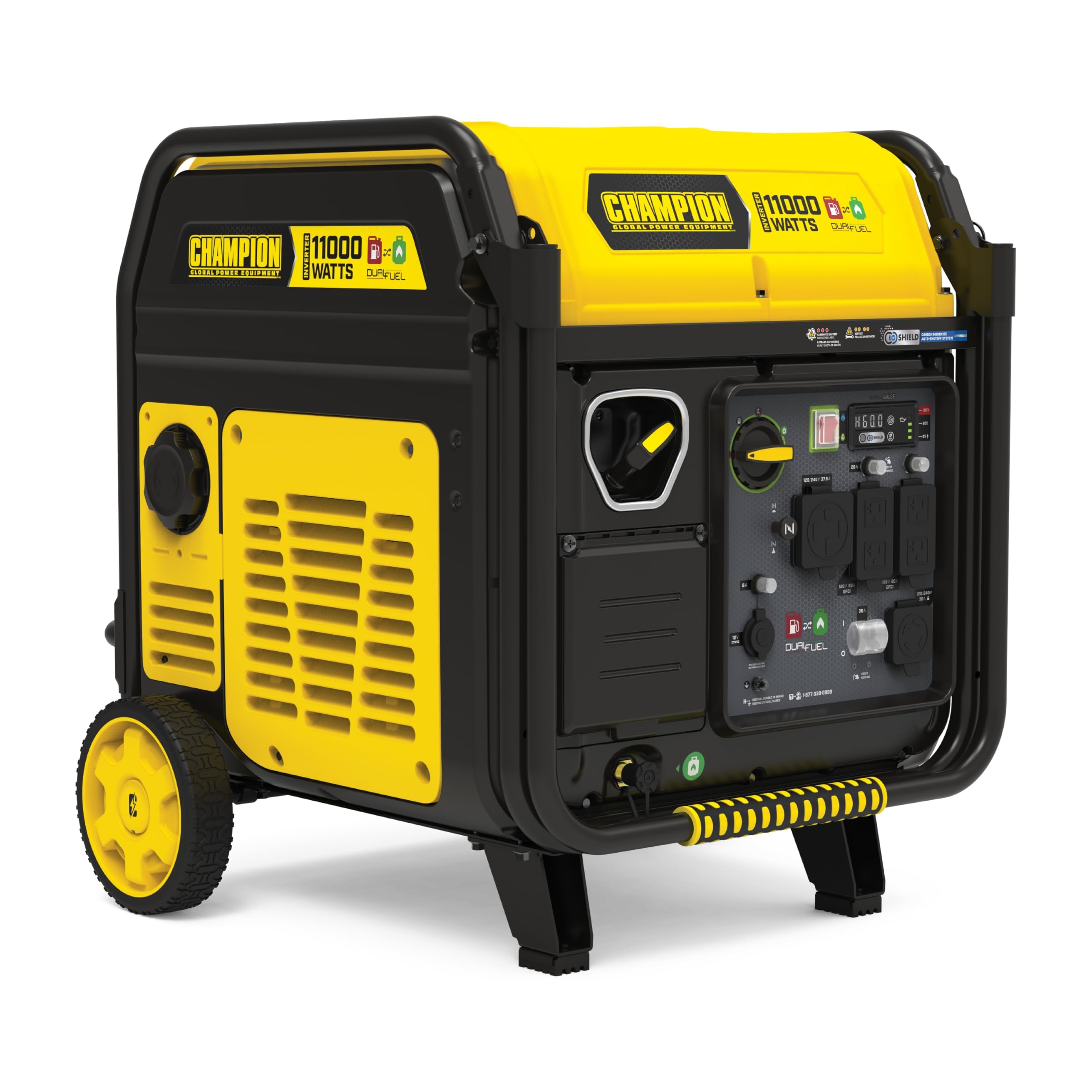
Champion’s 11,000-watt inverter generator produces 9,000 running watts on gasoline and 8,100 on propane, with a 50-amp 14-50R outlet backed by a 37.5A breaker. The inverter technology delivers clean power (under 3% THD) safe for sensitive electronics, and the 64 dBA noise level at 23 feet makes it noticeably quieter than conventional open-frame generators of similar output.
The 459cc Champion engine includes electric start with a toggle switch and Cold Start Technology for reliable ignition in freezing weather. Run time reaches 15 hours on a full gasoline tank at half load, and the dual-fuel capability lets you switch between gasoline and propane without any tools. Users report that it starts easily on propane and runs refrigerators, freezers, and even central AC units without issue.
The power panel includes two GFCI 120V 20A duplex outlets, a 120/240V 30A locking outlet, the 50A 14-50R, and a 12V automotive outlet. The Intelligauge monitors voltage, frequency, and operating hours. CO Shield provides automatic shutdown if carbon monoxide accumulates, and the 3-year warranty with free lifetime technical support adds peace of mind.
Why it’s great
- Inverter technology delivers clean power for electronics
- 64 dBA is significantly quieter than comparable non-inverter models
- Dual fuel with easy switchover and Cold Start Technology
Good to know
- 50A outlet is paired with a 37.5A breaker, limiting continuous draw
- Heavy at 205 lbs despite inverter design
3. Pulsar PGD105TiSCO Tri Fuel Inverter Generator, 10,500-Watt

The Pulsar PGD105TiSCO runs on gasoline, propane, or natural gas, giving you three fuel pathways to keep your home powered. Output reaches 10,500 peak and 8,500 running watts on gasoline, 9,500 peak and 8,000 running on propane, and 8,400 peak and 6,800 running on natural gas. The 50-amp 14-50R outlet is complemented by a 30-amp L14-30R and four GFCI 120V 5-20R outlets.
The 458cc OHV engine is paired with an inverter that produces clean sine wave power safe for sensitive electronics. The digital control center displays hours, voltage, load, and frequency. Super-quiet operation is rated at 62 dBA, and the remote start key fob means you can fire it up from inside the house during a storm. The 6.9-gallon fuel tank supports up to 9 hours of continuous operation at half load.
Users who rode out Hurricane Beryl report it powered their entire home from natural gas with zero assembly required. The included propane and natural gas hoses with regulators mean you don’t need to buy extra parts. The CO sensor provides automatic shutdown for safety, and the unit is both EPA and CARB compliant, so it’s legal to own in all 50 states.
Why it’s great
- True tri-fuel operation with all hoses and regulators included
- 62 dBA inverter operation is whisper-quiet for its class
- Remote start and digital display add convenience
Good to know
- Heavy at 247 lbs, needs two people for initial placement
- Some users report hidden oil plug issues from the factory
4. DuroMax XP15000HXT 15,000 Watt Tri Fuel Portable Generator
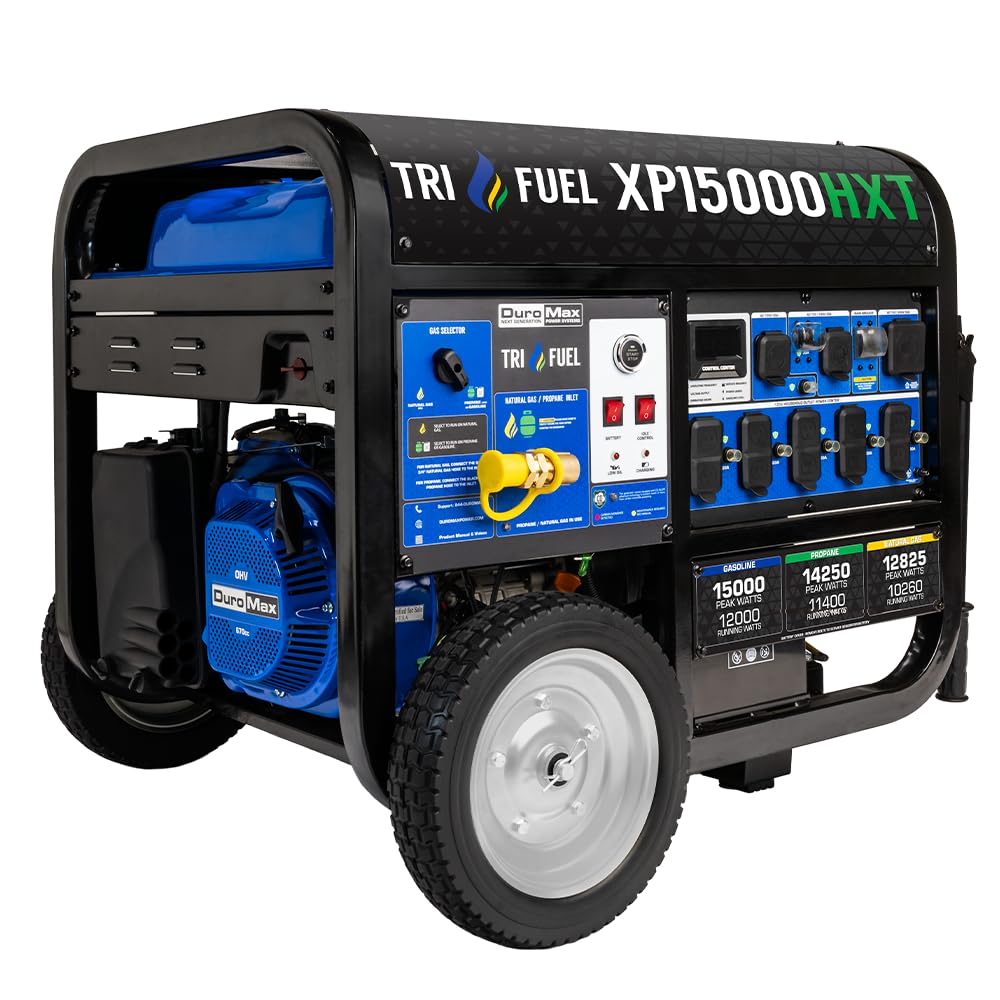
The DuroMax XP15000HXT is built for homeowners who refuse to compromise on capacity. With 15,000 peak watts and 12,000 running watts on gasoline, it comfortably handles a 50-amp 240V load plus surge capacity for motor starts. The tri-fuel system runs on gasoline, propane, or natural gas, and the front-facing fuel selector switch lets you change sources in seconds without tools.
The 500cc OHV engine features a push-button electric start and a remote start key fob. The power panel includes four 120V 20A GFCI outlets, a 120V 30A twist-lock, a 120/240V 30A twist-lock, and a heavy-duty 120/240V 50A outlet. The advanced LED display shows gas level, load percentage, voltage, frequency, and runtime hours. CO Alert automatically shuts down the generator if carbon monoxide reaches dangerous levels.
DuroMax uses 100% copper windings, which conduct heat better than aluminum and extend generator life. The wheel and handle kit makes it mobile despite the 362-pound weight. Users running all-electric homes with HVAC report it handles full loads for hours without issue, and the natural gas hose and propane regulator are included, so you only need to supply the fuel.
Why it’s great
- True 15,000W peak capacity with 50-amp breaker on 14-50R
- Tri-fuel with front-facing selector switch for quick changes
- 100% copper windings for better heat dissipation and longevity
Good to know
- Extremely heavy at 362 lbs, requires two people to maneuver
- Louder than inverter models, typical for open-frame design
5. Westinghouse 28,000 Peak Watt Home Backup Portable Generator

This is the generator you buy when you want to forget power outages exist. The Westinghouse 28,000-watt unit delivers 20,000 running watts, enough to power a 3,200-square-foot home with a 6-ton AC, 600-foot well pump, two refrigerators, and everything else simultaneously. The 999cc V-twin OHV engine with cast iron sleeve is built for sustained high-load operation.
The power panel is extraordinary: four GFCI 120V 20A household outlets, two 50-amp 14-50R outlets, two 30-amp L14-30R outlets, one 30-amp L5-30R, and a ST Switch outlet. You can run two 50-amp inlet cables to a 100-amp interlock for massive whole-home capacity. The 17-gallon fuel tank provides up to 17 hours of runtime at 25% load, and the remote start key fob with auto choke makes starting effortless.
Low THD makes it safe for sensitive electronics, and the idle control reduces engine speed when loads are light, saving fuel and lowering noise. The CO sensor provides automatic shutdown for safety. Users who have survived extended outages (including 8-day events) report flawless performance, noting that this portable unit costs a fraction of a permanently installed standby generator while delivering comparable power.
Why it’s great
- 20,000 running watts can power an entire large home with AC and well pump
- Two 50-amp outlets allow dual-cable setup for 100-amp interlock
- 17-hour runtime at 25% load means overnight operation
Good to know
- Extremely heavy at 541 lbs, needs a dolly or winch for placement
- Very loud, requires strategic placement away from living areas
6. Westinghouse 12,500 Watt Dual Fuel Home Backup Portable Generator

The Westinghouse 12,500-watt dual-fuel generator provides 9,500 running watts on gasoline and 8,500 on propane, with a genuine 50-amp 14-50R outlet that’s transfer switch ready. The 457cc cast-iron sleeve engine is the same reliable platform Westinghouse uses across its lineup, and the remote start key fob means you don’t have to go outside in a storm to get power going.
Run time reaches 12 hours on the 6.6-gallon fuel tank at half load, with a fuel gauge so you always know how much is left. The VFT display gives real-time voltage, frequency, and lifetime hours. Outlets include two GFCI 120V 20A household receptacles and a 30-amp L14-30R, all with rubber covers for safety. Automatic low-oil shutdown protects the engine from damage.
Users consistently describe the setup as straightforward, with the battery charger, oil, funnel, and tool kit all included in the box. The 3-year limited warranty and nationwide customer service network provide strong backup. At 210 pounds, it’s one of the lighter options in this class, making it more manageable for homeowners who need to move it between storage and operating position.
Why it’s great
- Genuine 50-amp 14-50R outlet at a mid-range investment point
- Remote start key fob adds convenience during stormy weather
- Lighter than most competitors at 210 lbs, easier to move
Good to know
- 12-hour runtime requires refueling overnight on heavy loads
- Break-in period documentation could be clearer per some users
7. DuroStar DS13000MXT 13,000-Watt Tri Fuel Portable Generator
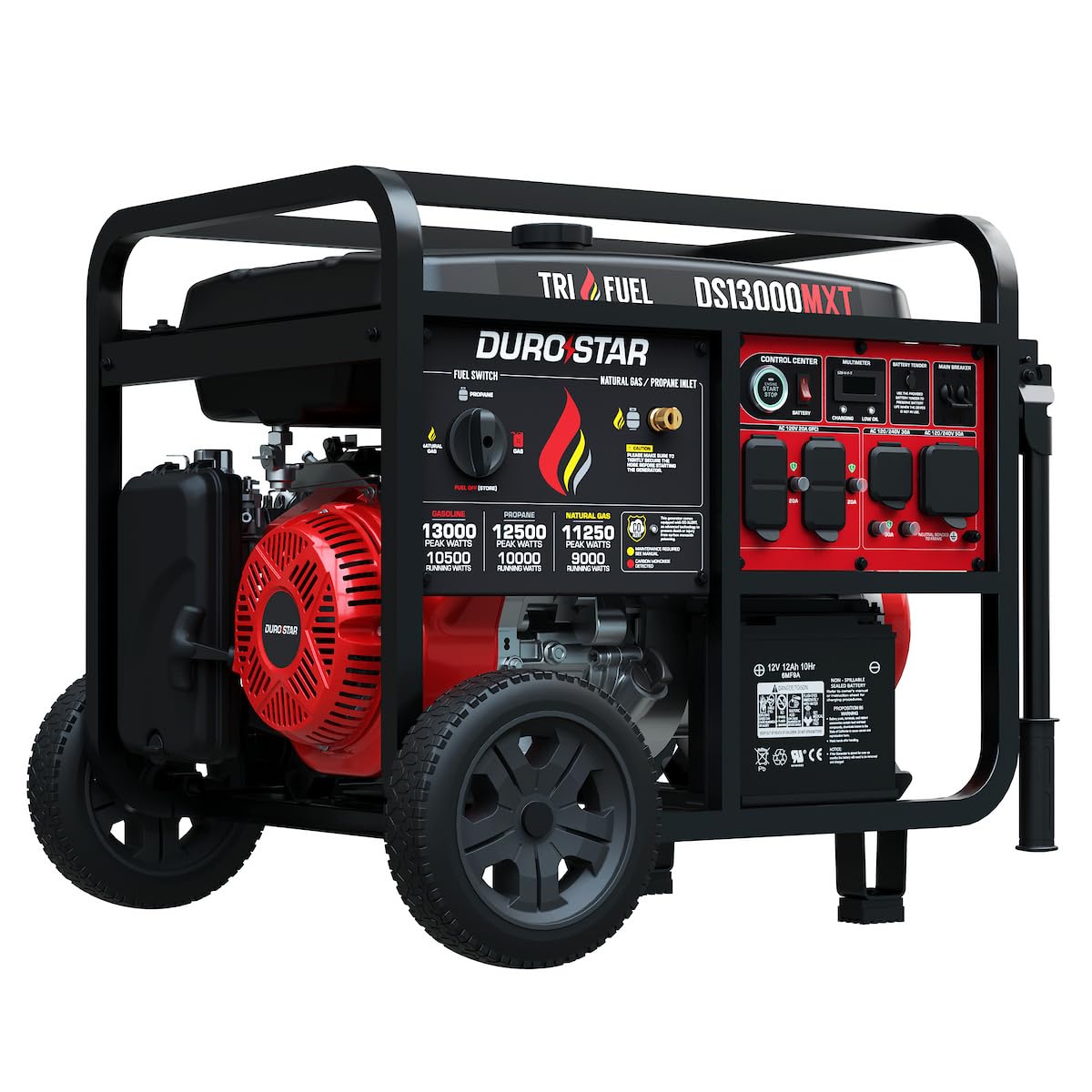
The DuroStar DS13000MXT brings genuine tri-fuel capability to a more accessible investment point, running on gasoline, propane, or natural gas. With 13,000 peak watts and 10,000 running watts on gasoline, it delivers enough power for most homes including well pumps and central AC. The 500cc engine features push-button electric start and a remote start key fob for convenient operation.
The power panel includes a transfer-switch-ready 50-amp outlet, plus a variety of 120V and 240V receptacles. The CO Alert system automatically shuts down the generator if carbon monoxide is detected, providing essential safety. The included wheel and handle kit makes the unit mobile despite its size, and the 15-foot natural gas hose and propane regulator mean you can connect to existing fuel sources immediately.
Users report easy assembly and reliable starting on all three fuels. The fuel selection knob lets you switch sources in seconds. The unit is popular with food truck owners who need reliable 50-amp power on the go, as well as homeowners preparing for hurricane season. The comprehensive tool kit and oil funnel included in the box mean you don’t need to buy anything extra to get started.
Why it’s great
- Tri-fuel capability at a mid-range investment point
- CO Alert auto-shutdown for safety during operation
- Natural gas hose and propane regulator included
Good to know
- Oil is not included, must be purchased separately
- Open-frame design is louder than inverter models
8. Champion Power Equipment 9,000-Watt Electric Start Tri Fuel Home Backup Portable Inverter Generator
 Check Price on Amazon
Champion’s 9,000-watt tri-fuel inverter generator stands out for its weight — at 156 pounds, it’s nearly 100 pounds lighter than many competitors with similar output. The inverter technology produces clean sine wave power safe for sensitive electronics, and the 72 dBA noise level with Economy Mode makes it 50% quieter than a traditional 7,250-watt generator. The tri-fuel capability runs on natural gas, propane, or gasoline, with all hoses included.
The 420cc Champion engine features battery-included electric start with a reliable toggle switch and Cold Start Technology for easy ignition in freezing weather. Output reaches 9,000 starting and 7,250 running watts on gasoline, 9,000 starting and 6,525 running on propane, and 9,000 starting and 5,875 running on natural gas. The Intelligauge monitors voltage, frequency, and operating hours, while CO Shield provides automatic carbon monoxide shutdown.
Users with 2.5-ton central AC units report that the inverter generator handles startup surges without needing a soft start kit. The 50-amp 14-50R outlet is transfer switch ready, and the four GFCI 120V outlets handle household loads. The 3-year limited warranty with free lifetime technical support adds significant value.
Why it’s great
- Lightest tri-fuel inverter generator in this class at 156 lbs
- Inverter technology with clean power and fuel-saving Economy Mode
- All hoses (propane and natural gas) included in the box
Good to know
- Running watts on natural gas (5,875W) limits 50A output
- 72 dBA is quieter than conventional but louder than premium inverters
9. GENMAX Portable Generator, 9,000W Super Quiet Dual Fuel Portable Inverter

The GENMAX GM9000iEDC delivers 9,000 peak and 7,600 running watts with inverter technology that produces clean power safe for sensitive electronics. The 458cc 4-stroke OHV engine runs on gasoline or propane, and the 62 dBA noise level at 23 feet with 25% loading makes it one of the quietest 50-amp-capable generators available. The 6.9-gallon fuel tank provides extended runtime, and the Low Idle Mode maximizes fuel efficiency when loads are light.
The power panel includes a 50-amp 14-50R outlet, a 30-amp L14-30R, four GFCI 120V 20A outlets, and USB ports. The 5-in-1 digital data center shows hours, voltage, load percentage, fuel level, and frequency. Remote start with key fob and electric push-button start provide flexible ignition options. Parallel capability allows you to connect two GM9000iEDC units for up to 18,000 peak watts using a parallel kit.
CO Detect automatically shuts down the generator if carbon monoxide reaches unsafe levels. Users report the generator powers a 50-amp RV with two large AC units and a microwave simultaneously without strain. The unit is EPA and CARB compliant, legal in all 50 states. The 3-year warranty with free lifetime technical support provides strong backing.
Why it’s great
- 62 dBA operation is genuinely quiet for neighborhood-friendly use
- Parallel capable to double output for extreme loads
- Inverter technology with clean power and Low Idle Mode
Good to know
- Heavy at 281 lbs despite inverter design
- Handle pin reported to break by some users during initial use
10. Pulsar PGD95BISCO Super Quiet Dual Fuel 9,500W Home Backup Inverter Generator
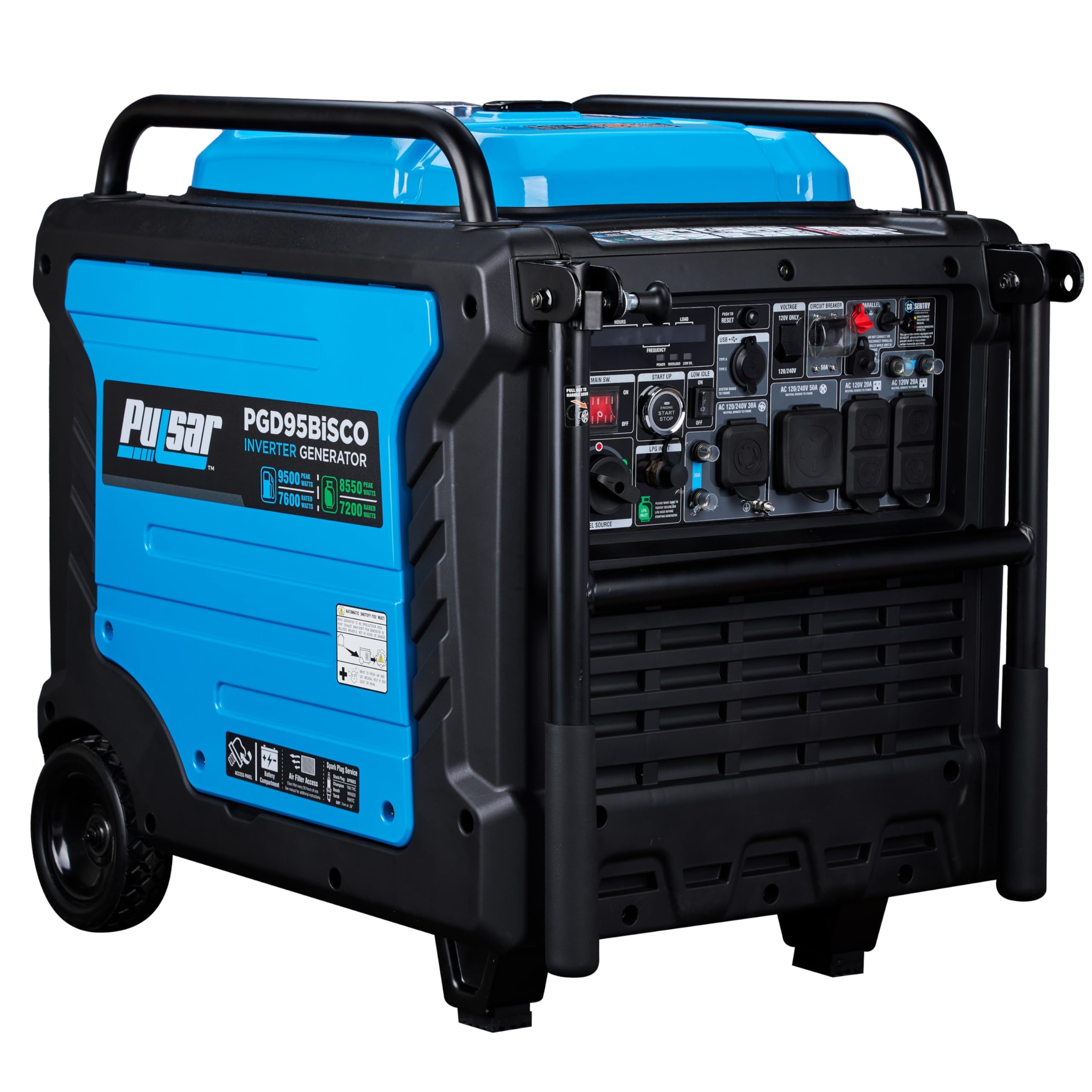
The Pulsar PGD95BISCO provides 9,500 peak and 7,600 running watts on gasoline, with 8,550 peak and 7,200 running watts on propane. The inverter produces pure sine wave power safe for all sensitive electronics, and the 62 dBA noise rating with foam insulation makes it one of the quietest options in its power class. The 6.9-gallon fuel tank delivers up to 9.5 hours of runtime at half load.
The power panel includes a 120/240V 50A 14-50R outlet, a 30A L14-30R, four GFCI 120V 20A outlets, and a 12V DC outlet. Remote start with key fob and electric push-button start provide convenient ignition. The digital control center displays hours, voltage, load, and frequency. CO sentry automatically shuts down the generator if carbon monoxide accumulates, and low oil and low battery shutoff protect the engine.
Users in hurricane-prone areas report the generator starts instantly on propane and provides reliable backup power for refrigerators, lights, and window AC units. The super-quiet operation means it won’t disturb neighbors, and the foam insulation keeps the sound signature low. The unit is parallel capable for doubling output, and the wheel kit makes it mobile despite the 281-pound weight.
Why it’s great
- Pure sine wave inverter power safe for computers and smart appliances
- 62 dBA super quiet operation with foam insulation
- Remote start and CO sentry for convenience and safety
Good to know
- Requires grounding for full 240V output
- Some users find it louder than the 62 dBA rating under load
11. GENMAX Tri Fuel Generator, 10,500-Watt Tri Fuel Portable Inverter Generator

The GENMAX GM10500iETC is the highest-output single-cylinder silent inverter generator on the market, delivering 10,500 peak and 8,500 running watts on gasoline, 9,500 peak and 8,000 running on propane, and 8,400 peak and 6,800 running on natural gas. The tri-fuel capability with a patented fuel selector switch gives you maximum flexibility, and the inverter technology keeps THD under 3% for safe operation with sensitive electronics.
The power panel is comprehensive: a 50-amp 14-50R outlet, a 30-amp L14-30R, four 120V 20A GFCI outlets, a 12V DC cigarette lighter outlet, parallel connectors, and a battery charging port. The voltage transfer switch supports both 120V and 240V simultaneous use. The digital display shows voltage, frequency, load, and operating hours. ATS capability with the included cable means it can integrate with automatic transfer switch systems for true standby operation.
Users praise the quiet operation, with one reporting it powered an entire house for 6+ hours on ECO mode without issue. The neutral floating design with a bonding plug (sold separately) allows easy conversion between floating and bonded neutral for home backup or portable use. The unit includes a rain cover, oil filter, magnetic dipstick, and all necessary hoses and connectors.
Why it’s great
- Highest output single-cylinder inverter with genuine tri-fuel
- ATS ready with included cable for automatic standby operation
- Comprehensive protection suite: overload, thermal, overvoltage, and more
Good to know
- Some units arrive without the owner’s manual in the box
- Heavy at over 280 lbs, requires two people for setup
Understanding the Specs
Running Watts vs. Peak Watts
Running watts (also called rated watts) is the continuous power the generator can sustain for hours. Peak watts (also called starting watts) is the brief surge needed to start motors in appliances like AC compressors and well pumps. A 50-amp 240V load requires 12,000 running watts minimum. If your generator only hits that number on peak watts, it will bog down or trip breakers when the load persists. Always compare running watts on your primary fuel when evaluating generators.
50-Amp Outlet and Breaker Rating
A NEMA 14-50R outlet is the standard for 50-amp RV and home backup connections, but not all 14-50R outlets are created equal. Check the breaker feeding that outlet — some manufacturers pair a 14-50R with a 30-amp or 37.5-amp breaker, limiting your actual draw to 7,200W or 9,000W respectively. For true 50-amp capability, the breaker must be rated for 50 amps (12,000W at 240V). Always verify the breaker rating, not just the outlet type.
Fuel Type and Runtime
Dual-fuel generators run on gasoline and propane; tri-fuel adds natural gas. Gasoline provides the highest wattage output but degrades in storage and requires regular maintenance. Propane stores indefinitely and burns cleaner, but output drops about 10-15% compared to gasoline. Natural gas offers unlimited runtime if connected to your home’s gas line, but output drops another 10-15% below propane. Choose based on your fuel availability and storage preferences.
Inverter vs. Conventional Alternator
Inverter generators convert AC power to DC and back to AC, producing a pure sine wave with less than 3% total harmonic distortion (THD). This clean power is safe for sensitive electronics like computers, TVs, and smart appliances. Inverters also adjust engine speed to match the load, saving fuel and reducing noise. Conventional generators run at a fixed speed (typically 3,600 RPM) regardless of load, making them louder and less fuel-efficient, but they are simpler and often cheaper to repair.
FAQ
What size generator do I need to run my whole house on 50 amps?
Can I connect a 50-amp generator to my house without an electrician?
Is an inverter generator worth the extra investment for home backup?
How long can I run a 50-amp generator continuously?
Final Thoughts: The Verdict
For most homeowners, the best 50 amp generator winner is the Westinghouse 14,500-watt dual-fuel because it delivers genuine 50-amp capacity with 19-hour runtime and remote start at a balanced investment point. If you want whisper-quiet operation and clean inverter power, grab the Champion 11,000-watt dual-fuel inverter. And for extreme whole-home power that rivals permanent standby units, nothing beats the Westinghouse 28,000-watt V-twin.

Mo Maruf
I created WellFizz to bridge the gap between vague wellness advice and actionable solutions. My mission is simple: to decode the research and give you practical tools you can actually use.
Beyond the data, I am a passionate traveler. I believe that stepping away from the screen to explore new environments is essential for mental clarity and physical vitality.