Our readers keep the lights on and my smoothie glass nicely filled. As an Amazon Associate, I earn from qualifying purchases.
Capturing the raw energy of a live performance demands a camera that sees what you feel—the sweep of a hand, the glint off a cymbal, the emotion in a dimly lit venue. Choosing the wrong tool can leave you with blurry shots and missed moments, while the right one turns challenge into artistry.
I’m Mohammad Maruf — the founder and writer behind WellFizz. For over a decade, I’ve specialized in dissecting market data and technical specifications to identify the gear that truly performs under pressure, separating marketing hype from real-world capability.
This guide is built from analyzing hundreds of data points and user experiences to direct you to the equipment that will elevate your work. After thorough research, our top recommendation delivers full-frame versatility in a package that masters the demanding environment of a best camera for music photography.
How To Choose The Best Camera For Music Photography
Selecting a camera for concerts and stages isn’t about the most megapixels; it’s about performance under pressure. The ideal model combines speed, sensitivity, and reliability to work with you, not against you, in unpredictable lighting.
Sensor Size and Low-Light Capability
Full-frame sensors (like those in premium mirrorless cameras) capture more light, providing cleaner images with less grain at high ISO settings in dark venues. APS-C sensors in mid-range models offer a great balance of quality and value, while smaller sensors in compact cameras may struggle with noise but excel in portability.
Autofocus Performance and Speed
Fast and accurate autofocus is non-negotiable. Look for systems with many focus points, reliable face/eye detection, and tracking that can keep up with a moving performer. Dual Pixel AF technology and phase-detection systems are particularly valuable for both photos and video.
Lens Versatility and Aperture
A kit lens with a versatile zoom range (like 24-105mm) is a solid start, but a fast aperture (f/2.8 or lower) is key for isolating subjects and shooting in low light without a flash. Ensure the camera has a robust lens ecosystem so you can grow your kit as your needs evolve.
Portability and Durability
Gigs often mean crowded spaces and long nights. A lightweight, compact body is easier to maneuver, but it must feel sturdy enough to handle the environment. Weather-sealing is a bonus for outdoor festivals or unpredictable conditions.
Quick Comparison
On smaller screens, swipe sideways to see the full table.
| Model | Type | Best For | Key Feature | Amazon |
|---|---|---|---|---|
| Canon EOS RP | Mirrorless | Full-frame entry & travel | Compact full-frame body | Amazon |
| Sony a7 III | Mirrorless | Pro-level low light & speed | 15-stop dynamic range | Amazon |
| Panasonic LUMIX S9 | Mirrorless | Social media & compact travel | Ultra-compact full-frame | Amazon |
| Blackmagic PCC 6K G2 | Cinema Camera | Professional video & film | 6K RAW video recording | Amazon |
| Canon XA70 Pro | Camcorder | Dedicated video & streaming | 4K UHD with XLR audio | Amazon |
| Panasonic LUMIX ZS99 | Point & Shoot | Ultra-zoom concerts & travel | 30x optical zoom pocketable | Amazon |
| Canon EOS R100 | Mirrorless | Beginners to mirrorless | Dual Pixel CMOS AF | Amazon |
| Nikon D5200 | DSLR | Aspiring pros on a budget | Vari-angle monitor | Amazon |
| Canon EOS Rebel T7 | DSLR | First-time DSLR users | Built-in Wi-Fi & NFC | Amazon |
| Canon EOS Rebel T7 (Kit) | DSLR | Complete beginner kit | 24.1MP APS-C sensor | Amazon |
In‑Depth Reviews
1. Canon EOS RP Full-Frame Mirrorless Camera

The Canon EOS RP stands out as a remarkably accessible gateway into full-frame photography, offering the larger sensor’s superior low-light performance and depth in a body that’s both compact and intuitive. Its 26.2MP sensor paired with the DIGIC 8 processor delivers vibrant images with fine detail, which is crucial for capturing the texture of instruments and atmosphere in venues. For musicians and photographers on the move, its lightweight design means it won’t weigh you down during multi-set gigs or travel.
Where the RP truly shines for music photography is in its reliable Dual Pixel CMOS autofocus, which provides smooth and accurate focus tracking for both stills and video, essential for following a dynamic performer across the stage. The included RF 24-105mm lens offers a versatile zoom range that’s excellent for everything from wide crowd shots to tighter portraits, though its variable aperture means you’ll want faster glass for the darkest clubs. Users upgrading from entry-level DSLRs consistently praise the noticeable jump in image quality and the useful flip-out screen for creative angles.
Connectivity is seamless with built-in Wi-Fi and Bluetooth, allowing for quick photo transfers to a phone for social media updates—a handy feature for live event photographers. While its 4K video has a crop and its battery life is modest, these are reasonable trade-offs for the core stills performance. This camera proves that you don’t need a bulky, premium-priced system to get professional-grade results in challenging lighting.
Why it’s great
- Excellent full-frame image quality at a mid-range point.
- Compact and lightweight for easy portability to gigs.
- Reliable Dual Pixel AF ensures sharp shots of moving subjects.
- Versatile RF lens mount opens up a future-proof ecosystem.
Good to know
- 4K video recording comes with a significant crop factor.
- Battery life may require a spare for all-day shoots.
- Kit lens aperture is not ideal for extremely low-light situations.
2. Sony ILCE-7M3K/B a7 III Mirrorless Camera

The Sony a7 III is a benchmark in the mirrorless world, offering a professional toolkit that excels in the exact conditions music photographers face: dim, contrasty, and fast-paced. Its 24.2MP back-illuminated full-frame sensor achieves an exceptional 15-stop dynamic range, preserving detail in both the shadows of a dark stage and the highlights of spotlights. This capability, combined with a wide ISO range, means you can push settings without worrying about excessive noise ruining a crucial shot.
Autofocus performance is where this camera becomes a powerhouse, with 693 phase-detection points covering 93% of the frame. This system locks onto and tracks subjects with relentless accuracy, whether it’s a vocalist moving across the stage or a drummer’s quick gestures. The 10fps continuous shooting with silent shutter option is perfect for capturing a sequence of peak action without disturbing the audience. Users transitioning from other systems note the intuitive controls and outstanding battery life that easily lasts through long events.
While the included 28-70mm kit lens is competent for starters, the true potential is unlocked with Sony’s extensive E-mount lenses, including fast primes ideal for low light. The 4K video is stunning, and the overall build quality inspires confidence. For the photographer ready to invest in a system that won’t hold them back, the a7 III delivers pro-level results with reliability that has made it a industry staple.
Why it’s great
- Unmatched autofocus coverage and tracking speed.
- Superior low-light performance and dynamic range.
- Robust battery life for extended shooting sessions.
- Excellent 4K video quality with full pixel readout.
Good to know
- The included kit lens is decent but not exceptional.
- Menu system can be deep and complex for new users.
- A premium investment compared to entry-level options.
3. Panasonic LUMIX S9 Full-Frame Mirrorless Camera

The Panasonic LUMIX S9 redefines portability for full-frame imaging, packing a powerful 24.2MP sensor into one of the smallest bodies on the market. Its unique design philosophy centers on social media creators and travelers who refuse to compromise on image quality. For the music photographer who also shoots behind-the-scenes video or content for bands, the “Open Gate” recording is a game-changer, allowing you to capture footage that can be cropped to multiple aspect ratios for different platforms from a single shot.
Despite its minimalist form factor—lacking a traditional grip, viewfinder, and hot shoe—the S9 delivers impressive stills and video quality, with effective in-body image stabilization to smooth out handheld shots. The included 18-40mm collapsible lens makes the entire kit remarkably pocketable. User feedback highlights the excellent image quality and the creative potential of the built-in LUTs (Look-Up Tables) for applying cinematic color grades straight out of camera, which can speed up workflow for social media posts.
It’s important to understand this camera’s niche: it’s for the hybrid shooter who values discretion and speed of sharing above traditional controls. The ultra-fast Wi-Fi transfer to the LUMIX Lab app makes getting photos to your phone nearly instantaneous. While it may not be the primary choice for fast-action stills photography due to its contrast-detect AF system, its video capabilities and unique portability make it a compelling secondary camera or main tool for a content-focused photographer.
Why it’s great
- Unbeatable full-frame quality in a ultra-compact body.
- Open Gate video is incredibly versatile for social content.
- Fast wireless transfer and creative in-camera LUTs.
- Great for discreet shooting in venues.
Good to know
- Lacks a viewfinder and a standard hot shoe for accessories.
- Autofocus system is better suited for video than fast-action stills.
- The minimalist design may require an add-on grip for some.
4. Blackmagic Pocket Cinema Camera 6K G2

The Blackmagic Pocket Cinema Camera 6K G2 is a dedicated filmmaking tool that delivers image quality rivaling cameras many times its price. For the photographer who is equally focused on producing cinematic music videos, live session recordings, or documentary content, its Super 35 sensor and 13 stops of dynamic range capture breathtaking detail and color. Recording to 6K Blackmagic RAW or ProRes provides immense flexibility in post-production, which is essential for grading footage to match a specific artist’s visual aesthetic.
This camera is built around video functionality, featuring a large, bright 5-inch tilting touchscreen, dual mini-XLR inputs with phantom power for professional microphones, and a comfortable handgrip with dedicated recording controls. The inclusion of a full DaVinci Resolve Studio license underscores its post-production pedigree. Users in the field appreciate the ability to record to external SSDs via USB-C, which is ideal for long-form concert recordings where file sizes become enormous.
It’s critical to note that this is not a traditional stills camera; it’s a cinema camera that can capture high-resolution frames. Its operation, workflow, and power management (battery life is a known consideration) are geared towards a video crew or a solo operator with a planned setup. For the artist creating high-end visual content to accompany music, the image quality and professional features are unparalleled in this category.
Why it’s great
- Professional cinematic image quality with 6K RAW.
- Excellent connectivity with XLR inputs and external recording.
- Includes powerful DaVinci Resolve Studio software.
- Large, high-quality touchscreen for monitoring.
Good to know
- Battery life is limited, requiring external power solutions for long shoots.
- Workflow involves large files and dedicated post-production.
- Not optimized for fast-action still photography.
5. Canon XA70 Pro Camcorder

The Canon XA70 Pro is a purpose-built tool for the videographer who needs reliable, high-quality recording in a ready-to-shoot package. Its integrated 15x optical zoom lens, built on a 1-inch CMOS sensor, provides a tremendous reach from the back of a venue or the side of a stage without changing lenses. The inclusion of two XLR inputs with phantom power on the detachable handle is a standout feature for music work, allowing for direct connection to a soundboard or high-quality microphones to capture pristine audio alongside 4K video.
This camcorder is designed for run-and-gun situations where setup time is minimal and reliability is key. It offers robust optical image stabilization, dual SD card slots for relay or simultaneous recording, and UVC compatibility for plug-and-play live streaming via USB-C. For documenting tours, recording full live sets, or streaming performances, it presents a streamlined alternative to juggling a mirrorless camera with external audio gear. Users note its ability to record for extended periods without overheating, a common issue with smaller hybrid cameras.
While it excels in video, it is not a stills photography camera. Its controls and form factor are purely for video capture. The trade-off for its convenience and dedicated features is a smaller sensor compared to full-frame hybrids, which affects ultimate low-light performance. However, for a videographer prioritizing audio-visual capture in a single, manageable device, the XA70 Pro is a compelling professional solution.
Why it’s great
- Integrated long zoom lens and professional XLR audio.
- Excellent stabilization and no recording time limits.
- Dual SD slots and live streaming capability.
- Ergonomic, purpose-built design for video.
Good to know
- 1-inch sensor is smaller than full-frame alternatives.
- Not designed for still photography.
- Monitor resolution may not be ideal for critical focus.
6. Panasonic LUMIX ZS99 Point and Shoot Camera

The Panasonic LUMIX ZS99 is the ultimate pocket-sized powerhouse for getting close to the action. Its 30x optical zoom lens (24-720mm equivalent) lets you capture detailed shots of a performer’s expression from the back row, a feat impossible for any smartphone or standard kit lens. For concert-goers who want more than phone photos but don’t want to carry an interchangeable lens system, this camera is a revelation, slipping easily into a jacket pocket.
It balances this incredible reach with modern features like 4K video and photo modes, a tilting touchscreen for composing from odd angles, and Bluetooth for easy sharing. The optical image stabilization is effective at minimizing shake at those long focal lengths, which is critical for handheld shooting in a venue. User reviews from concert photographers specifically praise its ability to capture usable zoomed-in video where phones fall completely short, making it a dedicated tool for fans and amateur documentarians.
The trade-off for its portability and zoom is sensor size; the 1/2.3-inch sensor will struggle with noise in very low light compared to larger-sensor cameras. It’s best used in venues with some stage lighting. However, for its specific use case—getting a clear, framed shot from a distance in a compact form—it delivers exceptional value and capability that fills a unique gap in the market.
Why it’s great
- Massive 30x optical zoom in a truly pocketable body.
- Captures 4K video and has a useful tilt screen.
- Excellent stabilization for handheld long-zoom shots.
- Perfect for fans who can’t bring larger gear.
Good to know
- Small sensor limits low-light performance and dynamic range.
- Can overheat during long 4K recording sessions.
- Image quality can’t match larger-sensor cameras.
7. Canon EOS R100 Mirrorless Camera

The Canon EOS R100 is the most accessible entry point into Canon’s modern RF mirrorless system, offering a compelling blend of simplicity and capable technology. Its 24.1MP APS-C sensor and DIGIC 8 processor produce sharp, vibrant images suitable for online portfolios or social media. For a beginner photographer looking to step up from a phone, its guided interface and automatic modes make learning the ropes less intimidating, while still providing a path to manual control.
A key strength is the inclusion of Canon’s reliable Dual Pixel CMOS autofocus, which ensures subject tracking is fast and accurate for both photos and Full HD video—a feature often missing in entry-level cameras. The compact body and light weight make it easy to handle at gigs. While the kit lens (RF-S 18-45mm) has a limited zoom range and slow aperture, it gets you started, and the RF mount means you have access to Canon’s entire future lineup of lenses as your skills grow.
This camera makes clear compromises to hit its price point, such as a fixed, non-touch LCD screen and a 4K video mode with a heavy crop. However, for its primary goal of being a stills-focused learner’s camera with excellent color science and a trustworthy AF system, it represents strong value. It’s a smart first step into a system you can build upon.
Why it’s great
- Affordable gateway into the Canon RF mirrorless system.
- Reliable Dual Pixel AF performs well for its class.
- Compact, lightweight, and easy for beginners to use.
- Good image quality from the 24.1MP APS-C sensor.
Good to know
- Fixed rear screen limits shooting flexibility.
- 4K video is severely cropped and lacks advanced features.
- Kit lens is basic with a slow variable aperture.
8. Nikon D5200 DSLR Camera

The Nikon D5200 remains a respected and capable APS-C DSLR, often found at a compelling value point on the secondary market. Its 24.1MP sensor delivers excellent image quality with vibrant colors and good detail, holding up well for prints and online use. The articulating rear screen is a significant advantage for music photography, allowing you to shoot from high overhead or low to the ground without awkward contortions, which is invaluable in a crowded pit.
This camera appeals to the learner who prefers the optical viewfinder experience of a DSLR and the vast, affordable ecosystem of Nikon F-mount lenses. Its 5 fps continuous shooting is adequate for capturing moments of peak action. User reviews from event photographers note its reliability and the quality of its JPEG outputs straight from camera, which can speed up workflow. The battery life, when using the viewfinder, is typically robust for a full day of shooting.
As an older model, it lacks modern conveniences like built-in Wi-Fi or touch controls, and its autofocus system, while decent, can’t match the speed and coverage of newer mirrorless cameras. However, as a tool to learn the fundamentals of photography and produce high-quality work without a major initial investment, the D5200 continues to be a solid and pragmatic choice.
Why it’s great
- High-resolution sensor produces great image quality.
- Vari-angle screen is extremely useful for composition.
- Access to a huge selection of affordable Nikon lenses.
- Strong value for a capable APS-C DSLR.
Good to know
- Lacks modern connectivity like Wi-Fi.
- Autofocus system is older and less advanced.
- Older model with potentially limited new stock.
9. Canon EOS Rebel T7 DSLR Camera (with Bag & Card)
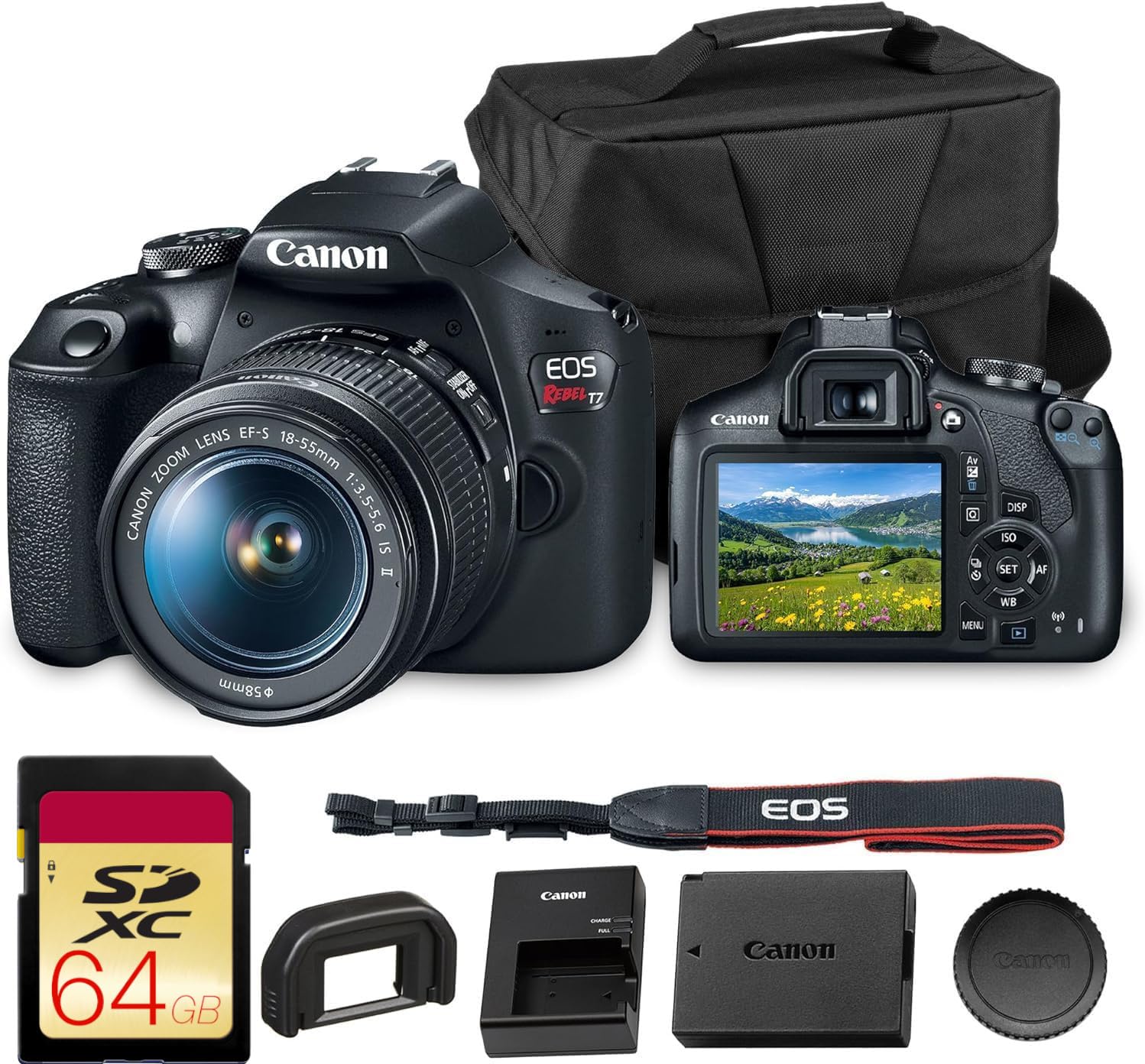
This Canon Rebel T7 kit represents the classic, all-in-one starter package for photography. Beyond the camera itself, it includes essential extras like a shoulder bag and a 64GB memory card, meaning you can start shooting immediately. The 24.1MP APS-C sensor is more than capable of producing sharp, detailed images for web use and moderate prints, and the DIGIC 4+ processor handles colors pleasingly.
For a complete beginner at a concert or event, the automatic modes and on-screen guides provide a safety net while learning. The built-in Wi-Fi and NFC are standout features at this level, enabling easy transfer of photos to a phone for quick sharing—a function highly valued by new photographers wanting to post their work. Compatibility with the enormous range of Canon EF and EF-S lenses means this camera can grow with your ambition, from the kit lens to fast primes for low light.
The T7 is a basic DSLR by modern standards, with a 9-point autofocus system and Full HD video that won’t compete with newer models. However, its purpose is to offer a straightforward, reliable introduction to interchangeable lens photography without complexity or a high barrier to entry. For the gift-giver or the hesitant first-timer, this complete bundle removes all guesswork.
Why it’s great
- Complete starter kit with bag and memory card included.
- Easy-to-use interface with helpful guide modes.
- Built-in Wi-Fi/NFC for instant sharing.
- Compatible with a vast selection of Canon lenses.
Good to know
- Autofocus system is limited for fast-moving subjects.
- Video is limited to 1080p Full HD.
- Older image processor compared to current models.
10. Canon EOS Rebel T7 DSLR Camera (Body & Lens)

This standard Canon Rebel T7 package provides the core camera and 18-55mm kit lens, offering the same reliable image quality and user-friendly operation as the bundled kit but as a more streamlined offering. It’s the workhorse entry-level DSLR, proven over years to help photographers learn the ropes. The optical viewfinder provides a direct, lag-free way to compose shots, which some prefer over electronic viewfinders, especially in brightly lit conditions.
Its performance profile is well-understood: the 24.1MP sensor delivers very good detail in good light, the 9-point AF system is adequate for static or predictably moving subjects, and the body is lightweight and comfortable to hold. For someone who may already have accessories like a bag or memory cards, or who wants to choose their own, this is the ideal way to acquire the camera body. It retains the useful Wi-Fi connectivity for wireless transfers and remote shooting via smartphone.
This model is a testament to enduring value. While it won’t excel in challenging low-light autofocus scenarios or offer advanced video features, it consistently produces quality images for its price bracket. For the hobbyist on a tight budget who wants a trustworthy Canon DSLR to learn on and build a lens collection, this T7 remains a fundamentally sound and sensible starting point.
Why it’s great
- Proven, reliable image quality from a 24.1MP sensor.
- Straightforward DSLR operation ideal for learning.
- Includes versatile 18-55mm starter zoom lens.
- Wi-Fi enabled for connectivity.
Good to know
- Limited autofocus points and slower Live View AF.
- No 4K video or touchscreen interface.
- Basic feature set compared to newer models.
Understanding the Specs
Sensor Size
Full-frame sensors offer the best low-light performance and depth of field control but come in larger, premium bodies. APS-C (or “crop”) sensors provide a great balance of quality and value, while smaller 1-inch or 1/2.3-inch sensors prioritize zoom and portability but sacrifice some light-gathering ability.
Autofocus (AF) System
Look for the number of focus points and the technology used. Phase-detection and Dual Pixel CMOS AF are fast and reliable for tracking. More points spread across the frame give you better composition flexibility. Face and eye detection are invaluable for keeping a performer in sharp focus.
FAQ
Is a DSLR or mirrorless camera better for music photography?
Can I use a point-and-shoot camera for concert photos?
What lens should I get after the kit lens?
How important is 4K video for music work?
Final Thoughts: The Verdict
For most people, the best camera for music photography winner is the Canon EOS RP because it marries accessible full-frame performance with a portable, user-friendly design that excels in low light. If you want uncompromising professional speed and dynamic range, grab the Sony a7 III. And for capturing incredible close-ups from the crowd without bulk, nothing beats the Panasonic LUMIX ZS99.

Mo Maruf
I created WellFizz to bridge the gap between vague wellness advice and actionable solutions. My mission is simple: to decode the research and give you practical tools you can actually use.
Beyond the data, I am a passionate traveler. I believe that stepping away from the screen to explore new environments is essential for mental clarity and physical vitality.