Our readers keep the lights on and my smoothie glass nicely filled. As an Amazon Associate, I earn from qualifying purchases.
Choosing the right air compressor isn’t just about filling tires; it’s about unlocking the potential of your tools and projects without getting stuck with frustrating limitations or unnecessary bulk. The wrong specs can leave you waiting for air instead of working, or annoy your neighbors with excessive noise.
I’m Mohammad Maruf — the founder and writer behind WellFizz. My approach involves deep market research and analyzing thousands of data points and technical specifications to separate genuinely capable tools from marketing hype.
This guide breaks down the critical factors like CFM, tank size, and noise into simple terms, helping you find the unit that matches your real-world needs without overspending. The goal is to help you confidently select the perfect best air compressor for your garage, workshop, or home.
How To Choose The Best Air Compressor
Selecting an air compressor is less about finding the most powerful one and more about matching its capabilities to your specific tasks. Mismatched air supply is the most common source of frustration. Let’s break down the key decision points.
Understand Your Air Demand (CFM)
Cubic Feet per Minute (CFM) is the volume of air the compressor can deliver. It’s the single most important spec. Check the CFM requirements of your air tools (found in the manual) and ensure your compressor meets or exceeds the highest demand. Running a tool that needs more CFM than your compressor provides will cause the tool to stall and the compressor to run continuously, burning out the motor.
Tank Size Dictates Work Rhythm
Tank capacity, measured in gallons, is your air reservoir. A larger tank lets you use air-hungry tools like impact wrenches or sanders for longer periods before the compressor motor kicks on to refill it. For intermittent tasks like nailing or inflating tires, a small “pancake” or “hotdog” tank is sufficient and more portable. For spraying or sustained sanding, a larger tank is non-negotiable.
Oil-Free vs. Oil-Lubricated
Oil-free compressors are virtually maintenance-free and provide clean air, ideal for painting or indoor use where oil vapor is a contaminant. They tend to be lighter and more affordable but often have a shorter lifespan and run hotter. Oil-lubricated models, like traditional workshop compressors, run cooler and quieter, lasting much longer with periodic oil changes, but require more upkeep and can emit trace oil.
Noise Level Matters
Compressor noise is measured in decibels (dB). A typical loud compressor runs around 85-90 dB (similar to a lawnmower), while “quiet” models operate in the 60-70 dB range (like a normal conversation). If you’re working in a garage attached to your home, in a community workshop, or on a indoor job site, a quieter model is a courtesy to yourself and others.
Quick Comparison
On smaller screens, swipe sideways to see the full table.
| Model | Type | Best For | Key Feature | Amazon |
|---|---|---|---|---|
| Makita MAC320Q | Quiet Series | Quiet indoor projects | Extremely quiet 60 dB operation | Amazon |
| DEWALT DWFP55130 | Portable | Trim & finish carpentry | 200 PSI max for quick recovery | Amazon |
| Craftsman 3 Gallon | Hotdog | General workshop tasks | 155 PSI max, compact design | Amazon |
| MZB 13.2 Gallon | Wheeled | High-demand air tools | High 14.83 CFM output | Amazon |
| Makita MAC5200 | Big Bore | Serious workshop duty | Oil-lubricated for long life | Amazon |
| Metabo HPT EC28M | Ultra-Quiet | Quiet job site nailing | 59 dB, very lightweight | Amazon |
| ECOMAX Wall Mount | Wall Mount | Garage convenience | Built-in 30ft retractable hose | Amazon |
| VEVOR 2.1 Gallon | Double Cylinder | Value-focused DIY | Good CFM for the size | Amazon |
| Timbertech AS186 | Airbrush | Hobby & detail work | 47 dB, includes 3L tank | Amazon |
| AZZUNO 1 Gallon | Quiet Compact | Light-duty portable use | Quiet 60 dB operation | Amazon |
| VEVOR 3 Gallon Pancake | Pancake | Entry-level inflation & nailing | Classic portable pancake form | Amazon |
In‑Depth Reviews
1. Makita MAC320Q Quiet Series Air Compressor

The Makita MAC320Q represents the sweet spot for the serious DIYer or tradesperson who values a peaceful workspace. Its standout feature is a remarkably quiet 60 dB operation, which is about four times quieter than a standard compressor, making it ideal for indoor remodeling, trim work, or any environment where noise is a concern.
It uses an oil-free, dual-piston pump designed for maintenance-free operation, and its motor runs at a lower 1,750 RPM to promote longer life. The 3-gallon tank provides a decent air reserve for tools like finish nailers and staplers, and the complete roll-cage construction offers serious protection against job-site bumps during transport.
While its 2.6 SCFM output won’t power continuous-use tools like sanders, it’s perfectly matched for the intermittent demands of carpentry. The dual quick-connect couplers are a thoughtful touch, allowing you to run two nailers simultaneously without swapping hoses. This compressor is a premium investment that pays off in reduced fatigue and neighborly goodwill.
Why it’s great
- Exceptionally quiet operation transforms the work experience.
- Robust roll-cage build quality inspires confidence in durability.
- Low-RPM, oil-free design balances performance with minimal maintenance.
- Dual couplers add convenience for multi-tool setups.
Good to know
- A premium option, representing a significant investment.
- Heavier than some other portable 3-gallon models.
- CFM is best suited for intermittent, not continuous, tool use.
2. DEWALT DWFP55130 Air Compressor
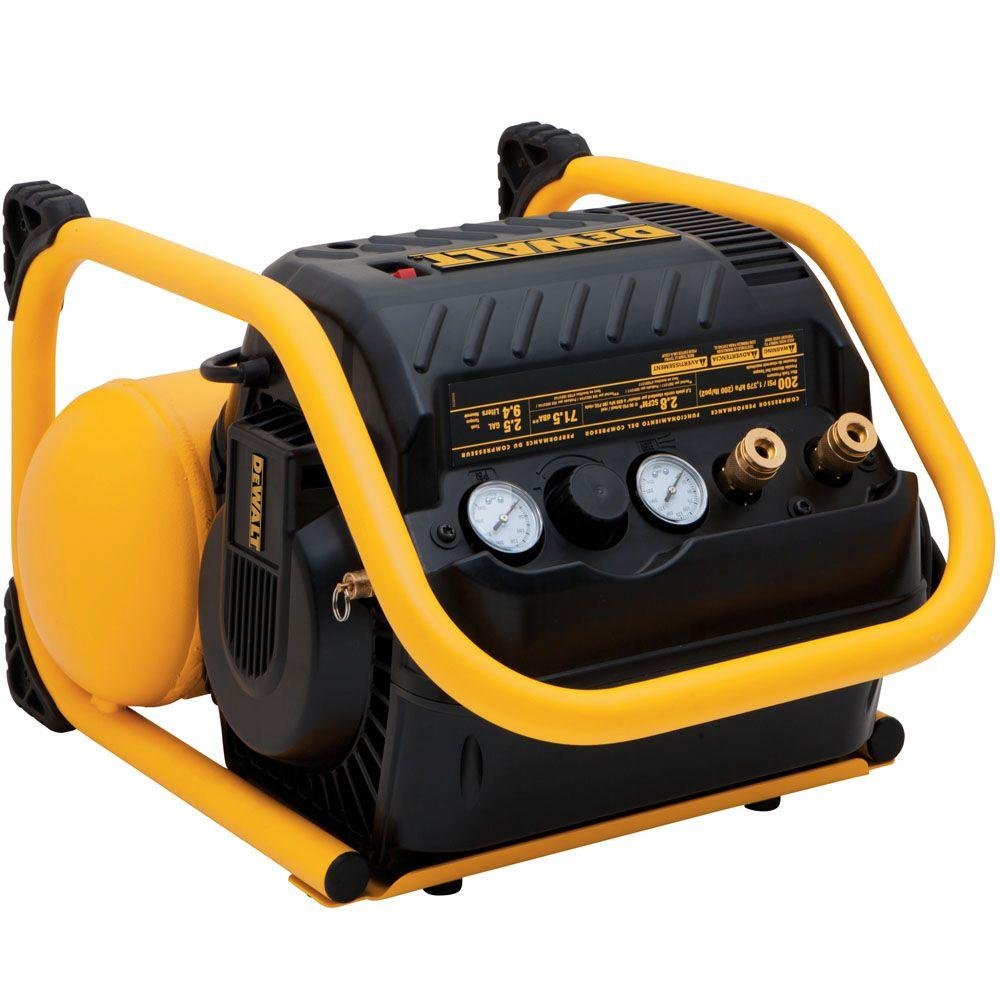
DEWALT built this compressor with the finish carpenter in mind. Its key advantage is a high 200 PSI maximum tank pressure, which translates to more stored air energy in a compact 2.5-gallon package. This means you can fire more nails (especially larger gauge ones) before the motor needs to kick on for a recharge, significantly speeding up your workflow.
It operates at a quiet 71.5 dB, which is a major step down from traditional pancake compressors. The oil-free pump ensures clean air and no maintenance beyond draining the tank. The design is smartly versatile, allowing it to be stored or operated either vertically to save floor space or horizontally for a lower center of gravity.
The inclusion of dual couplers, a protective roll cage, a ball valve for easy draining, and cord wraps shows DEWALT’s attention to job-site practicality. Its 3.0 SCFM @ 90 PSI output is solid for its class, reliably running finish nailers, brad nailers, and for tasks like tire inflation. It’s a professional-grade tool that balances power, quietness, and smart design.
Why it’s great
- High 200 PSI max pressure allows for more shots between cycles.
- Quiet operation and flexible storage/orientation options.
- Thoughtful pro features like dual couplers and an easy-drain ball valve.
- Trusted brand reputation for durability on the job site.
Good to know
- The gauges can be hard to read when the unit is laid on its side.
- Lacks integrated wheels; you carry its 36-pound weight.
- The power cord is somewhat short, requiring an extension cord in many setups.
3. Craftsman 3 Gallon Hotdog Air Compressor

The Craftsman 3-gallon “hotdog” compressor is a classic, reliable workhorse for the home garage or workshop. Its elongated tank design provides a good balance of air capacity and a narrow footprint, making it easy to tuck under a workbench. With a robust 155 PSI maximum pressure, it delivers strong, consistent power for a wide range of tasks.
This model is built for versatility, capable of handling inflation, nailing, stapling, bolting, and even light-duty spraying or drilling. The oil-free, maintenance-free pump system is a major plus for users who want a “set it and forget it” tool, aside from basic tank draining. It’s notably lightweight for its output, making it genuinely portable from site to site.
While not in the “quiet series” category, its performance per dollar is compelling. It delivers air tool capability that can come surprisingly close to larger, more expensive units for shorter-duration tasks. For the homeowner or DIYer tackling weekend projects, car maintenance, and workshop builds, this Craftsman offers proven performance in a familiar and trusted package.
Why it’s great
- Excellent balance of power, capacity, and portability at a mid-range point.
- High 155 PSI max pressure supports a wide variety of tools.
- Zero-maintenance oil-free pump design simplifies ownership.
- Trusted brand with a solid warranty for peace of mind.
Good to know
- At 87 dB, it is on the louder side, typical of traditional compressors.
- The control panel and gauges are reported by some users to feel less durable than the compressor itself.
- CFM is sufficient for intermittent, not continuous, use of high-demand tools.
4. MZB 13.2 Gallon Ultra Quiet Air Compressor
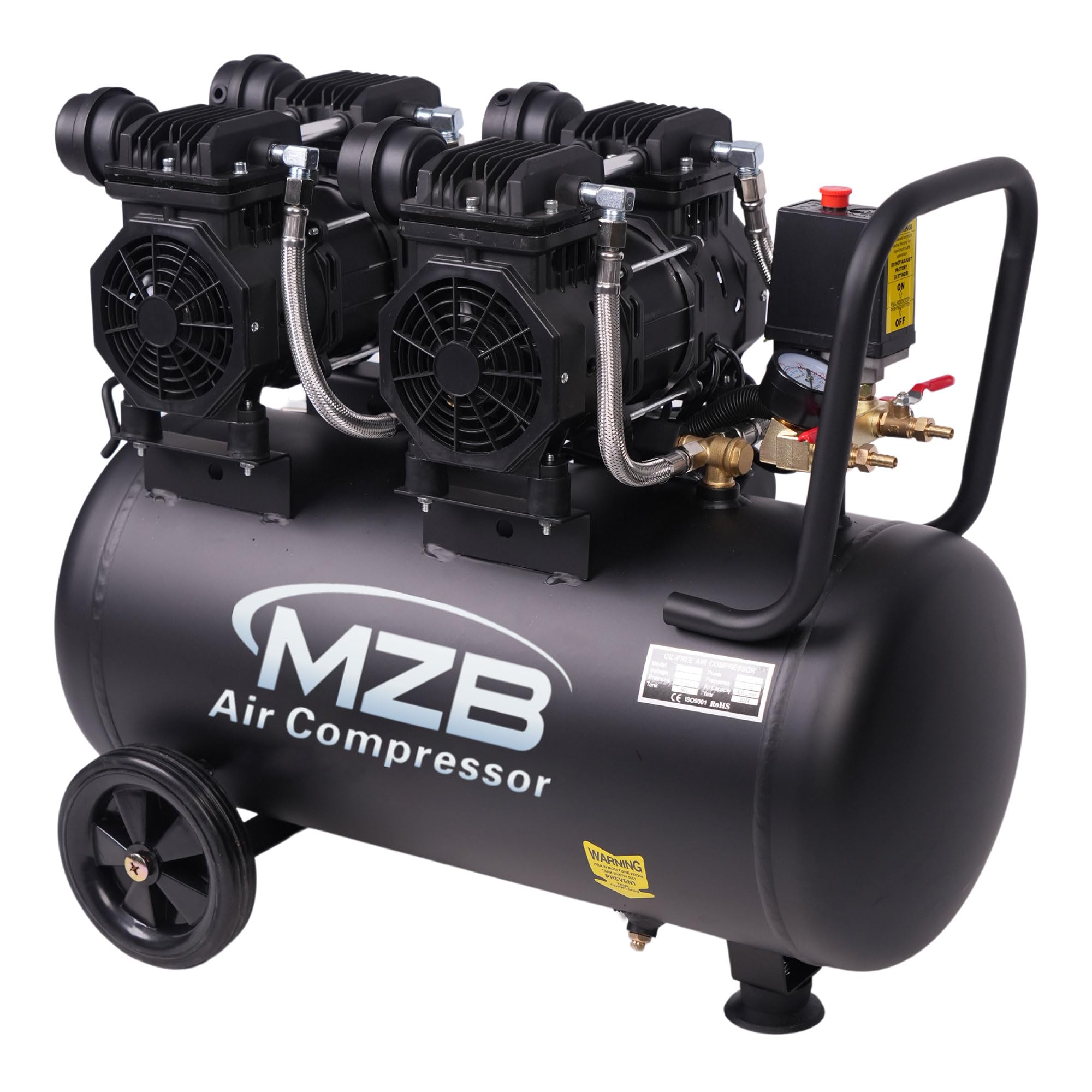
The MZB compressor is for the user who needs serious air volume but doesn’t have 220V power or space for a gigantic industrial unit. Its headline spec is a formidable 14.83 CFM at 90 PSI, which is enough to run demanding tools like die grinders, sanders, and larger impact wrenches that would stall a smaller portable compressor.
Pairing this high output with a sizable 13.2-gallon tank means you can work for extended periods. Remarkably, it achieves this while operating at a relatively quiet 70 dB, thanks to dual silencers. The inclusion of wheels and a handle makes this sizable unit movable around a workshop, addressing its primary drawback: weight and bulk.
It’s crucial to note this compressor has a significant power appetite. It requires a dedicated 20-amp circuit with proper 12-gauge wiring to function without tripping breakers. For the advanced DIYer, auto enthusiast, or small shop owner ready to power real air tools, this MZB offers a compelling, feature-packed package that bridges the gap between hobbyist and professional gear.
Why it’s great
- Exceptionally high CFM output for a 110V compressor, enabling use of power-hungry tools.
- Large tank supports sustained operation.
- Quieter than expected for its power class.
- Good portability for its size with integrated wheels.
Good to know
- Absolutely requires a dedicated 20-amp circuit to operate.
- Some units may have quality control issues like shipping damage.
- The design lacks an unloader valve, which can make restarting under pressure difficult.
5. Makita MAC5200 Big Bore Air Compressor
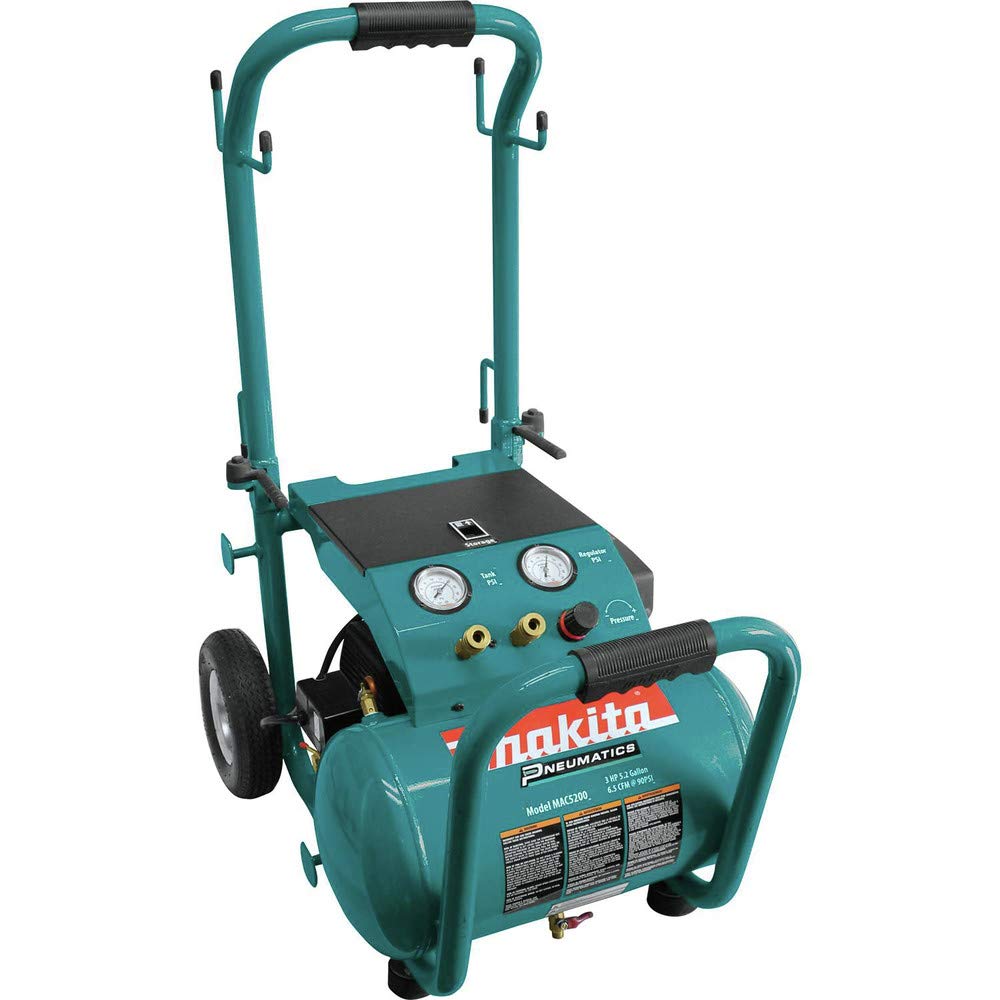
The Makita MAC5200 is the definition of a heavy-duty, oil-lubricated workshop compressor. It’s built around a cast-iron “Big Bore” pump that is engineered for cooler operation, faster recovery, and dramatically extended lifespan compared to oil-free models. This is the compressor you buy for decades of reliable service.
With 6.5 CFM at 90 PSI and a 5.2-gallon tank, it delivers robust, consistent air for automotive work (including impact wrenches for lug nuts), framing nailers, and other demanding tools. The oil-lubricated design makes it notably quieter and lower-pitched than screaming oil-less compressors, a welcome feature in a home shop.
While it’s heavy, Makita added excellent portability features: sturdy rubber wheels, a folding handle, and side grab handles. This makes moving this beast around a concrete floor manageable. For the serious hobbyist or professional who values longevity, cool operation, and reliable high-volume air over absolute portability and zero maintenance, the MAC5200 is a top-tier choice.
Why it’s great
- Cast-iron, oil-lubricated pump promises exceptional durability and cooler running.
- High, usable CFM and tank capacity for serious tasks.
- Superior portability for its weight class with wheels and folding handle.
- Quieter, deeper sound profile than comparable oil-less units.
Good to know
- Requires periodic oil changes, adding a maintenance step.
- Premium price point reflects its professional-grade construction.
- Very heavy; moving it beyond a flat, smooth surface is difficult.
6. Metabo HPT EC28M Quiet Air Compressor

The Metabo HPT EC28M is arguably the king of quiet, portable compressors. At just 59 dB, it’s quiet enough to hold a normal conversation right next to it, making it perfect for indoor trim work, finish carpentry, or any environment where noise is a critical issue, like occupied homes or apartments.
Weighing only 25 pounds and featuring a compact, roll-cage protected design, it’s incredibly easy to carry from room to room or up a ladder. The oil-free motor requires no maintenance, and the universal quick coupler allows for fast swaps between different gauge nailers. Its integrated control panel lets you dial in the exact PSI your tool requires.
Its limitations are directly tied to its ultra-compact design: the 1-gallon tank provides a very small air reserve. It’s ideal for driving brads, pins, and finish nails, but will cycle frequently. It is not intended for tools that demand continuous airflow. For the pro or DIYer who prioritizes quiet operation and extreme portability above all else for light-duty fastening, it’s a superb tool.
Why it’s great
- Unmatched quietness in its category, revolutionizing indoor work.
- Extremely lightweight and portable with a protective roll cage.
- Maintenance-free oil-free operation.
- Excellent for trim carpenters and finish work.
Good to know
- Very small tank means frequent motor cycles during sustained nailing.
- Not suitable for any air tool requiring continuous CFM (sanders, grinders).
- Higher price per gallon of capacity due to its quiet-tech engineering.
7. ECOMAX Wall Mount Air Compressor

The ECOMAX wall-mount compressor solves a specific problem: garage clutter and hose management. By mounting permanently to your wall, it frees up floor space and keeps your air source organized and ready. The built-in, retractable 30-foot air hose is the star feature, providing impressive reach to all corners of a two or three-car garage without any hose tangles.
This unit is designed for convenience and light-to-medium duty. The 0.5-gallon vertical tank and 1.5 HP motor are sufficient for topping off tires, using a blow gun for cleaning, or running a brad nailer or stapler for short periods. Because it’s wall-mounted, you can unplug it and carry it (it’s relatively light) for tasks away from its mount, using the tank’s stored air.
It’s important to have realistic expectations: the tiny tank means it will cycle constantly if you try to fill a completely flat tire or run a tool continuously. However, for the weekend warrior who values a tidy, always-accessible inflation station and light tool use, the ECOMAX offers a unique and highly convenient solution.
Why it’s great
- Eliminates hose mess with a built-in, retractable 30-foot hose.
- Saves valuable floor space with a secure wall-mount design.
- Provides great reach and convenience for garage tasks.
- Can be unplugged and used portably for short tasks.
Good to know
- Very small tank requires patience for larger inflation jobs.
- The included hose quality may not be as durable as a separate premium hose.
- Best for intermittent, light-duty use rather than sustained tool operation.
8. VEVOR 2.1 Gallon Air Compressor

The VEVOR 2.1-gallon model is a strong contender in the value segment, offering a compelling mix of decent air delivery (2.2 CFM) and a usable tank size. Its double-cylinder, oil-free design aims for efficiency and faster fill times, making it a capable partner for nail guns, inflation, and light spraying.
It features a noise reduction design with dual mufflers, bringing its operation down to a reported 70 dB, which is noticeably quieter than many budget compressors. The build emphasizes durability with a reported three-layer protective process on the tank to resist rust and wear. For users needing a step up from a tiny pancake compressor without committing to a larger, heavier hotdog or wheeled unit, this VEVOR fits the bill.
Customer feedback highlights that it’s quiet and recovers pressure quickly. However, the 2.1-gallon tank is still on the smaller side, meaning it will run frequently during sustained tool use. It represents a solid, budget-conscious choice for the DIYer who has outgrown a 1-gallon compressor but doesn’t need the capacity of a 4+ gallon model.
Why it’s great
- Good CFM and tank size ratio for the cost, offering capable performance.
- Quieter than many competitors in its class.
- Oil-free, low-maintenance design.
- Compact and relatively portable for its output.
Good to know
- Tank size may still be limiting for continuous-use tools, causing frequent cycling.
- Some users note the fittings or gauge panel may feel less robust.
- As a value brand, long-term durability may vary compared to established names.
9. Timbertech AS186 Airbrush Compressor

The Timbertech AS186 is a specialized compressor designed for one thing: providing clean, consistent, and pulse-free air for precision work. With an ultra-quiet 47 dB operation and a built-in 3-liter (0.8 gallon) tank, it’s the standard for serious airbrushing, cake decorating, model painting, and temporary tattoos.
The tank is crucial here—it eliminates the pulsing airflow common in tankless diaphragm compressors, ensuring a smooth, even spray that’s essential for fine artwork and gradients. The unit features an industrial-style regulator with a moisture trap to keep water out of your air line, protecting your work from spits and sputters. It automatically starts and stops between 3-4 Bar (43-58 PSI), maintaining pressure within an ideal range for detail work.
This is not a general-purpose workshop compressor. Its airflow, while steady, is low in volume (CFM) and meant for small nozzles. For hobbyists and artists who demand professional results from their airbrush, this Timbertech model is a reliable, quiet, and feature-complete foundation that outperforms cheaper, tankless alternatives.
Why it’s great
- Extremely quiet and includes a tank for pulse-free airflow.
- Complete setup with regulator, moisture trap, and pressure gauge.
- Automatic start/stop function protects the motor and maintains pressure.
- Industry-standard design for serious airbrush artists.
Good to know
- Arrives with little to no instruction manual, requiring some user knowledge.
- The heat sink plate can get very hot during extended use.
- Specialized only for low-CFM applications like airbrushing.
10. AZZUNO 1 Gallon Air Compressor

The AZZUNO 1-gallon compressor aims to deliver a quiet experience in a very compact, portable package. Its claimed 60 dB noise level makes it a candidate for indoor or noise-sensitive environments, and its oil-free, 1 HP motor is designed for maintenance-free operation. The form factor is more upright than a traditional pancake, potentially offering a smaller footprint.
It boasts a relatively high air delivery for its size (2.5 CFM at 90 PSI), which suggests it should keep up with a single nail gun or inflation duties without much issue. The build emphasizes durability with anti-rust treatments and features like dual cooling fans and automatic overheating protection. For someone with very limited space who needs air for light tasks and values a quieter motor, this model presents a compelling option.
It’s important to temper expectations regarding “ultra quiet”—60 dB is quiet for a compressor, but it’s still a distinct mechanical sound. Some users have noted the need to add an external regulator if you require adjustable output pressure for tools like airbrushes. As an entry-level, quiet-ish compressor, it offers a good set of features and a strong warranty for peace of mind.
Why it’s great
- Quieter than standard compressors, good for home use.
- Compact, space-saving vertical design.
- Surprisingly good CFM output for a 1-gallon unit.
- Backed by a strong 3-year warranty.
Good to know
- “Ultra quiet” is subjective; it’s quieter but not silent.
- Lacks an adjustable output pressure regulator on the unit itself.
- Some concerns raised about the stock power cord’s gauge in early units.
11. VEVOR 3 Gallon Pancake Air Compressor
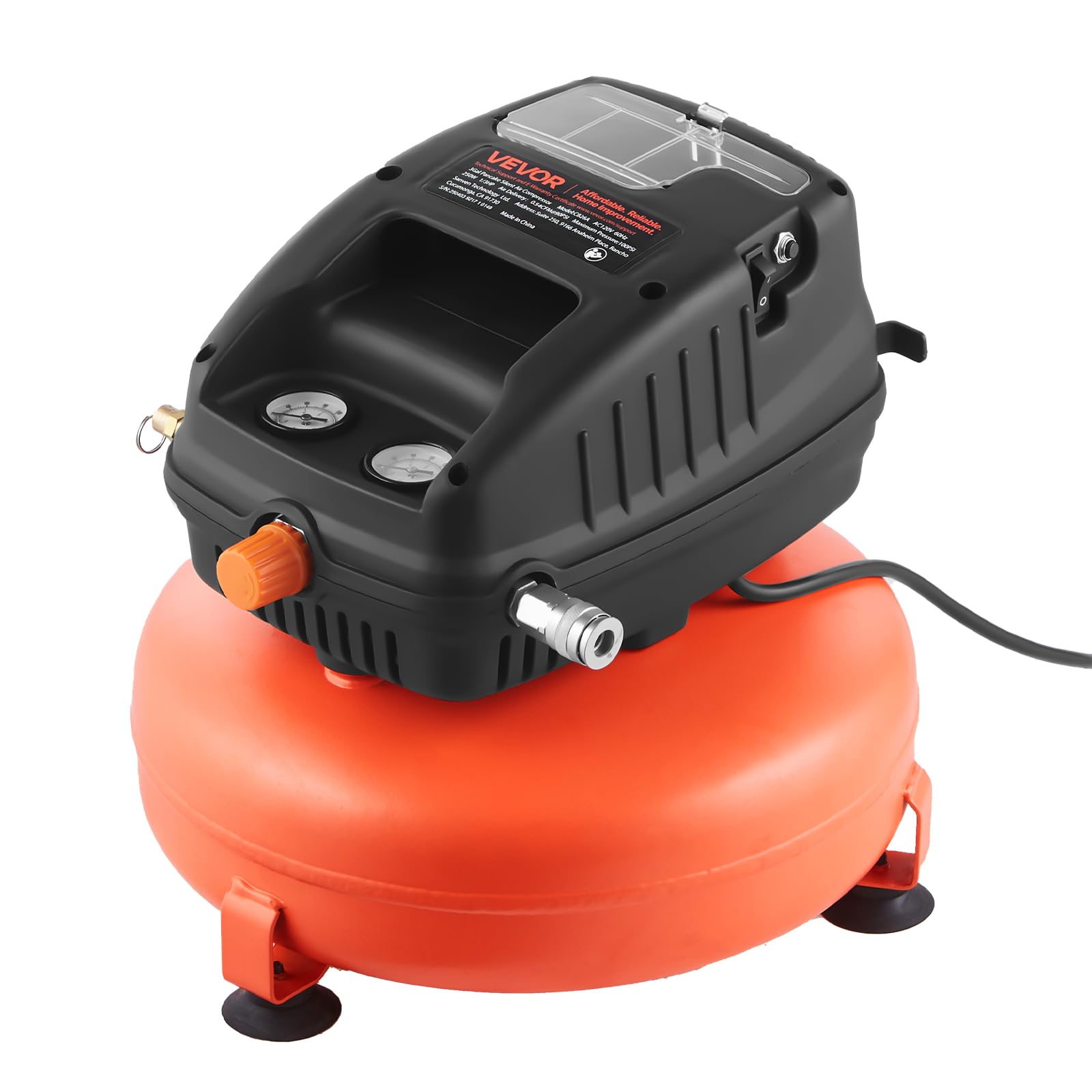
The VEVOR 3-gallon pancake is a classic entry-point into the world of air compressors. The low-profile pancake design provides stability and makes it easy to store under a workbench. Its oil-free motor simplifies ownership, and the 3-gallon tank offers a bit more capacity than the smallest models, allowing for a few more nail shots or a longer inflation session before the motor kicks on.
It’s equipped with dual pressure gauges (tank and output), a feature sometimes missing on budget models, which is very useful for monitoring performance. The build includes a heavy-duty iron tank with a safety valve and anti-slip rubber feet. For the cost-conscious DIYer who needs a basic compressor for occasional tire filling, using a brad nailer for small projects, or general garage blowing duties, this VEVOR covers the fundamentals.
Its CFM is modest (0.54 CFM at 90 PSI), so it’s best suited for very low-air-demand tools and will require patience when filling larger volumes. As with many value-oriented products, experiences with long-term durability and customer support can vary. For light, intermittent use, it represents a functional starting point.
Why it’s great
- Classic, stable pancake design at an entry-level point.
- Includes dual gauges for better control and monitoring.
- Oil-free for minimal maintenance.
- Good tank size for basic tasks.
Good to know
- Low CFM limits the types of tools it can effectively run.
- Can be noisy during operation.
- Long-term reliability may be a consideration compared to established brands.
Understanding the Specs
CFM (Cubic Feet per Minute)
This is the flow rate—the volume of air the compressor can deliver. It’s the most critical spec. Match the CFM of your compressor to the required CFM of your most demanding air tool. If the tool needs more air than the compressor provides, the tool will underperform and the compressor will overwork.
PSI (Pounds per Square Inch)
This is pressure. Tools have a minimum PSI required to operate (e.g., 90 PSI). Your compressor’s maximum PSI must exceed this. A higher max PSI (like 150-200) means more potential energy is stored in the tank, allowing for more tool actuations (nail shots) between motor cycles.
Tank Size (Gallons)
The tank is an air reservoir. A larger tank lets you use air intermittently (like with a nail gun) for longer before the motor turns on. It does not increase the CFM. For continuous-use tools (sanders, grinders), even a large tank will deplete quickly; here, high CFM is paramount.
Decibels (dB)
Noise level. A 10 dB increase sounds about twice as loud. Standard compressors run 80-90 dB (very loud). “Quiet” models operate at 60-70 dB (conversation level). This is crucial for indoor use, home garages, and maintaining good relations with anyone nearby.
FAQ
What size air compressor do I need for a nail gun?
Can I use an air compressor for painting?
Is an oil-free compressor better than an oil-lubricated one?
Why does my compressor run constantly?
Final Thoughts: The Verdict
For most people, the best air compressor winner is the Makita MAC320Q Quiet Series because it masterfully balances quiet operation, solid build quality, and sufficient power for the vast majority of DIY and professional trim work. If you want maximum power for high-demand tools on a standard outlet, grab the MZB 13.2 Gallon (just ensure you have the proper electrical circuit). And for ultimate job-site quietness and portability for finish carpentry, nothing beats the Metabo HPT EC28M.

Mo Maruf
I created WellFizz to bridge the gap between vague wellness advice and actionable solutions. My mission is simple: to decode the research and give you practical tools you can actually use.
Beyond the data, I am a passionate traveler. I believe that stepping away from the screen to explore new environments is essential for mental clarity and physical vitality.