Our readers keep the lights on and my smoothie glass nicely filled. As an Amazon Associate, I earn from qualifying purchases.
Choosing a 10-inch table saw blade isn’t about swapping out a part; it’s about unlocking the true potential of your saw and your projects. The stock blade that came with your saw is likely a compromise, designed to be “good enough” for everything but exceptional at nothing. The right specialty blade changes everything—reducing effort, eliminating tear-out, and delivering a finish that often needs no sanding.
I’m Mohammad Maruf — the founder and writer behind WellFizz. For over a decade, my process has centered on deep market research, analyzing thousands of user experiences and technical specifications to separate genuine innovation from clever marketing in the tools and wellness space.
This guide cuts through the noise, comparing blades across every tier to match you with the perfect tool for your specific work. Your search for the best 10 inch table saw blade ends with data-driven clarity, not guesswork.
How To Choose The Best 10 Inch Table Saw Blade
Selecting a blade is a functional decision that directly affects your results, safety, and enjoyment. The goal isn’t to find one “do-it-all” blade, but to understand which blade excels at the tasks you perform most. Let’s break down the critical factors.
Tooth Count & Grind: The Purpose Engine
This is the most important decision. Low tooth counts (24-30) are for ripping—cutting with the wood grain. They have deep gullets to clear chips quickly. High tooth counts (60-80) are for crosscutting and fine finishing, making many small cuts for a smooth surface. A 40-tooth blade is a popular general-purpose compromise. The grind—Alternate Top Bevel (ATB), Flat Top Grind (FTG), or Hi-ATB—determines how the tooth slices. ATB is common for clean crosscuts, FTG is for strong ripping, and Hi-ATB is for ultra-fine, chip-free finishes on veneers and laminates.
Kerf Thickness: Power vs. Precision
Kerf is the width of the cut the blade makes. A “full kerf” (about .098″ to .125″) is stiff, stable, and ideal for powerful cabinet saws. A “thin kerf” (about .091″ to .094″) removes less material, puts less strain on your saw’s motor (great for jobsite or contractor saws), and reduces waste. However, thin-kerf blades can be more prone to deflection on very hard woods.
Carbide Quality & Coatings
The carbide tips are what actually do the cutting. Higher-end blades use denser, more durable carbide blends (like TiCo) that stay sharp longer. Non-stick coatings (like Freud’s Perma-SHIELD or Diablo’s equivalent) reduce friction, prevent pitch buildup, resist corrosion, and help keep the blade cooler, which extends its life between sharpenings.
Quick Comparison
On smaller screens, swipe sideways to see the full table.
| Model | Type | Best For | Key Feature | Amazon |
|---|---|---|---|---|
| Diablo D1080X | Ultra-Finish | Chip-free crosscuts & delicate moldings | 80 Hi-ATB teeth, Perma-SHIELD coating | Amazon |
| Freud P410 | General Purpose | Versatile ripping & crosscutting | Fusion Trio Tooth, advanced anti-vibration | Amazon |
| DEWALT DWA11080 | Fine Finish | Smooth cuts on plywood & hardwoods | Patented low-vibration slot design | Amazon |
| Freud LU88R010 | Crosscut | Precision crosscutting on radial/table saws | Thin kerf (.090″), 60-tooth ATB | Amazon |
| Freud LU87R010 | Rip | Effortless ripping on underpowered saws | Thin kerf (.094″), 24-tooth FTG | Amazon |
| CMT 253.060.10 | Miter Finish | Glass-smooth finish on compound miter saws | 1 FTG + 2 ATB grind, laser-cut plate | Amazon |
| Diablo D1024X | Rip | Superior quality rip cuts in thick wood | 24 ATB teeth, Tri-metal shock resistant | Amazon |
| Forrest Woodworker II | Premium Combo | The ultimate do-everything combination blade | Legendary glue-ready cuts, lifetime service | Amazon |
| WEN BL1080 | Ultra-Fine | Budget-conscious fine finish work | 80 carbide teeth, ultra-thin kerf | Amazon |
| WEN BL1060 | Fine-Finish | Affordable smooth crosscuts | 60-tooth design for indoor finish work | Amazon |
| WEN BL1040 | General Purpose | Entry-level all-around cutting | 40-tooth, carbide-tipped, wide compatibility | Amazon |
In‑Depth Reviews
1. Diablo D1080X Ultra Finish Saw Blade
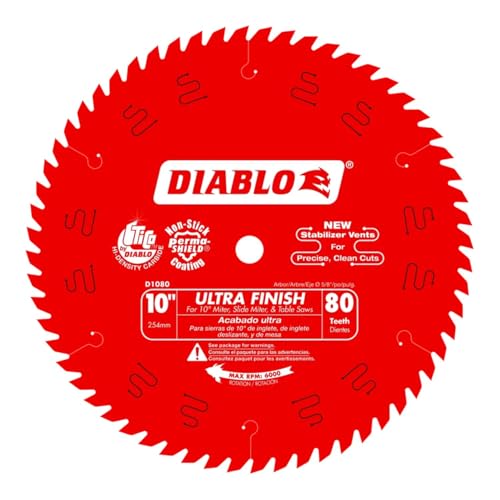
For woodworkers who demand a flawless, chip-free surface right off the saw—especially when working with veneered plywood, oak, pine, or delicate moldings—the Diablo D1080X is a benchmark. Its 80 high-alternate top bevel (Hi-ATB) teeth are engineered to score the wood fibers before the full cut, virtually eliminating tear-out on both sides of the workpiece. This is a dedicated crosscut and finishing blade that professionals rely on for cabinetry and fine trim.
The blade’s performance is enhanced by Diablo’s TiCo Hi-Density carbide, which provides a sharper edge and longer life than standard carbide tips. The Perma-SHIELD non-stick coating is a critical feature, reducing friction and heat buildup while preventing pitch and resin from adhering to the blade. Users consistently report that it makes their saw run quieter and with less vibration, a sign of superior balance and build quality.
While it carries a mid-range tag, its performance rivals premium options. The super-thin laser-cut kerf ensures fast, efficient cuts with minimal waste. It’s important to note this is not a ripping blade; its strength is in delivering a finish so smooth it often requires little to no sanding. For anyone prioritizing crosscut quality above all else, this blade is an exceptional investment.
Why it’s great
- Produces unbelievably clean, chip-free cuts on veneers and delicate materials.
- Non-stick coating reduces maintenance and extends blade life significantly.
- Noticeably quieter and smoother operation due to excellent balance.
Good to know
- Specialized for crosscutting/finishing, not designed for heavy ripping tasks.
- The red coating can transfer onto wood during the first few cuts.
2. Freud P410 Premier Fusion General Purpose Blade

If you want one blade to handle the majority of your work without constant swapping, the Freud P410 “Premier Fusion” represents a top-tier general-purpose solution. Its innovative Fusion Trio Tooth Design combines three different grinds on the same blade, allowing it to tackle both ripping and crosscutting with a polish usually reserved for dedicated blades. This makes it ideal for shops where efficiency is key, or for woodworkers who don’t want to invest in a full blade set immediately.
The technology here is impressive. The blend of 30° Hi-ATB, double grind, and Axial Shear Face Grind works together to score, slice, and shear wood fibers for an exceptionally clean cut in materials ranging from hardwoods to melamine-coated panels. Laser-cut anti-vibration slots dampen noise and sideways movement, contributing to a crisp, splinter-free finish. The Perma-Shield coating ensures longevity.
User feedback highlights its ability to produce “glue-ready” edges on crosscuts and clean, efficient rip cuts up to about 1.5 inches thick. It’s a step above a standard 40-tooth combo blade, offering performance that can delay the need for buying separate rip and crosscut blades. For a high-performance, do-almost-everything option, the P410 is a compelling choice.
Why it’s great
- Remarkably versatile, delivering fine-finish crosscuts and clean rips with one blade.
- Advanced tooth geometry reduces tear-out on veneers and laminates.
- Substantial build quality with effective vibration damping.
Good to know
- Not a replacement for a dedicated 24-tooth rip blade on very thick, hard lumber.
- The Hi-ATB grind leaves an uneven bottom, making it unsuitable for dados.
3. DEWALT DWA11080 Fine Finish Blade
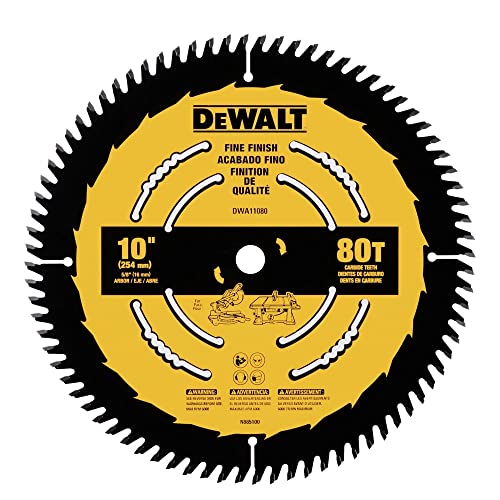
DEWALT brings its tool engineering expertise to the blade market with the DWA11080, an 80-tooth fine-finish blade designed for smooth, accurate cuts. A standout feature is its patented body slot design, engineered specifically to reduce vibration. This results in a noticeably quieter and more stable cutting experience, which not only improves cut quality but also reduces user fatigue over long sessions.
The blade uses ultra-sharp carbide formulated for clean cutting and is marketed to last up to three times longer than a standard blade. The optimized tooth geometry aims for increased accuracy, making it a reliable choice for precise trim work, cabinetry, and cutting sheet goods like plywood where a clean edge is paramount. It’s a full-kerf blade, providing inherent stiffness for consistent cuts.
Ideal for the serious DIYer or professional who values a smooth-operating tool, this blade delivers dependable, high-quality results. It holds its edge well through extended use on hardwoods and engineered woods, making it a solid mid-range investment for those who want DEWALT’s brand assurance and engineered performance in a finishing blade.
Why it’s great
- Patented design dramatically reduces vibration and noise for smoother operation.
- Provides clean, accurate cuts in plywood and hardwoods with minimal tear-out.
- Good longevity and edge retention for its category.
Good to know
- As a full-kerf blade, it may strain underpowered contractor or jobsite saws.
- A dedicated specialty blade, not intended for ripping tasks.
4. Freud LU88R010 Thin Kerf Crosscut Blade
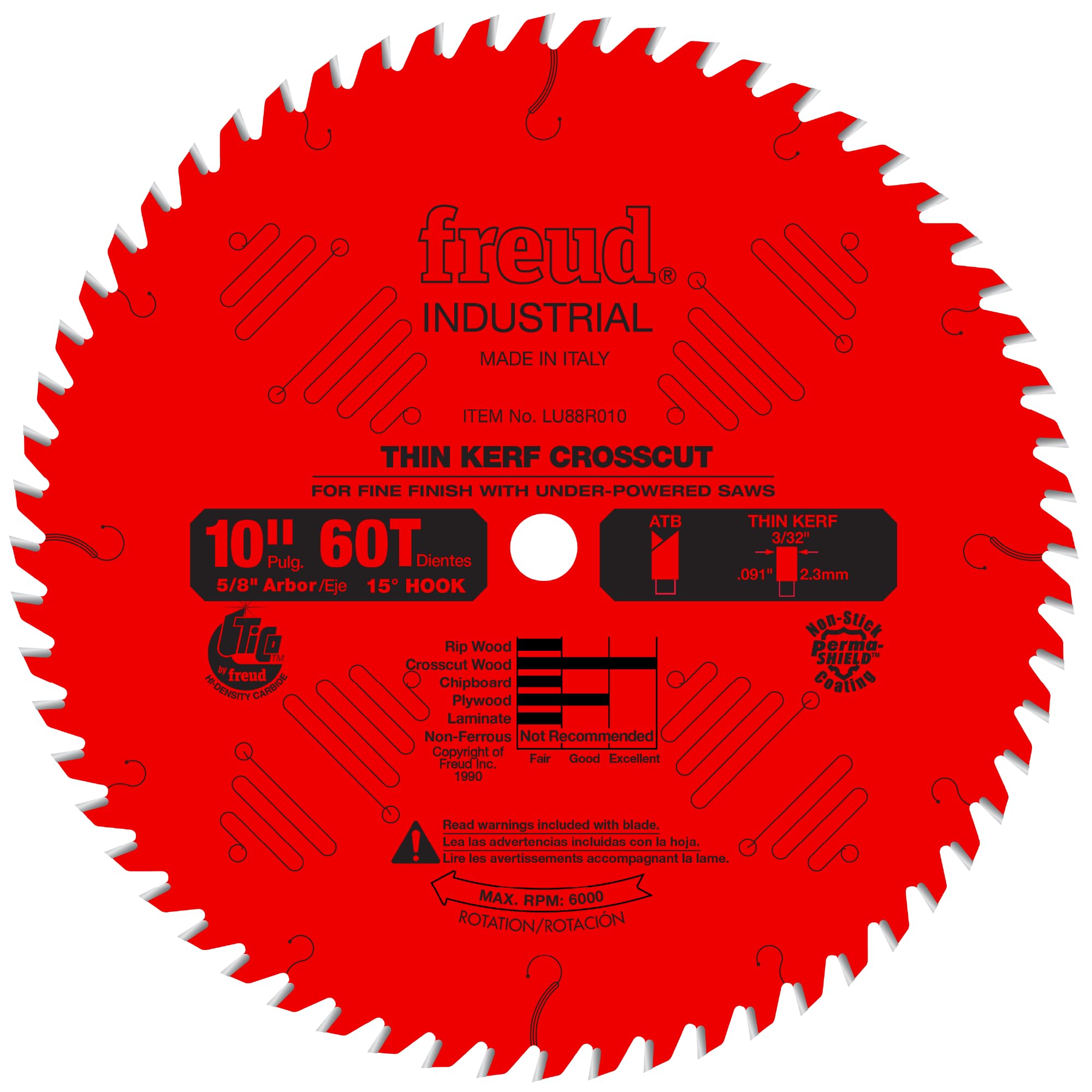
The Freud LU88R010 is a purpose-built tool for woodworkers who need exceptional crosscutting performance on saws with limited power, such as older contractor saws or jobsite models. Its defining characteristic is a very thin .090″ kerf, which removes minimal material, reduces waste, and places far less demand on the motor. This allows the saw to maintain speed and power through the cut, resulting in less burning and strain.
Featuring 60 ATB (Alternate Top Bevel) teeth made from Freud’s premium TiCo Hi-Density carbide, this blade is engineered for smooth, fine cuts in wood, plastic, and non-ferrous metals. The thin kerf and positive hook angle facilitate a faster, easier feed rate. Like its siblings, it includes the Perma-Shield non-stick coating for reduced drag and protection against corrosion.
This blade excels on radial arm saws and table saws where crosscutting is the primary task. Users upgrading from a dull or generic blade often describe the experience as transformative—cutting hardwoods “like butter” with a clean, shiny surface. It’s a professional-grade solution for a specific need, offering premium performance in a thin-kerf format.
Why it’s great
- Ideal for lower-powered saws, reducing motor strain and preventing bog-down.
- Produces exceptionally smooth, fine crosscuts with minimal effort.
- High-quality carbide and coating ensure long life and easy maintenance.
Good to know
- Very thin plate can be more susceptible to deflection if misaligned or used for ripping.
- Specialized for crosscutting; not a general-purpose or ripping blade.
5. Freud LU87R010 Thin Kerf Rip Blade
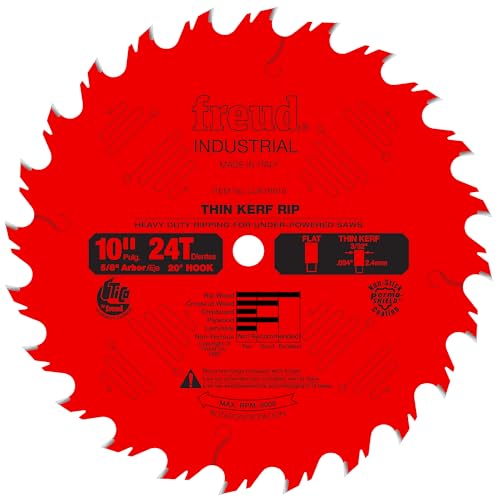
For owners of portable or underpowered table saws, ripping thick hardwood can be a challenge that leads to burned wood, tripped breakers, and frustration. The Freud LU87R010 is the engineered solution. As a thin-kerf (.094″) rip blade with 24 Flat Top Grind (FTG) teeth, it is designed to remove material quickly and efficiently with minimal resistance, allowing smaller saws to perform like larger ones.
The FTG teeth leave a flat-bottomed cut, which is ideal for joinery work. The 20° positive hook angle aggressively pulls the wood through the cut, and the thin kerf ensures the motor isn’t overworked. The Perma-Shield coating keeps pitch buildup at bay. The result, as described by users, is a blade that rips through dense woods like ash and oak with surprising ease, leaving a clean, glue-ready edge and virtually no burning.
This is not a combination blade. It is a specialist that turns a struggling jobsite saw into a competent ripping machine. If ripping is your primary task and your saw has ever bogged down or stalled, this blade will feel like a major upgrade, restoring power and confidence to your workflow.
Why it’s great
- Transforms the ripping capability of underpowered portable and contractor saws.
- Leaves a flat-bottomed, clean rip cut ideal for joinery.
- Extremely efficient design reduces waste and motor strain.
Good to know
- Will cause severe splintering on crosscuts, especially in plywood or veneers.
- Specialized use only; requires a separate blade for crosscutting.
6. CMT 253.060.10 ITK Industrial Finish Blade
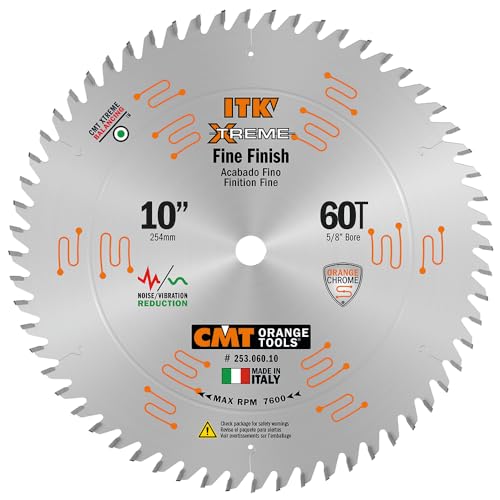
While many blades claim miter saw compatibility, the CMT 253.060.10 is specifically engineered for sliding compound miter saws to deliver a “glass-smooth” finish. Its unique tooth configuration—one Flat Top Grind tooth followed by two Alternate Top Bevel teeth (1 FTG + 2 ATB)—is designed for optimal performance on these tools, providing a superb balance between cutting speed and a pristine surface.
The blade features a laser-cut steel plate with expansion slots to dampen vibration and reduce noise, a critical factor for user comfort during long sessions of cutting trim or flooring. The micro-grain carbide tips are formulated for long-lasting sharpness. Users consistently note that this blade is quieter, smoother, and leaves a better finish than the stock blades that come with even high-end miter saws.
This is a premium mid-range choice for finish carpenters, trim installers, or serious DIYers who use their miter saw as a primary tool. It’s an upgrade that pays immediate dividends in cut quality and a more pleasant working environment. The blade is also designed to be re-sharpened, with grinding angles laser-etched on the body for the sharpening service.
Why it’s great
- Specialized tooth grind optimized for smooth, accurate miter saw cuts.
- Exceptionally quiet and vibration-free operation.
- High-quality, sharpenable construction offers long-term value.
Good to know
- Primarily intended for miter saws, though it can be used on a table saw for crosscuts.
- Full-kerf design requires a saw with adequate power.
7. Diablo D1024X Ripping Saw Blade

The Diablo D1024X is a workhorse ripping blade that delivers professional-grade performance at a very accessible price point. Designed for superior rip cuts in wood, plywood, and OSB from 3/4″ to 2-3/4″ thick, its 24 ATB teeth and TiCo Hi-Density carbide are built to power through material with ease. The tri-metal shock-resistant brazing is a key feature, allowing the carbide tips to withstand the extreme impact of knots and dense grain.
Users are often amazed at the improvement over a standard combination blade, describing it as cutting “like a hot knife through butter” with no burning and dramatically reduced feed pressure. The super-thin laser-cut kerf and Perma-SHIELD coating contribute to its efficient, clean-cutting performance. It’s an ideal first specialty blade for a woodworker looking to add a dedicated ripper to their arsenal.
Whether you’re ripping fence pickets from southern yellow pine or preparing hardwoods for a furniture project, this blade offers tremendous value. It brings Diablo’s renowned quality and innovation to a specific task, making hard work noticeably easier and extending the life of your saw by reducing strain.
Why it’s great
- Exceptional ripping performance that significantly reduces effort and burning.
- Durable construction handles tough materials like pressure-treated wood and knots.
- Offers premium Diablo features at a mid-range price.
Good to know
- Not for crosscutting; will leave a rougher finish on crosscuts.
- As a full-kerf blade, it requires a saw with sufficient power.
8. Forrest Woodworker II 10-Inch 40 Tooth Blade

The Forrest Woodworker II is legendary in fine woodworking circles, often considered the gold standard for a “do-it-all” combination blade. It’s a premium investment, handcrafted in the USA, and is built not to be disposable but to be a lifetime tool. The blade is famous for producing “glue-ready” cuts straight off the saw, with a surface so smooth it resembles planed wood.
Its .125″ kerf is on the wider side, providing exceptional stability and flatness in the cut, which is crucial for precision joinery. The 40-tooth, 30-degree ATB design is a masterful compromise, offering remarkably clean crosscuts and more than capable rip performance. The true value proposition lies in Forrest’s lifetime sharpening and reconditioning service; you send it back, and they return it performing like new.
This is the blade for the woodworker who views their tools as heirlooms and prioritizes absolute cut quality above all else. It’s for the person who never wants to wonder if a better blade would improve their work. The initial cost is high, but amortized over decades of service and resharpening, it represents a unique and justifiable tier of quality.
Why it’s great
- Unrivaled cut quality, often leaving a finish that needs no sanding.
- Extremely stable and flat-cutting due to its design and premium construction.
- Lifetime sharpening service makes it a truly long-term investment.
Good to know
- Premium price point is a significant investment.
- Wider kerf (.125″) consumes more material and requires a saw with good power.
9. WEN BL1080 80-Tooth Ultra-Fine Finish Blade
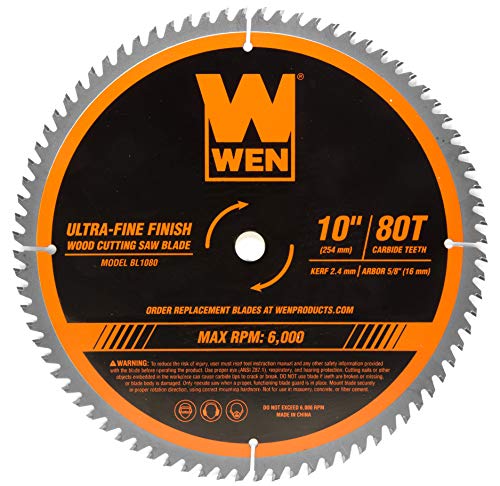
The WEN BL1080 punches far above its weight class, offering an 80-tooth ultra-fine finish configuration at an entry-level cost. It’s designed for woodworkers who need clean crosscuts for trim, baseboards, or fine projects but don’t want to commit to aplywood but only use their saw occasionally. The ultra-thin kerf makes it easy on the motor, and the 80 carbide-tipped teeth are arranged to minimize tear-out.
User reviews reveal genuine surprise at its capability, with many noting it cuts smoother than their old, more expensive blades and leaves edges with no splintering on trim work. It holds its sharpness well through hundreds of cuts on common softwoods and hardwoods. While it may not have the advanced coatings or exotic carbide of premium blades, its performance-to-cost ratio is outstanding.
Think of this as a disposable premium blade. For the cost, you can use it for a dedicated project or as a secondary blade without worry, and it will deliver results that far exceed its category. It’s a fantastic choice for DIYers, hobbyists, or as a dedicated blade for cutting melamine or laminates where you don’t want to risk damaging a more expensive blade.
Why it’s great
- Provides a true fine-finish cut at a remarkably accessible price point.
- Ultra-thin kerf is ideal for lower-powered saws and reduces material waste.
- A great “project-specific” or backup blade for any workshop.
Good to know
- Lacks the advanced non-stick coatings and vibration damping of higher-end blades.
- Long-term durability may not match professional-grade options, but the value is clear.
10. WEN BL1060 60-Tooth Fine-Finish Blade

Striking an excellent balance between cutting speed and finish quality, the WEN BL1060 is a 60-tooth blade designed for fine-finish work on indoor projects, trim, and general crosscutting. The tooth count is in the sweet spot for many woodworkers, aggressive enough not to bog down yet fine enough to leave a smooth surface that requires minimal cleanup.
It shares the same quality construction as other WEN blades: a thin kerf for efficiency, a 5/8-inch arbor for universal compatibility, and carbide-tipped teeth. Users report it delivers smooth cuts with no splintering, making it a reliable upgrade from a basic 40-tooth general-purpose blade. It’s particularly praised for its performance on miter saws when cutting moldings and finished lumber.
This blade embodies the “value workhorse” concept. It’s a smart purchase for someone who wants a noticeable upgrade in cut quality for their most common tasks without a significant investment. Many users adopt it as their everyday blade for non-critical ripping and crosscutting, saving their more expensive blades for final, show-quality cuts.
Why it’s great
- Perfect 60-tooth balance for efficient, smooth cuts on a wide variety of projects.
- Exceptional value, often costing less than a sharpening service for other blades.
- Ideal as a high-performance replacement for a worn-out stock blade.
Good to know
- Finish, while good, may not be as ultra-refined as an 80-tooth dedicated finish blade.
- A utilitarian tool without the bells and whistles of premium brands.
11. WEN BL1040 40-Tooth Carbide-Tipped Blade

The WEN BL1040 is the definition of a solid, no-frills entry point into quality carbide blades. As a 40-tooth general-purpose blade, it’s designed to competently handle both ripping and crosscutting in hard and softwoods, making it a perfect first upgrade from a steel or dull factory blade. Its ultra-thin kerf ensures it runs efficiently on any 10-inch saw.
For the budget-conscious DIYer or someone who needs a reliable spare, this blade delivers consistent performance. Reviews frequently highlight that it “cuts well,” “runs true,” and represents a “no brainer” for occasional use. It’s the blade you buy when you need to get the job done without overthinking the tool, and it will outperform any worn-out blade currently on your saw.
While it won’t match the specialized performance or longevity of the blades higher on this list, it resets the baseline for what a capable saw blade can cost. It’s an excellent tool for construction cleanup, rough dimensioning, or as a dedicated blade for cutting potentially damaging materials like pressure-treated wood, preserving your better blades for fine work.
Why it’s great
- Extremely accessible way to experience the benefit of a sharp, carbide-tipped blade.
- Wide compatibility with table saws, miter saws, and jobsite saws.
- Perfect as a disposable-use blade for rough or dirty cutting tasks.
Good to know
- A basic tool; don’t expect glue-ready finishes or advanced features.
- Best for utility work and beginners, not for fine woodworking.
Understanding the Specs
Tooth Count & Grind
This is the blade’s DNA. Tooth count dictates purpose: low (24-30) for fast ripping, high (60-80) for smooth crosscutting, middle (40-50) for general use. The grind—Alternate Top Bevel (ATB) for clean crosscuts, Flat Top Grind (FTG) for strong ripping and flat bottoms, or High-ATB for chip-free finishes on veneers—determines how the tooth slices the wood fiber.
Kerf & Arbor
Kerf is the width of the cut. A thin kerf (~.091″) reduces motor strain and waste, ideal for portable saws. A full kerf (~.098″+) offers stability and precision for powerful cabinet saws. The arbor is the mounting hole; 5/8-inch is the standard for 10-inch table saws. Always confirm this matches your saw’s arbor size for safe operation.
FAQ
Can I use one blade for both ripping and crosscutting?
What is the difference between a Diablo and a Freud blade?
How do I know if I need a thin kerf or full kerf blade?
How often should I replace or sharpen my table saw blade?
Final Thoughts: The Verdict
For most people, the best 10 inch table saw blade winner is the Diablo D1080X because it delivers near-premium, chip-free finishing performance at a mid-range price, solving the most common pain point of tear-out. If you want unparalleled versatility from a single blade, grab the Freud P410 Premier Fusion. And for the ultimate long-term investment in glue-ready perfection, nothing beats the Forrest Woodworker II.

Mo Maruf
I created WellFizz to bridge the gap between vague wellness advice and actionable solutions. My mission is simple: to decode the research and give you practical tools you can actually use.
Beyond the data, I am a passionate traveler. I believe that stepping away from the screen to explore new environments is essential for mental clarity and physical vitality.