Our readers keep the lights on and my smoothie glass nicely filled. As an Amazon Associate, I earn from qualifying purchases.
You can’t manage what you can’t measure, and the air inside your home often hides more than you realize. From dust and pollen to invisible gases and radon, understanding your indoor environment is the first step toward breathing easier.
I’m Mohammad Maruf — the founder and writer behind WellFizz. With over 15 years of experience evaluating wellness products, I focus on deep market research and analyzing technical specifications and sensor data to cut through the marketing noise.
This guide is the result of scrutinizing specifications, user reports, and performance data for dozens of models. Selecting the right best air quality monitor for home empowers you to detect hidden hazards and create a healthier living space proactively.
How To Choose The Best Air Quality Monitor For Home
Selecting an air quality monitor isn’t about getting the most sensors; it’s about matching the device’s capabilities to your specific concerns and environment. Focus on the pollutants most relevant to your home.
Identify Your Primary Air Quality Concerns
Start by considering what you want to measure. For general awareness of dust, allergens, and smoke, a monitor with a PM2.5 sensor is essential. If you have a tightly sealed home, experience stuffiness, or are concerned about ventilation, carbon dioxide (CO2) monitoring becomes critical. For those sensitive to chemicals from cleaning products, paints, or new furniture, a VOC (Volatile Organic Compound) sensor is key. Radon detection is a non-negotiable for basement rooms or ground-floor living spaces in many regions.
Evaluate Sensor Accuracy and Response Time
Not all sensors are created equal. Look for stated accuracy ranges, such as ± µg/m³ for particulates or ± ppm for CO2. A faster refresh rate (e.g., every 2 seconds vs. every 30 seconds) means you’ll see real-time changes when you cook or clean. Laser-based particle sensors and NDIR (Non-Dispersive Infrared) CO2 sensors are generally more reliable than older semiconductor types.
Consider Form Factor and Connectivity
Decide where you’ll place the monitor. A compact, portable unit with battery life is great for moving between rooms. A device with WiFi or Bluetooth allows for remote monitoring via an app, historical data tracking, and integration with other smart home devices like air purifiers or thermostats for automated responses.
Quick Comparison
On smaller screens, swipe sideways to see the full table.
| Model | Type | Best For | Key Feature | Amazon |
|---|---|---|---|---|
| Amazon Smart Air Monitor | Multi-Sensor | Smart home integration | Alexa routines, 5-factor score | Amazon |
| Airthings 2960 View Plus | Professional | Comprehensive safety monitoring | Radon, PM2.5, CO2, VOC sensors | Amazon |
| Temtop M10+ | Multi-Sensor | Quiet, long-term bedroom use | E-ink display, 60-day battery | Amazon |
| GoveeLife Smart Monitor | Smart Sensor | Budget smart features | WiFi, works with Govee appliances | Amazon |
| YNAK 16-in-1 Monitor | Multi-Sensor | Large, easy-to-read display | 7-inch screen, 9 parameters | Amazon |
| LifeBasis Air Monitor | Multi-Sensor | Portable room-to-room checks | 11 metrics, dual visual/audio alarm | Amazon |
| Temtop CO2 Monitor | CO2 Focus | Ventilation and CO2 tracking | NDIR sensor, 70-day battery | Amazon |
| Rozoroo 12-in-1 Monitor | Multi-Sensor | Comprehensive data on a budget | Smiley face AQI, 12 parameters | Amazon |
| Upgrade 16-in-1 Monitor | Multi-Sensor | All-day cordless monitoring | 12-hour battery, large display | Amazon |
| LEVOIT Air Purifier with Monitor | Purifier + Monitor | All-in-one air cleaning | Built-in AQI sensor, auto mode | Amazon |
| Temtop S1 Air Monitor | Basic Meter | Entry-level PM2.5 & temp check | Compact, 60-day battery life | Amazon |
In‑Depth Reviews
1. Amazon Smart Air Quality Monitor

The Amazon Smart Air Quality Monitor excels at making complex air data simple and actionable within a smart home ecosystem. It tracks five key factors—PM2.5, VOCs, carbon monoxide, humidity, and temperature—and synthesizes them into a single, easy-to-understand air quality score visible in the Alexa app.
Its greatest strength is seamless integration. You can set routines where poor air quality triggers other devices, like turning on an air purifier or announcing an alert on your Echo. The small, minimalist design features a color-coded LED that gives an instant, glanceable status without needing to open an app.
User reports confirm it’s sensitive to everyday activities like cooking or burning candles, providing timely feedback. While it doesn’t offer raw data for every sensor on the device itself, the app provides sufficient detail for most homeowners. It’s a wired device, best placed in a central, always-on location.
Why it’s great
- Perfect for Alexa-powered smart homes with automated routines.
- Simplifies complex data into a single score and color indicator.
- Reliably detects changes from cooking, cleaning, and other activities.
Good to know
- Requires a power outlet and WiFi connection for full functionality.
- Some users note VOC readings can be overly sensitive to harmless scents.
- Detailed historical data requires using the Alexa app.
2. Airthings 2960 View Plus

The Airthings View Plus is the definitive choice for comprehensive, long-term air quality and safety monitoring. It’s the only device in this lineup that includes a certified radon sensor, alongside precise detectors for PM2.5, CO2, VOCs, humidity, temperature, and air pressure.
This monitor is built for data-driven users. The free app provides extensive historical graphs and trends, allowing you to correlate air quality changes with your habits or outdoor conditions. The cable-free, battery-powered design offers flexible placement, and the e-ink display shows customizable readings without consuming much power.
Feedback highlights its value in identifying ventilation issues and verifying the effectiveness of mitigation systems, like radon fans. The long-term data storage and professional-grade sensor approach make it an investment in ongoing health awareness, particularly for those in basements or newer, tightly sealed homes.
Why it’s great
- Uniquely monitors radon, the leading cause of lung cancer in non-smokers.
- Excellent app with deep historical data analysis and cloud storage.
- Battery-powered with a clear, low-power e-ink display.
Good to know
- Positioned at a premium price point.
- Requires a week for initial radon sensor calibration.
- App and device need internet access for full functionality.
3. Temtop M10+ Indoor Air Quality Monitor

The Temtop M10+ combines a sleek, minimalist design with practical multi-sensor functionality, making it an elegant and unobtrusive addition to any room. Its e-ink display is easy to read in various light conditions and uses minimal power, contributing to an impressive battery life of up to two months on a single charge.
It monitors six key parameters: CO2, PM2.5, VOCs, temperature, and humidity. The companion app allows for remote checking of current levels and review of historical data, though some users find the app features basic. A significant benefit for bedrooms is the ability to fully silence audible alarms, allowing for peaceful, continuous monitoring through the night.
This unit is praised for its discreet presence and long battery life, though some variability in VOC readings has been noted. It’s an excellent choice for those who want a capable, always-on monitor that blends into modern home decor without cords or frequent charging.
Why it’s great
- Sleek, paper-like e-ink display is easy on the eyes and power-efficient.
- Exceptionally long battery life for cord-free placement anywhere.
- Silent operation mode is perfect for uninterrupted sleep monitoring.
Good to know
- App functionality is somewhat limited compared to premium brands.
- VOC sensor accuracy can be inconsistent in some user reports.
- Display does not have a backlight for dark rooms.
4. GoveeLife Smart Air Quality Monitor

The GoveeLife monitor delivers impressive smart features and connectivity at a mid-range point, making advanced air quality tracking more accessible. It measures PM2.5, temperature, and humidity with a fast two-second data refresh rate, providing near-instant feedback on air changes.
Its primary advantage is deep integration with the Govee ecosystem. You can set automations where this monitor triggers other GoveeLife appliances, like turning on an air purifier when PM2.5 rises or a humidifier when humidity drops. The app offers free two-year data storage and export, which is excellent for tracking long-term trends.
Users appreciate its compact design and reliable WiFi connection. The LED display shows air quality levels at a glance, and the device is powered via USB-C. While it doesn’t measure CO2 or VOCs, its core PM2.5 tracking is accurate enough for managing allergens, dust, and smoke response in a connected home setup.
Why it’s great
- Excellent value with robust app features and long-term data history.
- Seamlessly automates other Govee smart home devices.
- Fast sensor response gives a real-time view of air changes.
Good to know
- Limited to PM2.5, temp, and humidity (no CO2/VOC).
- Requires a power outlet, as it has no battery.
- Automations only work with other Govee-branded appliances.
5. YNAK 16-in-1 Air Quality Monitor
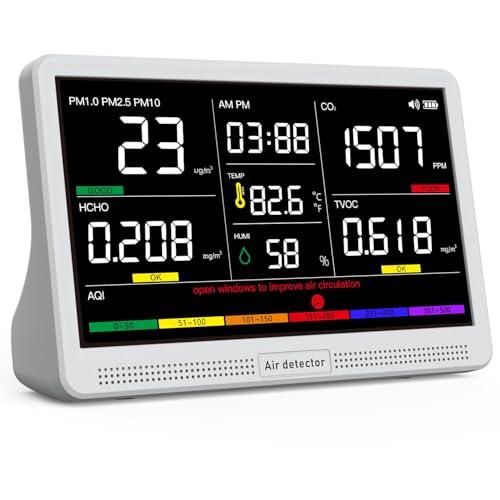
If your priority is a large, crystal-clear display that can be read from across the room, the YNAK monitor is a standout choice. Its 7-inch screen simultaneously shows all nine measured parameters—CO2, PM1.0/2.5/10, HCHO, TVOC, temperature, humidity, and AQI—eliminating the need to cycle through menus.
The device is highly responsive, with users reporting it detects changes from cooking, lasers, or 3D printing within 20-30 seconds. The color-coded AQI system (green to purple) provides immediate, intuitive understanding of air safety. It includes a substantial internal battery for portability, though for permanent placement, it can remain plugged in.
This model is particularly favored for workshops, living rooms, or offices where you want constant, visible feedback. The external high-precision sensors are designed for direct air sampling, and the unit features multiple alert buzzers for different pollutants, which can be muted if desired.
Why it’s great
- Massive, bright display shows all data at once for ultimate convenience.
- Very fast sensor response to pollutants and everyday activities.
- Comprehensive sensor array covers all major indoor air concerns.
Good to know
- Its size is much larger than typical portable monitors.
- Battery life is limited to several hours for cordless use.
- The interface uses physical buttons, not a touchscreen.
6. LifeBasis 11-in-1 Air Quality Monitor

The LifeBasis monitor strikes a strong balance between portability and a wide sensor array. Its relatively flat, vertical design makes it easy to carry from room to room or even pack for travel, while still tracking 11 key metrics including CO2, particulate matter, VOCs, and formaldehyde.
It features a clear TFT display with color-coded indicators for quick air quality assessment. The dual alert system provides both a visual color change and an audible ticking alarm when pollutants exceed safe levels. Independent testing by users suggests it employs genuine, separate sensors for different metrics, which improves reliability over devices that infer readings.
With a rechargeable battery offering up to 12 hours of use, it’s well-suited for conducting spot checks throughout a home, in a car, or at the office. The ability to manually calibrate the CO2 sensor is a noted advantage for maintaining accuracy over time.
Why it’s great
- Highly portable form factor ideal for multi-location testing.
- Uses distinct sensors for accurate differentiation of pollutants.
- Helpful dual visual and audio alarm system for warnings.
Good to know
- Battery life is sufficient for spot checks but not continuous days of use.
- Lacks WiFi connectivity for remote monitoring.
- Some units have had quality control issues reported.
7. Temtop CO2 Monitor

For those whose primary concern is ventilation and carbon dioxide levels, this dedicated CO2 monitor from Temtop is a focused and effective tool. It utilizes an accurate NDIR (Non-Dispersive Infrared) sensor, the same technology found in more expensive professional units, to measure CO2 from 400 to 5000 ppm.
Its major selling point is exceptional battery life—up to 70 days in standby mode—thanks to an efficient photoacoustic sensor and power-saving algorithm. The display is a simple, non-backlit LCD that won’t disturb sleep, and both audio and visual alarms can be customized or disabled for nighttime use.
This device is perfect for classrooms, home offices, or bedrooms where occupant density can quickly degrade air quality. It provides clear, reliable data to inform when to open a window or increase ventilation, directly addressing stuffiness and cognitive fatigue linked to high CO2 levels.
Why it’s great
- Accurate NDIR CO2 sensor at a very accessible price point.
- Outstanding battery life minimizes maintenance and charging.
- Discreet, sleep-friendly design with customizable alarms.
Good to know
- Only measures CO2, temperature, and humidity (no particulates or VOCs).
- The display can be faint and lacks a backlight.
- Some users report screen reliability issues over time.
8. Rozoroo 12-in-1 Air Quality Monitor
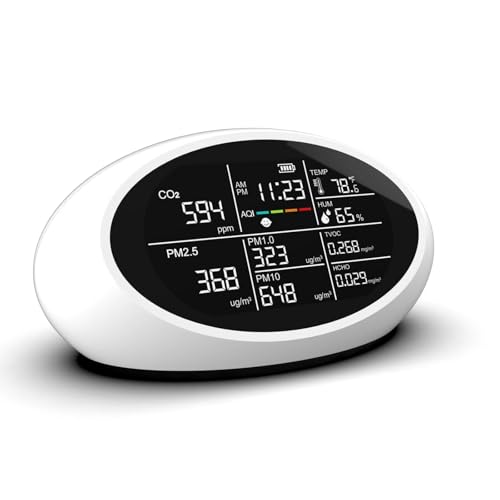
The Rozoroo monitor offers an extensive suite of sensors at a budget-friendly price, making it a compelling entry point for comprehensive air quality awareness. It tracks 12 parameters, including the rarer PM1.0 and HCHO (formaldehyde), and presents an overall AQI with a simple, effective smiley face indicator.
Its dual-chip architecture is designed to process sensor data and manage the display separately for faster, more stable performance. The built-in 5000mAh battery allows for true cordless operation and portability around the house. For many users, its most impactful feature has been revealing unexpectedly high CO2 levels in closed rooms, prompting immediate ventilation improvements.
Setup is straightforward, and the device provides clear visual and audible alarms. While fit and finish may not feel premium, the breadth of data provided for the cost is significant, making it a practical tool for initial home air quality audits.
Why it’s great
- Exceptional value with a very wide array of sensors.
- Intuitive smiley-face AQI gives an instant overall assessment.
- Large battery supports extended cordless use and portability.
Good to know
- Build quality and screen viewing angles can be limited.
- Accuracy may vary across the full sensor suite.
- Some units may have quality control or charging issues.
9. Upgrade 16-in-1 Air Quality Monitor
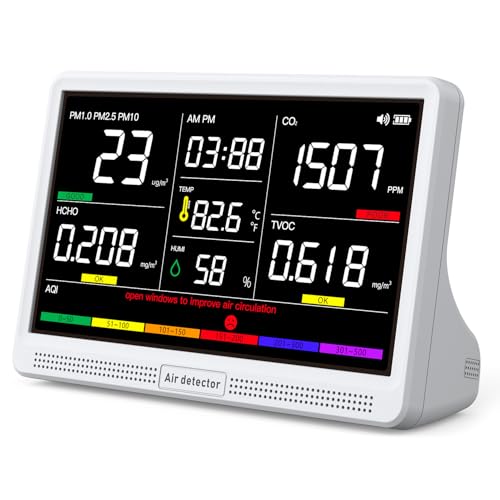
This upgraded variant of the large-display monitor focuses on extended cordless operation. It shares the same excellent 7-inch screen and 9-parameter sensor array as other similar models but is distinguished by a larger 3500mAh battery capable of up to 12 hours of continuous use on a single charge.
This makes it uniquely suited for all-day monitoring sessions in different parts of the home without needing a power outlet. You can start it in the living room in the morning, move it to a home office for the afternoon, and place it in a bedroom at night—all while maintaining a constant, easy-to-read stream of air quality data.
The fast sensor response and clear color alerts remain, providing immediate feedback on environmental changes. This model is ideal for users who want the comprehensiveness of a stationary display monitor but require the flexibility to move it regularly throughout their living space.
Why it’s great
- Extended battery life enables true full-day, whole-home portable monitoring.
- All the benefits of a large, multi-parameter display without being tethered.
- Responsive sensors provide real-time feedback on air quality changes.
Good to know
- Still a relatively large device to carry around.
- Needs to be recharged daily with heavy cordless use.
- Similar in core function to other large-display models.
10. LEVOIT Air Purifier with Monitor
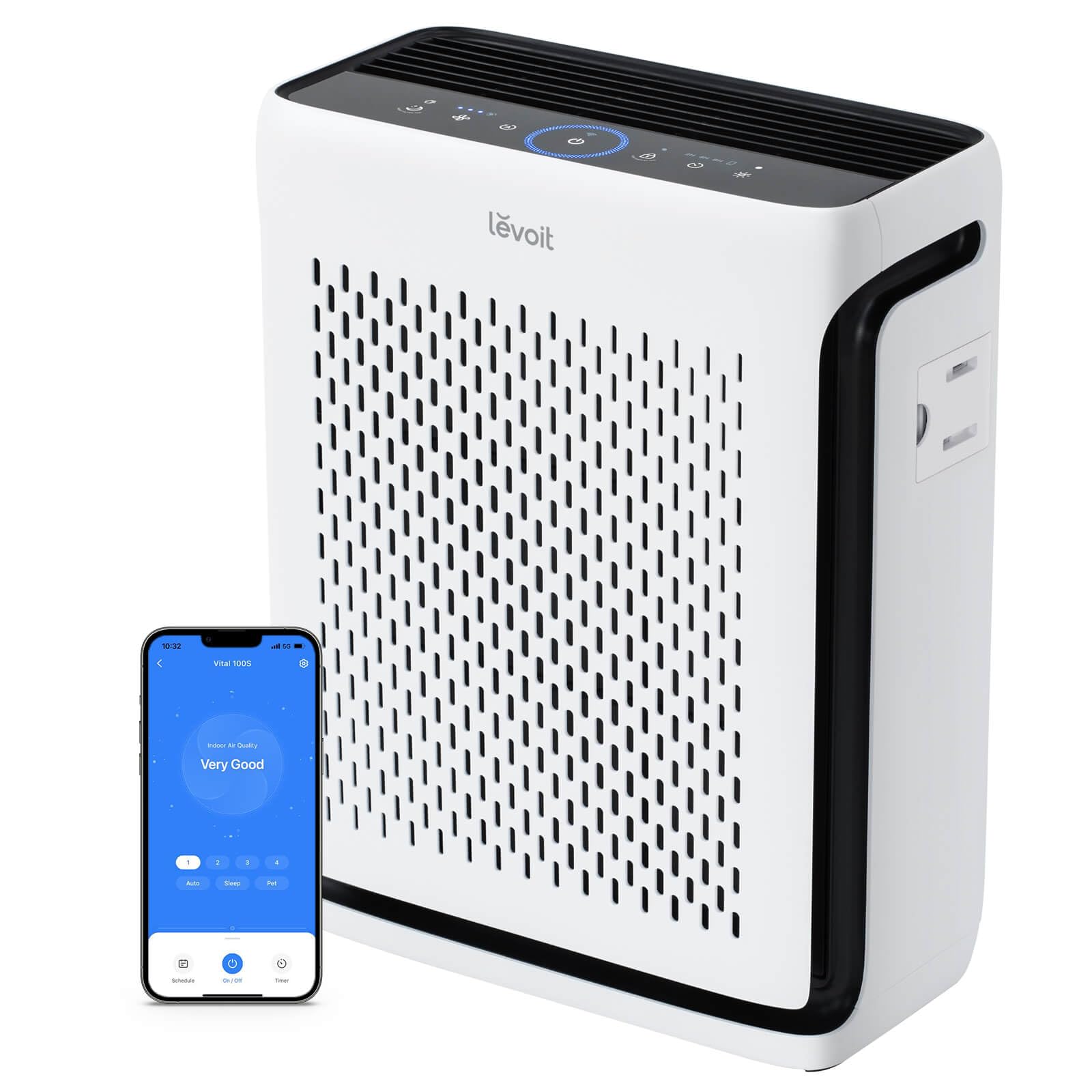
This isn’t just a monitor; it’s a complete air cleaning system with a built-in air quality sensor. The Levoit Vital 100S-P is an AHAM-verified air purifier capable of cleaning large rooms, and its integrated laser dust sensor allows it to automatically adjust fan speed in response to detected particulate levels.
It’s the perfect choice if your goal is not just to monitor but to immediately improve air quality. The smart app allows for scheduling, remote control, and integration with voice assistants. In auto mode, it provides hands-free operation, ramping up when cooking or vacuuming and quieting down when the air is clean.
Users praise its effectiveness for allergies, pet dander, and dust, noting its quiet operation, especially in sleep mode. While its sensor is focused on particulates (triggering the purifier’s auto mode), it provides a practical, action-oriented approach to air quality management.
Why it’s great
- Combines accurate monitoring with automatic, powerful air purification.
- AHAM verification provides trusted performance metrics for room size.
- Quiet, effective operation with smart scheduling and voice control.
Good to know
- Primarily monitors particulates to control the purifier (not a standalone multi-sensor).
- Is a larger appliance, not a portable monitoring device.
- Ongoing cost for replacement filters.
11. Temtop S1 Air Quality Monitor

The Temtop S1 is a straightforward, entry-level device focused on the fundamentals: PM2.5, AQI, temperature, and humidity. Its compact, pocket-sized design and 60-day battery life make it a simple tool for basic air quality checks and for verifying the performance of your air purifiers.
It uses a laser particle sensor and is designed to be highly portable. For users new to air quality monitoring, it provides a low-commitment way to understand baseline particulate levels in different rooms. The magnetic back allows for easy placement on appliances or metal surfaces.
Feedback is mixed on its accuracy and consistency; some users find it reliable for spotting trends and changes, while others report readings can get “stuck” or vary between units. It serves best as an introductory device for basic awareness rather than for precise, scientific measurement.
Why it’s great
- Extremely affordable entry point into air quality monitoring.
- Compact and portable with very long battery life.
- Simple to use with no complex setup or apps required.
Good to know
- Sensor accuracy and consistency can be unreliable.
- Only measures PM2.5 and climate data (no CO2/VOC).
- Lacks connectivity or data logging features.
Understanding the Specs
Particulate Matter (PM2.5/PM10)
PM2.5 refers to fine inhalable particles with diameters of 2.5 micrometers or smaller, like dust, pollen, and smoke. PM10 includes larger particles. Monitors use laser scattering sensors; look for a measurement range (e.g., 0–1000 µg/m³) and accuracy (e.g., ±10%). This data directly informs the Air Quality Index (AQI) for particulates.
Carbon Dioxide (CO2)
CO2 levels indicate ventilation quality. Outdoor air is ~400 ppm. Indoors, levels above 1000 ppm can cause drowsiness and poor concentration. Premium monitors use NDIR (Non-Dispersive Infrared) sensors for high accuracy. Beware of cheaper models that estimate CO2 from VOC sensors, which is unreliable.
Volatile Organic Compounds (VOCs)
VOCs are gases emitted from products like cleaners, paints, and furnishings. They are measured in parts per billion (ppb). Semiconductor sensors are common but can be cross-sensitive to harmless odors. Electrochemical sensors are more selective but typically found in higher-end units.
Sensor Refresh Rate
This is how often the device samples the air and updates the display. A fast refresh rate (2–5 seconds) is crucial for seeing real-time changes during cooking or cleaning. Slower rates (30–60 seconds) are acceptable for general trend monitoring but won’t capture quick spikes.
FAQ
Where is the best place to put an air quality monitor?
Can air quality monitors detect mold or viruses?
How accurate are these home air quality monitors?
Do I need a monitor if I already have an air purifier with a sensor?
Final Thoughts: The Verdict
For most people, the best air quality monitor for home winner is the Amazon Smart Air Quality Monitor because it seamlessly integrates awareness and action within a smart home, making air quality management effortless. If you want comprehensive safety monitoring including radon, grab the Airthings 2960 View Plus. And for a stylish, discreet monitor with exceptional battery life for the bedroom, nothing beats the Temtop M10+.

Mo Maruf
I created WellFizz to bridge the gap between vague wellness advice and actionable solutions. My mission is simple: to decode the research and give you practical tools you can actually use.
Beyond the data, I am a passionate traveler. I believe that stepping away from the screen to explore new environments is essential for mental clarity and physical vitality.