Our readers keep the lights on and my smoothie glass nicely filled. As an Amazon Associate, I earn from qualifying purchases.
When cardiac arrest happens at home, the clock starts ticking. The American Heart Association states that for every minute without CPR and defibrillation, survival chances drop by 7-10%. Having an accessible, reliable AED at home isn’t about medical expertise; it’s about turning a panicked bystander into a potential lifesaver during those first, critical minutes before help arrives.
I’m Mohammad Maruf — the founder and writer behind WellFizz. For years, I’ve analyzed the home preparedness market, breaking down the technical specifications, user reviews, and real-world application data of life-saving equipment to separate true readiness from marketing noise.
Our guide cuts through the clutter, focusing on the actual device and the essential support system you need to be truly prepared, helping you make an informed choice for the best aed for home.
How To Choose The Best AED For Your Home
Selecting a home AED isn’t about finding the most complex device; it’s about finding the most reliable and simplest one for a high-stress situation. You and anyone in your home should be able to operate it with zero prior experience. Beyond the unit itself, consider how you’ll store it, make it visible, and keep your skills sharp. Here’s what to prioritize.
The Device Itself: Simplicity is Everything
Look for clear, calm audio and visual prompts that guide you through every step, from placing pads to delivering a shock. The best devices perform automatic daily self-checks on battery and pad functionality. Ensure it’s designed for adult use and has clear instructions for pediatric pad placement if needed. A long warranty on the unit and consumables (pads/battery) indicates manufacturer confidence.
Storage & Accessibility
Your AED must be instantly accessible. A dedicated wall cabinet protects the unit from dust, damage, and curious hands while keeping it in a fixed, known location. Consider if you want a simple cabinet or one with an audible alarm to deter tampering and signal when it’s opened. The cabinet should be universally sized to fit most home AED models.
Training and Maintenance
While AEDs are designed for untrained use, familiarizing yourself with CPR and the device dramatically improves response efficacy. A separate training AED is invaluable for practicing without draining the real unit’s battery or pads. Also, ensure your chosen location is known to all household members and visitors—clear, high-visibility signage is a crucial, often overlooked component.
Quick Comparison
On smaller screens, swipe sideways to see the full table.
| Model | Type | Best For | Key Feature | Amazon |
|---|---|---|---|---|
| Philips HeartStart Home AED | Defibrillator | Actual emergency cardiac response | Smart Analysis, real-time CPR coaching | Amazon |
| Activar Alarmed AED Cabinet | Storage | Secure, tamper-evident storage | Built-in alarm, universal fit | Amazon |
| AdirMed AED Cabinet | Storage | Simple, reliable accessibility | Magnetic door, large viewing window | Amazon |
| CMXIKJ AED Storage Cabinet | Storage | Sturdy, lockable protection | Stainless steel, snap lock | Amazon |
| American Red Cross AED Trainer | Training | CPR/AED certification practice | Branded kit with carry case | Amazon |
| Prestan UltraTrainer | Training | Portable, durable class training | Integrated pad sensors, multiple scenarios | Amazon |
| WNL Practi-Trainer Essentials | Training | Budget-conscious training | Reusable pads, compact design | Amazon |
| MCR Medical CPR Manikin Kit | Training Bundle | Comprehensive skill development | Includes feedback manikin & trainer | Amazon |
| NLShan AED Cabinet | Storage | Entry-level secure storage | Clear window, snap lock | Amazon |
| XFT-120NB AED Trainer | Training | Multi-language training | Four language prompts, portable | Amazon |
| SmartSign AED Projecting Sign | Signage | High-visibility location marking | Projects from wall, two-sided | Amazon |
In‑Depth Reviews
1. Philips HeartStart Home AED Defibrillator

The Philips HeartStart Home AED is the cornerstone of true home cardiac preparedness. This is not a trainer or an accessory; it’s a medically certified device capable of delivering a life-saving shock. It stands apart with its SMART Analysis technology, which continuously assesses the heart’s rhythm and will only advise a shock if it’s medically necessary, preventing misuse. The step-by-step voice instructions are famously clear and calm, designed to guide even a completely untrained person through the process.
Its readiness is assured through automatic daily, weekly, and monthly self-tests that check the battery and the SMART Pads Cartridge, giving you a visual “OK” status. The Quick Shock feature aims to deliver therapy within seconds of recognizing a shockable rhythm, which is critical for survival. It comes pre-equipped with a battery and pads, making it virtually ready to use out of the box, and includes training pads and a DVD for familiarization.
This is a premium, long-term investment in safety. It includes a substantial warranty and is backed by Philips, a leader in medical technology. For a household serious about being prepared for sudden cardiac arrest, this device represents the gold standard in reliable, user-friendly technology.
Why it’s great
- The only actual defibrillator on this list, capable of saving a life.
- Extremely clear voice prompts and CPR coaching for untrained users.
- Fully automatic self-testing provides constant peace of mind.
- Long manufacturer warranty supports a long-term investment.
Good to know
- A significant investment compared to training or storage products.
- Pads and batteries are consumables with expiration dates requiring replacement.
2. Activar Alarmed AED Cabinet
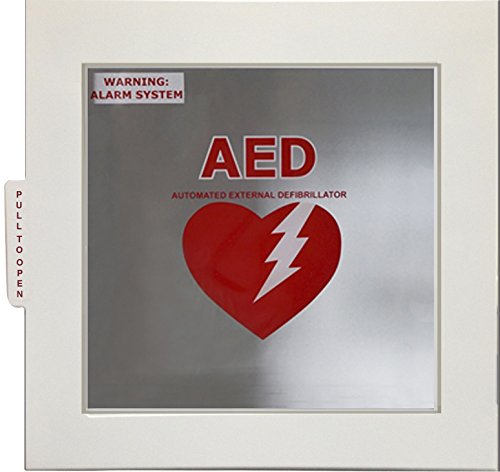
If you have a valuable AED, protecting it from tampering, theft, or accidental damage is paramount. The Activar Alarmed Cabinet provides a robust, universal storage solution with the added security of a built-in local alarm. The alarm serves a dual purpose: it deters unauthorized opening and, in a genuine emergency, its sound can help draw attention to the location, signaling that help is needed.
Constructed from 20-gauge steel with a clean white powder-coated finish, this cabinet is built to last in any home environment, from a garage to a hallway. The universal 15″W x 15″H x 7″D dimensions are designed to fit virtually all major AED brands, including the Philips HeartStart, with room to spare. The door features a simple pull-to-open latch for rapid access when seconds count.
User reviews highlight its straightforward installation and solid construction. The inclusion of an on/off switch for the alarm allows you to disable it during routine maintenance or checks without setting it off. This cabinet transforms your AED from a stored device into a secured, yet instantly accessible, emergency station.
Why it’s great
- Alarm adds a layer of security and can attract help in an emergency.
- Sturdy steel construction ensures long-term protection for your AED.
- Universal size reliably fits most home AED units and their cases.
- Simple pull-open mechanism allows for very fast access.
Good to know
- Some users report variability in alarm reliability or installation hardware.
- The alarm requires its own battery maintenance.
3. AdirMed AED Cabinet

For those who prioritize rapid, frictionless access over security alarms, the AdirMed AED Cabinet is an excellent mid-range choice. Its standout feature is the single-handle pull latch that releases a strong magnetic door—you simply pull and go. This design minimizes any fumbling during a high-stress moment, making retrieval of the AED as fast as physically possible.
The cabinet is crafted from quality alloy steel and features a large, clear window. This visibility is crucial; anyone scanning the room can immediately identify the AED’s location and confirm its presence without opening the door. The interior includes a shelf, offering space not just for the AED but potentially for a pair of gloves or a CPR face shield, creating a compact emergency station.
Feedback consistently praises its ease of mounting and clean, professional appearance suitable for a home office or main hallway. It’s a no-fuss, highly functional storage solution that understands its primary job: to make the AED visibly accessible in under three seconds.
Why it’s great
- Magnetic door with pull latch allows for arguably the fastest access.
- Large window provides immediate visual confirmation of the AED inside.
- Solid build quality and clean look suitable for any home area.
- Includes a shelf for storing additional small emergency items.
Good to know
- Lacks an alarm, which some may prefer for tamper deterrence.
- The magnetic seal may be less secure in very high-traffic or public settings.
4. American Red Cross AED Trainer

Familiarity breeds confidence in an emergency. The American Red Cross AED Trainer is a dedicated practice device that allows you and your family to run through realistic scenarios without touching your actual, life-saving AED. It replicates the voice prompts, pad placement, and sequence of a real event, helping to build the muscle memory that can cut seconds off your response time when it truly matters.
This kit is comprehensive, including the trainer unit, adult and child training pads with gel adhesive, a carrying case, and batteries. It features multiple training scenarios, a metronome for proper CPR compression pacing, and the option to switch between English and Spanish voice guidance. The inclusion of a water-resistant branded case makes it easy to store and transport, perfect for taking to a community class or practicing in different areas of the home.
As a tool from a leading first-aid authority, it aligns perfectly with formal CPR/AED training curricula. Practicing with this device demystifies the process, reduces panic, and turns the theoretical knowledge from a manual into a practiced skill.
Why it’s great
- From a trusted name in emergency preparedness training.
- Complete kit with everything needed to start practicing immediately.
- Dual language support and multiple scenarios enhance training value.
- Helps build crucial confidence without using real AED consumables.
Good to know
- Purely for training; cannot and will not deliver a shock.
- The adhesive on training pads can lose stickiness over many uses.
5. WNL Practi-Trainer Essentials
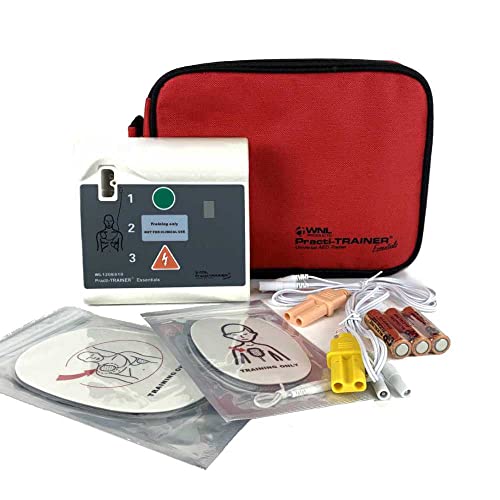
The WNL Practi-Trainer offers exceptional value for individuals or families wanting to practice AED operation without a significant outlay. It provides all the core training functionality—voice prompts, scenario simulation, CPR metronome—in a notably compact and lightweight package. This makes it incredibly easy to store in a drawer and pull out for a quick refresher session.
A major cost-saving feature is its reusable training pads. Unlike single-use gel pads, these are designed to be used over and over, significantly lowering the long-term cost of ownership. The kit is complete with the trainer, adult/child pads, connectors, batteries, and a nylon case. It’s fully compliant with AHA guidelines, ensuring the training you do is relevant and effective.
Instructors and home users alike praise its durability and simplicity. It proves that effective training doesn’t require a bulky, expensive device. For maintaining readiness on a budget, this trainer is a practical and reliable choice that encourages regular practice.
Why it’s great
- Offers core training features at an entry-level point.
- Reusable pads eliminate ongoing consumable costs.
- Very compact and portable for easy storage and practice anywhere.
- Noted for its long-term durability in training environments.
Good to know
- Its small size may feel less realistic compared to a full-size unit.
- Has a more basic, utilitarian feel than some branded trainers.
6. MCR Medical CPR Manikin with UltraTrainer
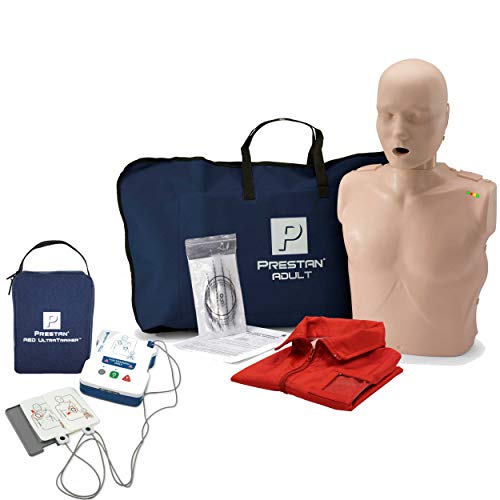
This bundle is for the serious home preparer or community educator who wants to master the full chain of survival: high-quality CPR integrated with AED use. The Prestan Professional Adult Manikin includes a visual feedback system with lights that indicate correct compression depth and rate, providing immediate, objective performance data—a feature usually found in professional training settings.
Paired with the Prestan UltraTrainer AED, this kit creates a holistic training environment. The manikin’s torso is designed to work with the trainer’s pads, which have integrated sensors to detect proper placement. This allows you to practice the entire sequence, from recognizing cardiac arrest and calling for help, to performing effective chest compressions, to operating the AED trainer, all with guided feedback.
While a more significant investment, this bundle represents the highest tier of at-home skill development. It’s the closest you can get to a formal classroom experience, making it ideal for families with a history of heart conditions, community volunteers, or those who simply want the deepest level of preparedness.
Why it’s great
- Manikin feedback transforms CPR practice from guesswork to precision.
- Integrated system (manikin + trainer) simulates a true emergency response.
- Excellent for building muscle memory and teamwork among family members.
- High-quality components are built to withstand repeated training sessions.
Good to know
- The most significant investment in training equipment on this list.
- Requires more storage space for the manikin and accessories.
7. CMXIKJ Stainless Steel AED Cabinet

The CMXIKJ cabinet offers a balance of security and accessibility with its stainless steel construction and snap-lock mechanism. The lock provides a firm closure that prevents the door from swinging open accidentally, yet it’s designed to be released with a firm press, ensuring it won’t be a barrier during an emergency. The stainless steel material is easy to clean and offers a modern, durable look.
Its transparent PC glass window and bold red lettering ensure the cabinet is immediately identifiable as an AED location from across a room. The interior dimensions are well-suited for most home AEDs without their carry cases, presenting the device in a ready-to-grab position. The shelf has a small lip to prevent the AED from sliding out.
Users find it sturdy and straightforward to mount. The snap lock provides a sense of security against casual tampering, more so than a simple magnetic catch, but reviews suggest testing the latch mechanism regularly to ensure it doesn’t stick over time, as smooth operation is critical.
Why it’s great
- Stainless steel construction is durable, modern, and easy to maintain.
- Snap lock offers a good middle ground between security and fast access.
- Clear window and bright labeling provide excellent visibility.
- Universal size fits most AED units securely.
Good to know
- The snap-latch mechanism may require maintenance to prevent sticking.
- Some may prefer a simpler pull-open design for absolute speed.
8. Prestan UltraTrainer (Single)
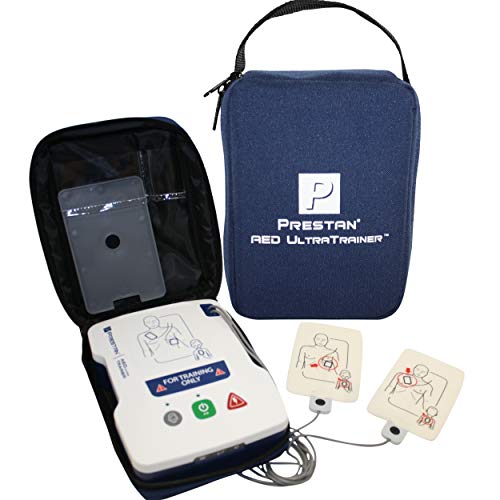
The Prestan UltraTrainer stands out in the training category for its smart design and durability. Its training pads contain integrated switches that detect when they are properly adhered to a manikin’s torso, allowing the training scenario to proceed—a feature that adds a layer of realism and ensures trainees practice correct pad placement. The pads themselves are known for their strong adhesion and reusability.
It’s a favorite among instructors for its portability and robustness. Despite its compact size, it doesn’t feel like a toy; it has a solid build quality and clear audio prompts. It offers five training scenarios and language selection, covering the essential variations a trainee might encounter. Its size makes it exceptionally easy to integrate into a home practice routine or take to a community center.
This trainer emphasizes quality over frills. It does its job—simulating AED operation accurately and reliably—without unnecessary complexity, making it a trusted tool for developing confident, competent responders.
Why it’s great
- Smart pads with placement sensors enhance training accuracy.
- Highly portable and durable, built for frequent use.
- Pads maintain strong adhesion over many uses without leaving residue.
- Solid mid-range option with professional training features.
Good to know
- Smaller than a real AED, which may be less ideal for realism.
- Batteries (C type) are not included.
9. NLShan Wall Mounted AED Cabinet

The NLShan cabinet is a budget-friendly entry into secure AED storage. It provides the core functions you need: a lockable steel enclosure, a clear window for identification, and a universal fit. The snap lock is straightforward, and the cabinet includes pre-drilled holes for relatively simple wall mounting. For the cost, it offers substantial value in protecting your investment.
Its design includes a small window on the door intended to hold a key for emergency access behind a perspex cover. This is a thoughtful feature in theory, though some user reviews note the execution of this key holder can be finicky. The interior space is adequate for most AEDs, though it’s wise to double-check the dimensions against your specific model.
This cabinet is a solid choice if you need basic, secure storage and are comfortable with a simpler locking mechanism. It gets the job done, making your AED visibly accessible while keeping it safe from dust and casual interference.
Why it’s great
- Provides secure, lockable storage at an entry-level point.
- Clear window and red lettering offer good emergency visibility.
- Includes mounting hardware for straightforward installation.
- Steel construction is durable for home use.
Good to know
- The key storage mechanism on the door is noted by some as poorly implemented.
- Fit and finish may be more basic than higher-end cabinets.
10. XFT-120NB AED Trainer
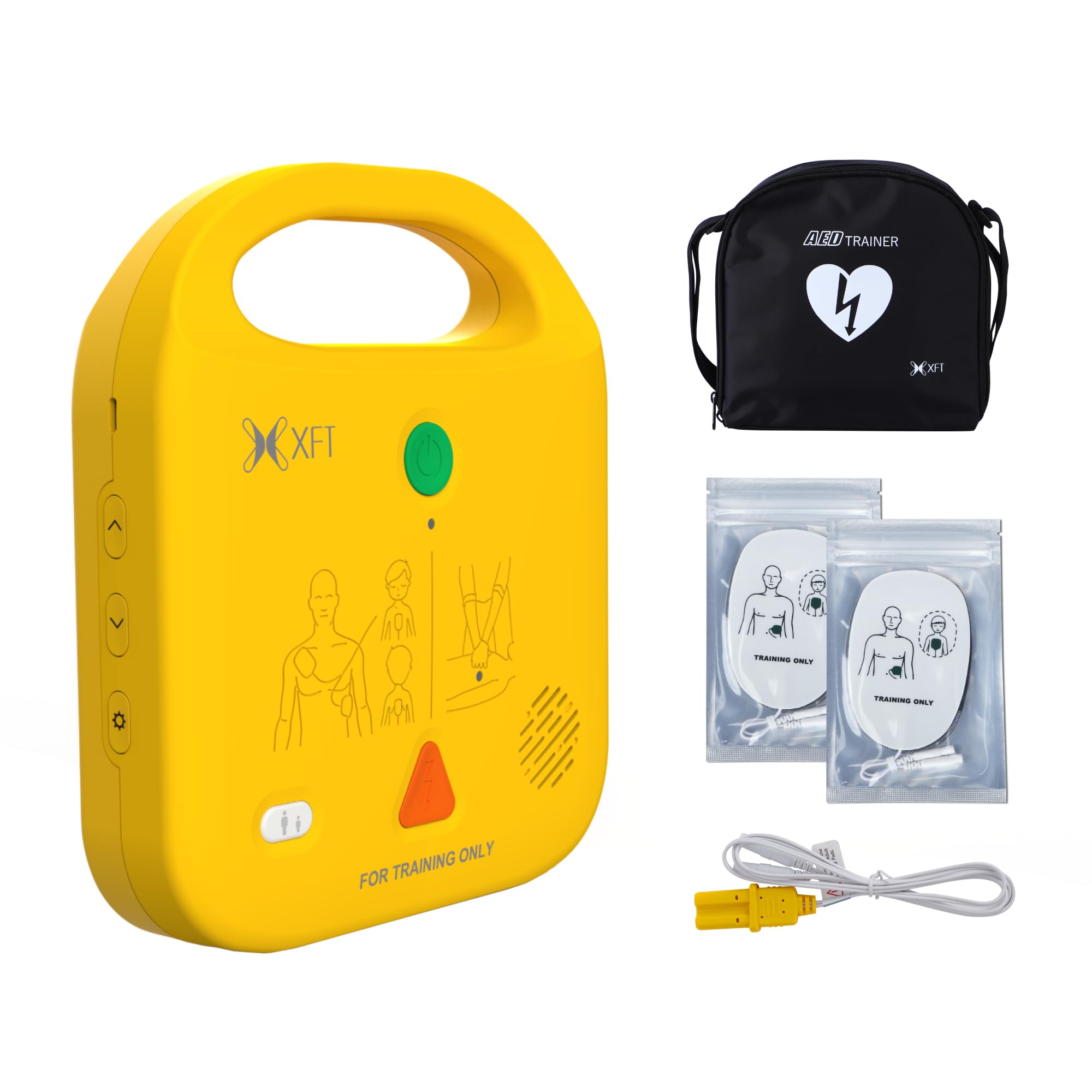
The XFT-120NB trainer distinguishes itself with multilingual voice prompts in English, Italian, French, and Spanish. This makes it an excellent choice for multilingual households, community centers, or training environments where participants may be more comfortable receiving instructions in their primary language. The ability to switch languages helps ensure comprehension, which is vital for effective learning.
It’s an incredibly compact and portable device, almost to a fault—its small size is its greatest asset for transport but can make it feel less substantial during practice. It includes five training scenarios and adjustable CPR compression modes, aligning with the latest AHA and ERC guidelines. The configuration saving function remembers your last settings, streamlining repeated training sessions.
For those who need a highly portable, versatile trainer for a diverse group, this device fills a unique niche. It proves that effective training technology is becoming increasingly accessible and adaptable to different users’ needs.
Why it’s great
- Four language options cater to a wide range of users.
- Extremely compact and lightweight for ultimate portability.
- Saves user settings for convenient repeated practice.
- Includes a storage shoulder bag as part of the kit.
Good to know
- Very small size may beperceived as toy-like by some users.
- Pads are very sticky, which is good for training but may surprise first-time users.
11. SmartSign AED Projecting Sign (2-Pack)
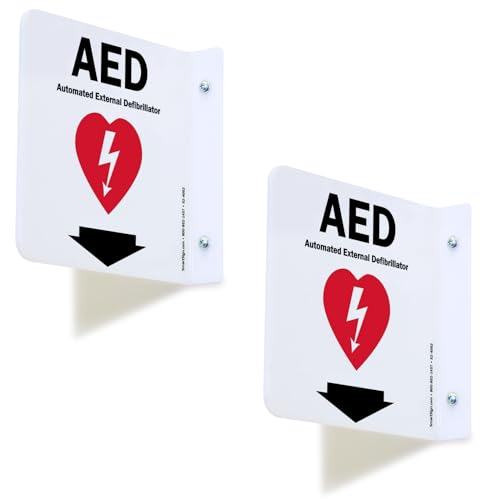
An often-overlooked but critical component of home AED readiness is clear, unambiguous signage. The SmartSign Projecting Sign solves the problem of visibility in hallways or corridors. Mounted on the wall, its L-bend design projects the 6″x6″ sign out into the walking path, making it visible from both directions—something a flat wall sign cannot achieve.
Constructed from thick, high-impact acrylic with baked-on enamel ink, this sign is built to last. It’s notably thicker than many competitors and features polished edges and rounded corners, giving it a professional, office-ready appearance rather than an industrial look. The pack of two is cost-effective, allowing you to mark the location from multiple approach angles or for use in different areas of a larger home.
Installation is flexible, with both high-bond adhesive strips and screws included. This sign performs one job perfectly: ensuring that in a moment of panic, no one wastes precious seconds searching for the AED. It declares the location with authority.
Why it’s great
- Projects from the wall, offering 180-degree visibility in hallways.
- Durable, thick acrylic with professional finish resists damage.
- Pack of two provides excellent value and coverage.
- Easy to install with multiple mounting options included.
Good to know
- Only a sign; does not include an AED, cabinet, or any other equipment.
- Ensuring it’s mounted at the correct height for optimal visibility is important.
Understanding the Specs
Real AED vs. Trainer
This is the most critical distinction. A real Automated External Defibrillator is a FDA-cleared medical device that can analyze a heart rhythm and deliver a therapeutic shock. It uses consumable battery packs and electrode pads that expire. A Training AED is a simulator that provides voice and visual prompts but contains no high-voltage components and cannot shock. It is for practice only. For home readiness, you need a real AED.
Voice Prompt & Guidance
In an emergency, clear instructions are paramount. Look for devices with calm, step-by-step audio prompts that guide you through pad placement, standing clear, and delivering compressions. Some advanced models offer real-time CPR feedback, coaching you on compression depth and rate. Multilingual options can be valuable in diverse households. The quality of these prompts can significantly reduce user anxiety.
Self-Testing & Maintenance
A reliable AED manages its own readiness. Daily, weekly, and monthly self-tests automatically check the battery charge, pad connectivity, and internal circuitry, providing a visual “OK” status. This eliminates the guesswork and manual calendar reminders. Warranty length on the unit (often 5-8 years) and on consumables indicates expected lifespan and manufacturer support.
Storage & Access Design
Specs for cabinets focus on universal interior dimensions (typically around 15″H x 15″W x 7″D), construction material (steel vs. acrylic), and access mechanism (magnetic door, snap lock, alarmed). The goal is to protect the AED while allowing retrieval in under 10 seconds. Signage is measured by its visibility angle and durability, not just its size.
FAQ
Do I really need an AED at home if I call 911?
Can I accidentally hurt someone with an AED?
What is the difference between an AED cabinet and a sign?
How often do I need to maintain or replace a home AED?
Final Thoughts: The Verdict
For most people, the best aed for home winner is the Philips HeartStart Home AED because it is the only product here that can actually save a life during cardiac arrest, combining medical-grade reliability with unparalleled ease of use. If you want to secure that investment and add a layer of deterrence, grab the Activar Alarmed AED Cabinet. And for building the confidence to use it effectively, nothing beats practicing with the WNL Practi-Trainer Essentials. Together, these components create a complete, responsive safety net that turns hope into actionable readiness.

Mo Maruf
I created WellFizz to bridge the gap between vague wellness advice and actionable solutions. My mission is simple: to decode the research and give you practical tools you can actually use.
Beyond the data, I am a passionate traveler. I believe that stepping away from the screen to explore new environments is essential for mental clarity and physical vitality.