Our readers keep the lights on and my smoothie glass nicely filled. As an Amazon Associate, I earn from qualifying purchases.
Connecting modern HDMI devices to an old coaxial TV system or distributing a single video source to every TV in your home can feel like a technical puzzle. The wrong modulator leaves you with a fuzzy picture, garbled audio, or a device that just won’t work with your setup.
I’m Mohammad Maruf — the founder and writer behind WellFizz. For over 15 years, I’ve specialized in dissecting complex product specifications and analyzing user data to separate the genuinely effective solutions from the marketing hype in the AV equipment space.
This guide is the result of deep market research into over a dozen units, comparing their core technologies, compatibility, and real-world reliability to solve your signal distribution challenges. After analyzing the specs and real-world performance of the top models, we’ve identified the clear winners for every setup and budget in our guide to the best 4k modulator.
How To Choose The Best 4K Modulator
Selecting a modulator isn’t just about plugging in cables. It’s about ensuring the device speaks the right technical language to both your source equipment and your display system. Focusing on these four key areas will prevent compatibility headaches and ensure a stable, viewable signal.
Analog vs. Digital Modulation
This is the most critical distinction. Analog modulators (often labeled for NTSC/PAL) output a signal that old CRT TVs and some older distribution amplifiers can understand directly. They are common in budget and mid-range units. Digital modulators (marked as ATSC or QAM) output a modern digital broadcast signal, identical to what you receive from a TV antenna. This is required for modern HDTVs to tune in the channel without an external converter box and provides superior picture quality. For future-proofing a home network, digital is the superior choice.
Input Connectivity
What are you trying to connect? Most modulators offer an HDMI input for modern sources like streaming sticks, game consoles, and Blu-ray players. Some also include RCA composite AV inputs (the yellow, white, and red cables), which are useful for older devices like VCRs or classic game consoles. A rare few have an RF input pass-through, allowing you to combine an existing antenna or cable signal with your new source. Match the inputs to your devices.
Output Format & Channel Flexibility
Your TV and region dictate the required output. In North America, you need NTSC format and often VHF channels like 3 or 4. Elsewhere, PAL is standard. Premium modulators let you select any open UHF/VHF channel, which is vital for avoiding interference in a multi-channel home distribution system. A simple fixed-channel unit is fine for one TV; whole-home setups need channel agility.
Build Quality & Control
Entry-level units are often lightweight plastic with minimal controls. Mid-range and premium models typically feature sturdier metal casings, internal cooling, and physical controls or web interfaces for fine-tuning output power, audio levels, and picture settings. For permanent installations, robust build quality and granular control are worth the investment for long-term reliability.
Quick Comparison
On smaller screens, swipe sideways to see the full table.
| Model | Type | Best For | Key Feature | Amazon |
|---|---|---|---|---|
| SatLink ST-7000 | Digital ATSC/QAM | Whole-home HD distribution | Professional-grade digital encoding | Amazon |
| Thor Broadcast Modulator | Digital ATSC/QAM | Advanced users & custom networks | Ethernet web GUI for configuration | Amazon |
| MINIMOD 2 Vecoax | Digital ATSC/QAM | RV & compact installations | Color display, simple channel naming | Amazon |
| VQP HDM61 Modulator | Analog NTSC | Reliable single-TV setup | Plug-and-play simplicity, strong reviews | Amazon |
| Heayzoki HD Modulator | Analog NTSC | Basic RCA-to-RF conversion | Entry-level budget option | Amazon |
| Dilwe HDMI RF Modulator | Analog NTSC/PAL | International format support | Dual NTSC/PAL output | Amazon |
| Bewinner HDMI RF Modulator | Analog NTSC | Connecting to vintage TVs | Wide compatibility list | Amazon |
| AoeSpy Modulator w/ Remote | Analog NTSC | Adjustable picture settings | Includes remote for fine-tuning | Amazon |
| AoeSpy Modulator w/ Switch | Analog NTSC/PAL | Multi-channel home systems | 136-channel selector, RF input | Amazon |
| ADRFClub HDMI/RCA Modulator | Analog NTSC/PAL | Flexible input options | HDMI & RCA inputs, channel switch | Amazon |
| Tangxi HDMI Modulator | Analog NTSC/PAL | Users needing level adjustments | Manual RF/Video/Audio level pots | Amazon |
In‑Depth Reviews
1. SatLink ST-7000 HDMI to RF Digital Modulator

The SatLink ST-7000 stands apart as a professional-grade digital modulator, moving beyond the analog limitations of most units in its class. It encodes your 1080p HDMI source into a crystal-clear ATSC or QAM digital signal, which any modern HDTV can tune in directly without any quality loss to static or snow. This makes it the ideal foundation for a serious whole-home video distribution network.
Setup involves connecting to your network and accessing a straightforward web interface to configure the output channel, modulation type, and signal strength. Users report excellent picture quality that rivals direct HDMI connections when the downstream signal is properly balanced with amplifiers. It’s designed for permanent installation, with a solid metal chassis that promotes stable, long-term operation.
While it represents a significant step up from entry-level options, its performance justifies the investment for distributing security camera feeds, satellite receivers, or media players to multiple TVs over existing coax. The ability to output a true HD digital broadcast is a game-changer for clean, reliable whole-house coverage.
Why it’s great
- Broadcasts a pristine digital ATSC/QAM signal compatible with all HDTVs.
- Professional web-based configuration allows precise control over output.
- Robust metal construction ensures reliability for 24/7 operation.
- Ideal for injecting a channel into existing cable or antenna distribution systems.
Good to know
- Requires basic network knowledge for initial IP configuration.
- Signal output power must be balanced with other sources to avoid interference.
- Does not correct for overscan, which may crop edges on some TV displays.
2. Thor Broadcast HDMI to Coax Modulator
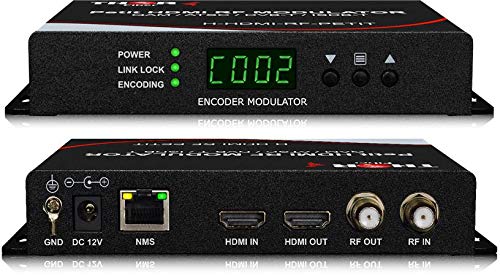
The Thor Broadcast modulator is a compact, feature-packed digital encoder designed for integrators and advanced users who demand maximum control. It performs the same core function as the SatLink—converting HDMI to ATSC or QAM—but adds a more granular proprietary desktop GUI for configuration, appealing to those who want to fine-tune every parameter of their RF output.
This unit excels in custom installations, such as in motorhomes or dedicated home theaters, where you need to lock down specific settings. Users leveraging it for security camera distribution or whole-home Roku sharing praise its excellent picture quality and stable operation. The Ethernet management port is a key feature, allowing for remote adjustments without physically accessing the device.
It’s important to note that initial setup requires connecting it to a PC, which can be a hurdle for non-technical users. However, for those who navigate this step, the reward is a highly reliable and configurable digital modulator that stands up to continuous use in demanding environments.
Why it’s great
- Extensive configuration options via Windows/Mac software or web GUI.
- Produces a very clean, low-latency HD digital signal.
- Compact form factor is easy to install in tight spaces or racks.
- Strong performance for distributing streaming devices or camera feeds.
Good to know
- Initial setup is more involved, requiring a direct PC connection.
- Some units may have firmware or hardware issues; check reviews closely.
- The included documentation can be sparse for troubleshooting.
3. MINIMOD 2 Vecoax HDMI to Coax Modulator

The MINIMOD 2 takes a user-friendly approach to digital modulation with its integrated color display and front-panel controls. This allows you to set the output channel number and even name the channel directly on the device, a unique feature that simplifies setup without needing a computer. It’s a favorite for RV and marine installations where space is at a premium and simplicity is valued.
It outputs a full 1080p ATSC signal that can be combined with existing antenna feeds, letting you watch both local broadcasts and your injected source on all TVs. The build quality feels substantial, and users report a major picture quality improvement over older analog modulators, especially when feeding modern HDTVs.
While the video quality is excellent for a modulated signal, purists should note it involves re-encoding the HDMI feed, which can introduce minor compression artifacts not present in a direct connection. For practical whole-home distribution, however, its combination of ease of use, compact size, and digital performance is hard to beat.
Why it’s great
- Convenient front-panel display and controls eliminate PC configuration.
- Allows custom naming of the output channel for easy identification.
- Solid digital performance in a compact, well-built enclosure.
- Excellent for integrating a single source into RV or home coax networks.
Good to know
- As a digital re-encoder, it may introduce slight latency and compression.
- Balancing its output with strong OTA antenna signals may require attenuation.
- Premium price point for a single-channel modulator.
4. VQP HDM61 HDMI to RF Modulator
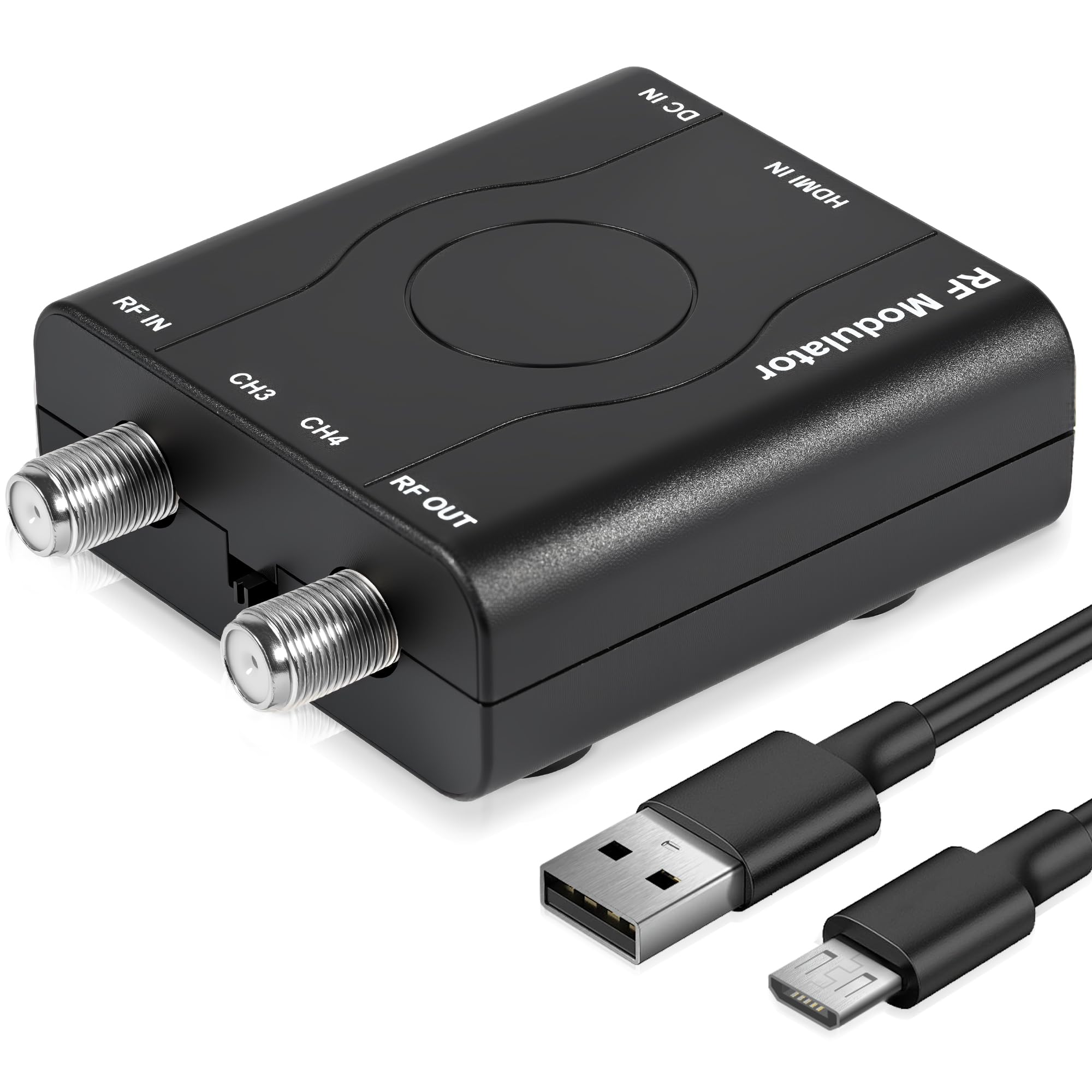
For a straightforward, reliable analog solution, the VQP HDM61 consistently earns top marks from users. This mid-range modulator excels at its primary job: converting an HDMI signal to a stable NTSC analog signal on channel 3 or 4 for an older TV. Its plug-and-play operation is a major highlight—many report connecting a Roku or Fire Stick and having it work perfectly within minutes.
The build quality feels more durable than the budget options, and it supports a good range of input resolutions up to 1080p. It’s the ideal choice for a single-room setup, like adding streaming capability to a garage workshop TV, a vintage CRT, or a kitchen television without HDMI ports. The consistency of positive feedback around ease of use sets it apart in the analog category.
Remember, as an analog modulator, the output will be standard definition (480i) quality, and text on screen may be fuzzy. But for watching video content on an older display, it provides a remarkably hassle-free and effective experience that justifies its position as our top value pick.
Why it’s great
- Extremely simple setup with consistent plug-and-play performance.
- Wide compatibility with streaming devices, game consoles, and laptops.
- Sturdy construction and reliable operation for an analog unit.
- Perfect for reviving a single old TV with modern content.
Good to know
- Analog output limits picture quality and readability of small text.
- Fixed to channels 3 or 4, offering no flexibility for multi-setup homes.
- Does not include a power adapter in the box (USB micro-B power).
5. Heayzoki High Definition HD Modulator

The Heayzoki unit is an entry-level modulator that fulfills a very specific need: converting RCA composite signals (the yellow, white, and red cables) to an RF coaxial signal. It’s important to clarify that despite “HDMI” appearing in its title, the model shipped often lacks an HDMI port entirely, a point of confusion noted in reviews. Where it succeeds is as a cost-effective bridge for devices like old DVD players, VCRs, or classic game consoles to connect to a TV with only a coaxial input.
For those with the correct use case, it performs adequately, providing a stable picture on the selected channel. The plastic construction is lightweight but functional for occasional use. It represents the most accessible point for solving a simple analog signal conversion problem.
This product is a reminder to carefully verify the inputs you actually need. If your source is HDMI, this is not the right choice. But if you have an old RCA-output device and a coax-only TV, this budget-friendly device can provide a working connection.
Why it’s great
- Extremely affordable solution for RCA composite to RF conversion.
- Simple operation with selectable output channels.
- Can be a lifesaver for connecting legacy AV equipment.
Good to know
- Frequently does not include an HDMI input as the listing suggests.
- Plastic build and basic components indicate limited long-term durability.
- Picture and audio quality are basic and can be inconsistent.
6. Dilwe HDMI RF Modulator

The Dilwe modulator offers support for both NTSC and PAL output formats, making it a consideration for users with international equipment or those living in PAL regions. It features a proper HDMI input alongside legacy AV inputs, aiming for broader compatibility than the most basic units.
User experiences with this model are mixed, which is common in this price segment. When it works, it successfully passes a signal from a Chromecast or similar device to an older TV. However, several reports cite poor image quality, garbled audio, or units that fail to function out of the box. Success seems to hinge on carefully following the setup steps and managing expectations for analog output quality.
This unit represents a step up in intended functionality from the Heayzoki, but with a noted variability in performance. It’s an option if you specifically need dual-format support on a tight budget, but be prepared for potential quality control issues.
Why it’s great
- Supports both NTSC and PAL television formats.
- Includes both HDMI and composite AV inputs for flexibility.
- Very affordable for the feature set on paper.
Good to know
- Inconsistent quality and performance across units.
- Many users report subpar picture and audio quality.
- Instructions can be unclear, leading to setup frustration.
7. Bewinner HDMI RF Modulator Adapter
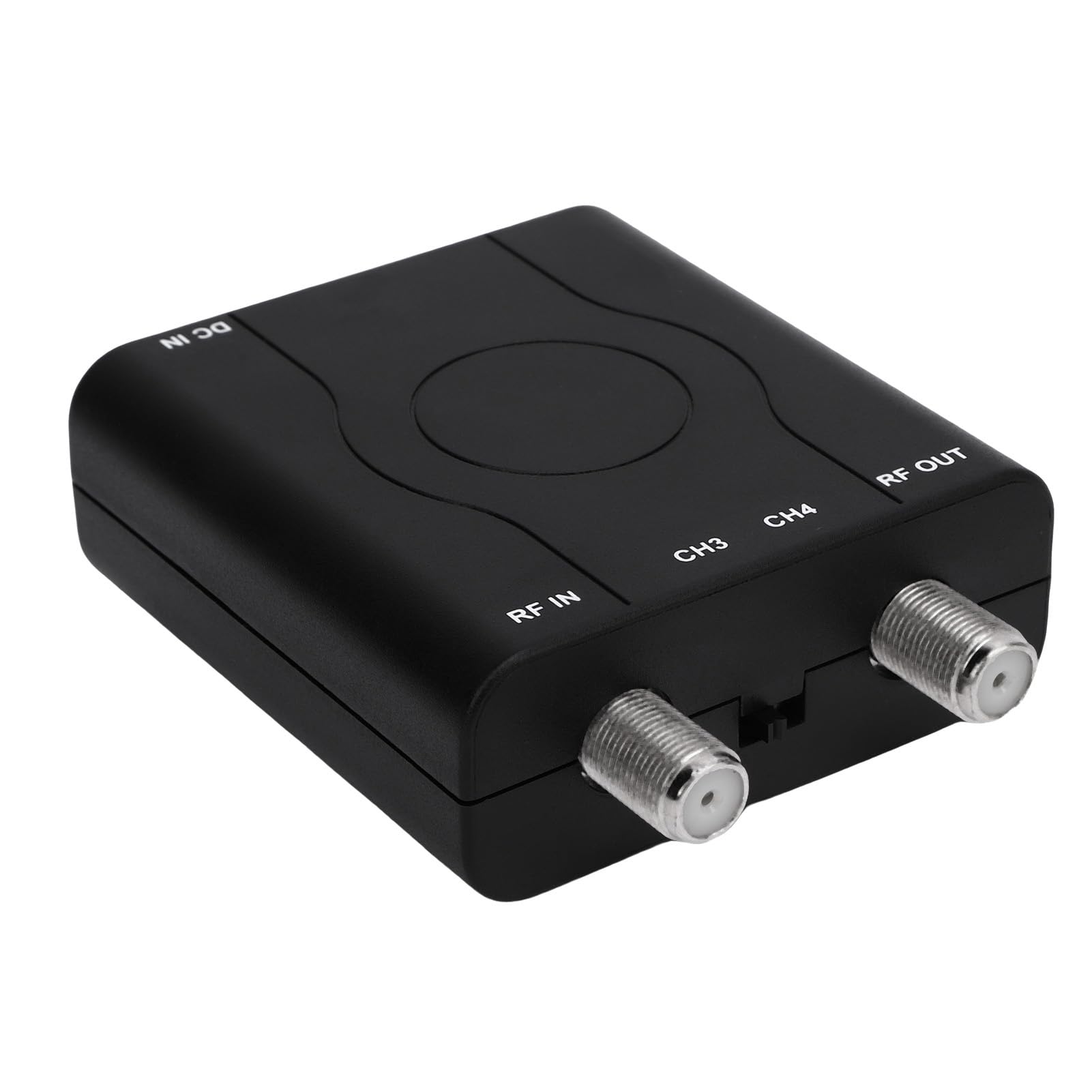
Bewinner’s HDM61 model is another competent analog modulator in the budget-to-mid-range space. It lists broad compatibility with PCs, gaming consoles, and TV boxes, and supports HDCP 1.4, which is necessary for streaming protected content from devices like Roku or Amazon Fire TV. Users have found it effective for connecting streaming sticks to older CRT TVs in RVs or workshops.
The feedback is generally positive, with users noting it works “as advertised” for enabling modern HDMI devices on vintage displays. The picture quality is in line with expectations for an NTSC analog signal—perfectly watchable for video content but not sharp for text. Shipping times from the manufacturer can sometimes be longer than average.
This unit is a reliable alternative to the VQP HDM61, offering similar performance and specs. It’s a solid choice if you find it available at a competitive point, providing a no-frills conversion from digital HDMI to analog RF.
Why it’s great
- Reliable performance for connecting HDMI devices to old TVs.
- Supports HDCP, making it compatible with major streaming devices.
- Clear, stable analog picture when set up correctly.
Good to know
- Analog limitations apply: SD quality and potential for signal noise.
- May ship from overseas, resulting in longer delivery times.
- Like most, it requires a separate USB power adapter.
8. AoeSpy HDMI RF Modulator w/ Remote

This AoeSpy model adds a valuable feature often missing from simpler modulators: a infrared remote control. This remote allows you to adjust brightness, contrast, chroma, and even change the output screen size (zoom), which is incredibly useful for fine-tuning the picture to look its best on a particular older TV. It’s a fixed-channel (CH3) NTSC analog modulator designed for North American sets.
Users who take the time to adjust the settings report much more satisfying results, especially on very old or finicky CRT displays. The ability to tweak theThe ability to tweak the signal for optimal display on a specific vintage set is a significant advantage. However, build quality and longevity are noted concerns, with some units failing after a year or two of moderate use.
Why it’s great
- Included remote allows for on-the-fly picture and audio adjustments.
- Helpful for optimizing the signal for very old or unique CRT TVs.
- Solid performance when working correctly, with good user guides.
Good to know
- Build quality may not support 24/7 operation long-term.
- Analog output quality is still limited to standard definition.
- Setup requires careful attention to select the correct NTSC-M mode.
9. AoeSpy Modulator w/ Channel Switch
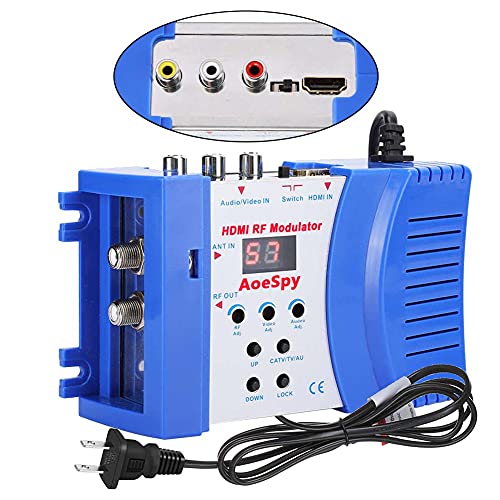
This advanced analog modulator is designed for users who need to inject a signal into a multi-TV home distribution system without interfering with existing channels. Its key feature is a digital channel selector that allows you to choose from a wide range of VHF and UHF channels (reportedly up to 136), not just the standard 3 or 4. It also includes an RF input to pass through an existing antenna or cable signal.
For the technically inclined, this unit offers powerful functionality. Successful users praise its clear output and the flexibility it provides for creating a small-scale analog cable TV system. However, the interface for selecting channels via band and number is not intuitive, and the instructions are often cited as poor. It requires patience and some understanding of broadcast frequencies to configure correctly.
This is not a plug-and-play device for a single TV. It’s a tool for a specific project: building or expanding a modulated analog distribution network where channel flexibility and signal combining are required.
Why it’s great
- Unprecedented channel selection for an analog modulator at this level.
- RF input allows merging with an existing antenna/cable feed.
- Powerful enough to drive a signal to multiple TVs with a distribution amplifier.
Good to know
- Complex, non-intuitive interface with inadequate documentation.
- Channel numbering on some units may be mapped incorrectly.
- Potential for audio interference or signal noise on certain channels.
10. ADRFClub HDMI/RCA to RF Modulator

The ADRFClub modulator is a capable mid-range analog unit that combines the features of several others into one package. It offers both HDMI and RCA inputs, a digital channel display with a selector switch, and support for both NTSC and PAL formats. This makes it a versatile choice for users with multiple source types or those needing to avoid interference by selecting an open channel.
Feedback suggests that when configured properly—which may involve experimenting with channels to find a clear one—it provides a stable and clear analog picture. It’s been used successfully for projects ranging from feeding security camera DVRs to home TVs, to setting up a retro gaming station on a CRT. The build quality is typical for this segment: functional but not overly robust.
Like its sibling AoeSpy model with the channel switch, the setup process can be a hurdle. It’s best suited for users who are comfortable with a bit of trial and error to achieve the desired result.
Why it’s great
- Flexible input options with both HDMI and RCA connectors.
- Digital channel display and selector for finding a clear broadcast frequency.
- Effective for distributing a source to multiple TVs in a home.
Good to know
- Configuration is not straightforward and lacks clear instructions.
- Interface uses technical terms that may confuse casual users.
- Performance can be inconsistent across different units and setups.
11. Tangxi HDMI Modulator RF Modulator
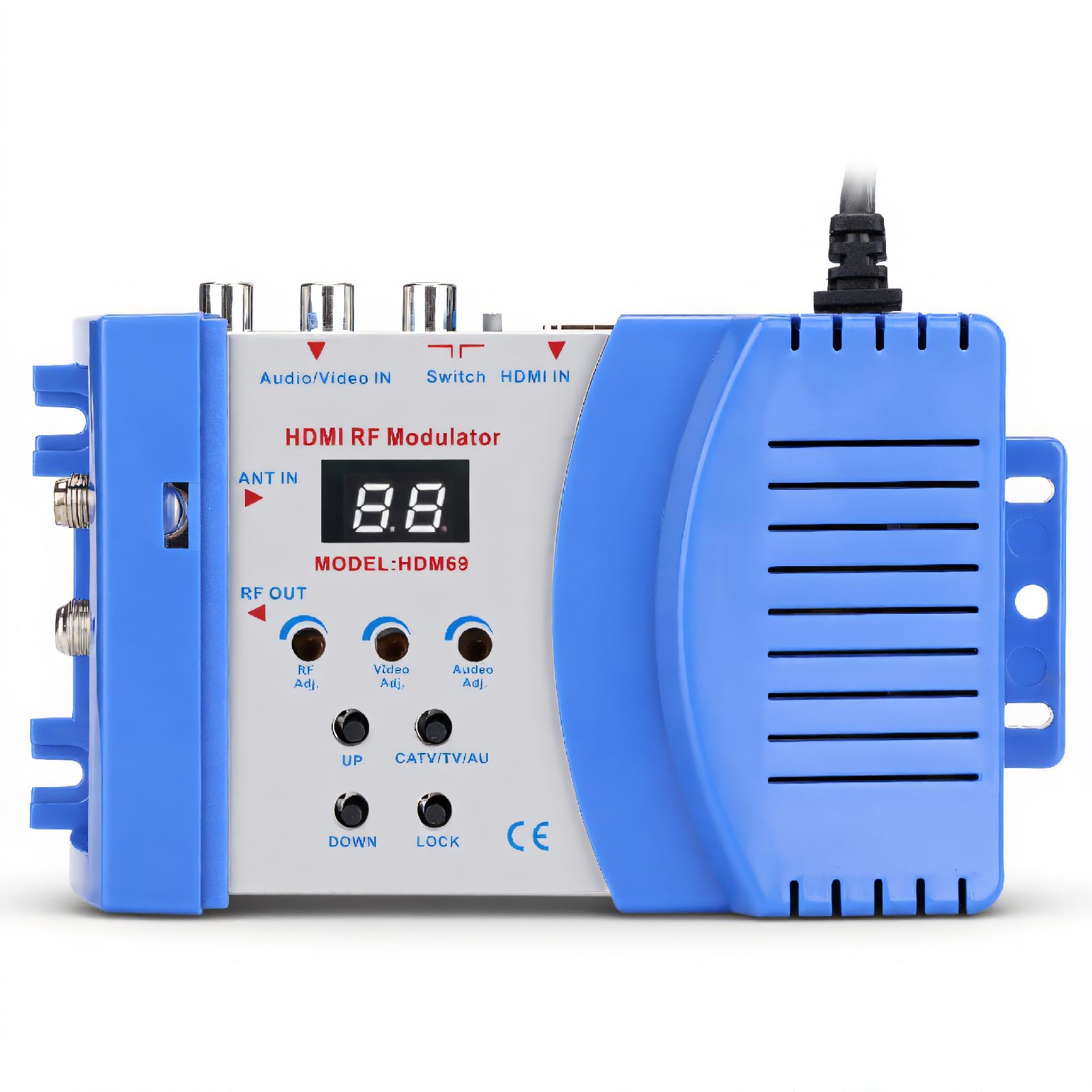
The Tangxi modulator distinguishes itself with manual adjustment pots for RF, Video, and Audio levels, accessible through small holes in the casing. This allows for precise calibration of the output signal to match your distribution system or TV, a feature typically found in more professional analog units. Its build uses a combination of ABS plastic and metal, giving it a sturdier feel than all-plastic competitors.
It supports both PAL and NTSC formats and can switch between VHF and UHF output frequencies. For users who understand how to adjust these levels—often with the aid of a TV or signal meter—it can produce a very clean analog signal. It retains its settings after a power loss, which is convenient.
The major drawback, as with many analog modulators, is its handling of aspect ratio. It does not automatically convert a 16:9 HDMI signal to a proper 4:3 output for older CRT TVs, resulting in a horizontally squished image. This limits its utility for modern widescreen content on vintage displays.
Why it’s great
- Manual adjustment pots allow for fine-tuning of output signal levels.
- Sturdier hybrid construction and stable performance.
- Remembers settings after being powered off.
Good to know
- Does not correct aspect ratio from 16:9 to 4:3 for CRT TVs.
- Adjustment pots require a small screwdriver and some technical knowledge.
- Some units may be shipped in PAL-only mode despite NTSC labeling.
Understanding the Specs
Modulation Type: ATSC/QAM vs. NTSC/PAL
This is the core technology. ATSC and QAM are digital broadcast standards. An ATSC/QAM modulator outputs a signal that modern digital TVs recognize as a regular HD channel, offering the best possible picture quality over coax. NTSC and PAL are older analog standards. Modulators using these output a signal that old CRT TVs understand directly, but any modern HDTV will need to tune it in via its analog tuner (often labeled “Antenna” or “Air”), and the picture will be standard definition.
Channel Agility & Frequency Range
Channel Agility refers to the ability to select your output channel. Basic modulators are fixed to channels 3/4 (VHF). Advanced units let you select any unused VHF or UHF channel, which is critical for multi-channel distribution to avoid interference. Frequency Range (VHF: 54-216 MHz, UHF: 470-890 MHz) determines where your signal lives. UHF channels are often clearer for distribution as they are less crowded in home environments.
Input Types & HDCP Support
HDMI Input is essential for modern sources. Ensure it supports the HDMI version (e.g., 1.4) and HDCP (High-bandwidth Digital Content Protection) compliance required by streaming devices and Blu-ray players. RCA Composite Input is useful for legacy devices. An RF Input (sometimes labeled “RF IN”) allows you to merge an existing antenna or cable feed with your new modulated channel.
Output Level & Adjustability
Output Level, measured in dBµV, is the signal strength. For a single TV, 60-75 dBµV is often sufficient. For distribution to many TVs, you may need 85-100 dBµV and an external amplifier. Adjustability via pots, a remote, or software allows you to balance this level to prevent overpowering other signals (causing interference) or being too weak (causing snow or break-up).
FAQ
Can a 4K modulator send a true 4K signal over coaxial cable?
Why is the picture from my modulator fuzzy or has lines?
What is the difference between an RF modulator and an HDMI converter?
Do I need a special coax cable or splitter for a modulator?
Final Thoughts: The Verdict
For most people, the best 4k modulator winner is the SatLink ST-7000 because it delivers future-proof, crystal-clear digital ATSC quality to all your HDTVs over existing coax. If you want maximum configuration control for a custom setup, grab the Thor Broadcast Modulator. And for a simple, reliable connection to a single older TV, nothing beats the plug-and-play ease of the VQP HDM61 Modulator.

Mo Maruf
I created WellFizz to bridge the gap between vague wellness advice and actionable solutions. My mission is simple: to decode the research and give you practical tools you can actually use.
Beyond the data, I am a passionate traveler. I believe that stepping away from the screen to explore new environments is essential for mental clarity and physical vitality.