Our readers keep the lights on and my smoothie glass nicely filled. As an Amazon Associate, I earn from qualifying purchases.
When a sudden cardiac arrest strikes, the presence of an Automated External Defibrillator (AED) can mean the difference between life and death. This guide cuts through the confusion to help you secure the right device, whether for a home, a bustling office, or a public venue.
I’m Mohammad Maruf — the founder and writer behind WellFizz. My expertise lies in deep market research, where I analyze specifications, performance data, and long-term reliability reports for critical health and safety equipment.
Navigating the world of defibrillators involves more than just picking a box; it’s about matching technology to need. Our deep-dive analysis of specifications and real-world use reveals the best aed defibrillator options for ensuring readiness in home, workplace, and public safety settings.
How To Choose The Best Aed Defibrillator
Selecting an AED isn’t a one-size-fits-all decision. Your choice hinges on whether you need a device for actual emergency response or for training purposes, the environment it will live in, and the features that ensure reliability when it matters most.
Real AED vs. Trainer: Know Your Goal
A genuine Automated External Defibrillator is a medical device designed to deliver a life-saving shock. An AED Trainer is a simulation tool for CPR and AED education; it cannot administer a shock. If you’re equipping a space for actual emergencies, only a real AED will do. Trainers are essential for education but are not a substitute.
Environment and Intended Use
Consider where the device will be deployed. A home AED prioritizes simplicity and long-term reliability with minimal maintenance. For offices, schools, or gyms, a device with robust daily self-tests and clear voice prompts is key. Public spaces demand highly visible storage, often with alarmed cabinets to prevent theft and signal use.
Key Operational Features
Look for clear, step-by-step voice instructions that guide even untrained users. Daily, weekly, and monthly automated self-tests are non-negotiable for ensuring readiness. Also, check pad compatibility—some models use long-life pads that expire in years, not months, reducing replacement costs.
Storage and Accessories
The fastest AED is useless if it’s hard to find or access. A durable, wall-mounted cabinet with a clear window protects the device and makes it instantly visible. For high-traffic or unsupervised areas, an alarmed cabinet provides security and alerts others that an emergency is in progress.
Quick Comparison
On smaller screens, swipe sideways to see the full table.
| Model | Type | Best For | Key Feature | Amazon |
|---|---|---|---|---|
| Philips HeartStart Home AED | Real AED | Home & personal use | SMART Analysis, daily self-test | Amazon |
| AMERICAN HOSPITAL SUPPLY AED Cabinet | Storage Cabinet | Professional settings | Alarmed system, clear window | Amazon |
| Prestan Ultratrainer | AED Trainer | CPR class instruction | Integrated pad sensors, multi-language | Amazon |
| American Red Cross AED Trainer | AED Trainer | Organizational training | Water-resistant case, warranty | Amazon |
| WNL Practi-Trainer Essentials | AED Trainer | Cost-effective training | Reusable pads, AHA compliant | Amazon |
| XFT-120NB AED Trainer | AED Trainer | Multi-language training | 5 scenarios, config saving | Amazon |
| AdirMed AED Cabinet | Storage Cabinet | Quick access locations | Large window, single-pull latch | Amazon |
| CMXIKJ AED Cabinet | Storage Cabinet | General public spaces | Stainless steel, snap lock | Amazon |
| AED Cabinet with Alarm | Storage Cabinet | High-security areas | Loud alarm & strobe light | Amazon |
| NLShan AED Cabinet | Storage Cabinet | Durable, washable storage | Clear window, corrosion-resistant | Amazon |
| SmartSign Projecting Sign |
In‑Depth Reviews
1. Philips HeartStart Home AED Defibrillator

The Philips HeartStart Home AED is the only device in this guide designed for actual life-saving intervention during sudden cardiac arrest. It represents the pinnacle of what a best aed defibrillator should be: reliable, intuitive, and ready when every second counts.
This unit operates with remarkable simplicity, providing clear, step-by-step voice prompts that guide even untrained users through CPR and defibrillation. Its advanced SMART Analysis technology assesses heart rhythm and features a Quick Shock capability, aiming to deliver therapy within seconds. For peace of mind, it performs automatic daily, weekly, and monthly self-tests, with status indicated by a clear LED light.
Included in the slim carry case are pre-installed battery and pads, making it virtually ready to use out of the box. It’s engineered for home environments where ease of use and long-term reliability are paramount, backed by substantial warranties for the device, battery, and pads.
Why it’s great
- Genuine life-saving device with shock delivery capability.
- Extremely user-friendly with clear audio and visual guidance.
- Comprehensive automated self-testing ensures constant readiness.
- Long warranty periods provide significant long-term value.
Good to know
- Voice prompts are in English only, which may be a limitation in multilingual settings.
- The self-test cycle produces audible clicks and a green light, which can be surprising if you’re unaware.
2. AMERICAN HOSPITAL SUPPLY AED Cabinet

For professional settings like offices, clinics, or schools, securing and highlighting your AED is as crucial as having one. This alarmed cabinet from AMERICAN HOSPITAL SUPPLY offers a robust, secure storage solution that also broadcasts when an emergency is underway.
The built-in alarm siren activates when the door is opened, alerting nearby personnel that a rescue is in progress—a feature that can help summon additional help. The clear window allows for immediate visual confirmation of the AED’s presence without needing to open the cabinet, saving precious time.
Constructed from stainless steel, it feels substantial and durable. The wall-mount design includes pre-drilled holes and hardware for straightforward installation on various surfaces. Its universal size accommodates many popular AED brands, making it a versatile choice for institutional preparedness.
Why it’s great
- Audible alarm enhances emergency awareness and security.
- Sturdy, professional-grade construction with a clean white finish.
- Transparent window provides instant visibility of contents.
- Easy to install with included mounting hardware.
Good to know
- Some users note the door closure can be inconsistent, requiring careful installation.
- The alarm is a standard feature; consider if a silent cabinet is preferred for frequent access areas.
3. Prestan Ultratrainer AED
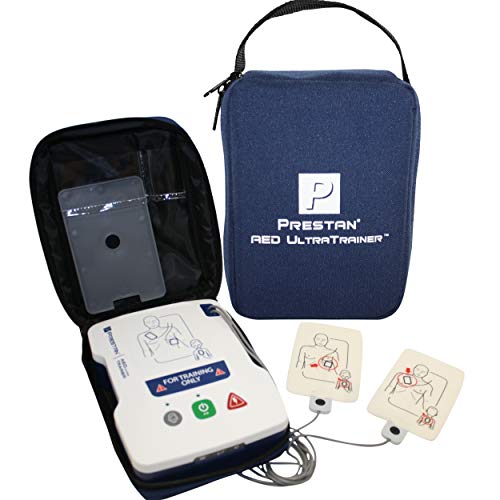
The Prestan Ultratrainer stands out in the training category for its intelligent design and durability. It’s a compact, portable simulator that provides a highly realistic AED training experience without the bulk of older models, making it ideal for instructors on the go.
Its key innovation is the integrated sensor in the training pads that detects proper adhesion to a manikin’s torso, allowing the scenario to proceed realistically. This feature, combined with five pre-programmed scenarios and language options (English and Spanish), creates an engaging training tool.
Instructors appreciate the long pad life, with reports of pads lasting for dozens of training sessions without losing adhesion or leaving residue. The device is built to withstand the rigors of classroom use, offering excellent value for frequent training programs.
Why it’s great
- Smart pad sensors enhance training realism and feedback.
- Exceptionally portable and lightweight for easy transport.
- Pads are durable and reusable many times over.
- Voice prompts and metronome support current AHA guidelines.
Good to know
- Requires C batteries, which are not included.
- The pad sensor placement can sometimes be finicky on certain manikin models, like infants.
4. American Red Cross AED Trainer

As a trusted name in first aid training, the American Red Cross AED Trainer delivers a solid, no-frills simulation experience at a mid-range point. It comes as a complete kit, ready for use in classrooms or organizational training sessions.
This trainer includes features essential for effective learning: a metronome for compression pacing, five scenario buttons, and the choice between automatic and semi-automatic modes. The bilingual capability (English and Spanish) makes it versatile for diverse groups.
The package is notable for including a water-resistant nylon carrying case, batteries, and gel-adhesive training pads. The two-year warranty adds a layer of confidence, though some users note that the adhesive on the pads may diminish with extensive use.
Why it’s great
- Complete, ready-to-use kit from a reputable organization.
- Bilingual voice prompts expand training accessibility.
- Includes a protective carrying case for storage and transport.
- Backed by a two-year manufacturer’s warranty.
Good to know
- Pad adhesive may wear out after repeated use, requiring replacement.
- Some users have reported issues with long-term durability of the voice module.
5. WNL Practi-Trainer Essentials AED
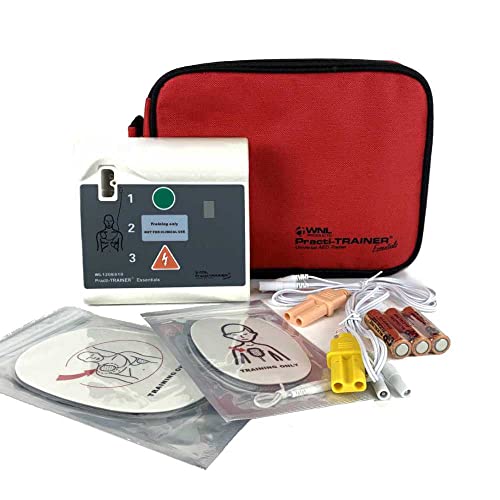
The WNL Practi-Trainer is a workhorse in the training world, known for its cost-effectiveness and durability. It strikes an excellent balance between functionality and long-term value, making it a favorite for CPR instructors who run frequent classes.
This trainer comes with reusable adult and child training pads, which are notably sticky and can withstand many sessions before needing replacement. The voice prompts guide users through simulated rescues, and the metronome helps maintain proper compression rhythm, fully complying with AHA guidelines.
Its compact size and lightweight design, coupled with a included nylon carrying case, make it highly portable. Users report that the units are reliable over years of use, with the initial set of AA batteries lasting an impressively long time.
Why it’s great
- Exceptional durability and longevity for frequent training use.
- Reusable pads reduce ongoing consumable costs.
- Very portable and easy to integrate into any training setup.
- Proven track record with instructors over many years.
Good to know
- The design is basic and less realistic compared to some newer models.
- Graphics on pads may wear off over extensive use, though functionality remains.
6. XFT-120NB AED Trainer
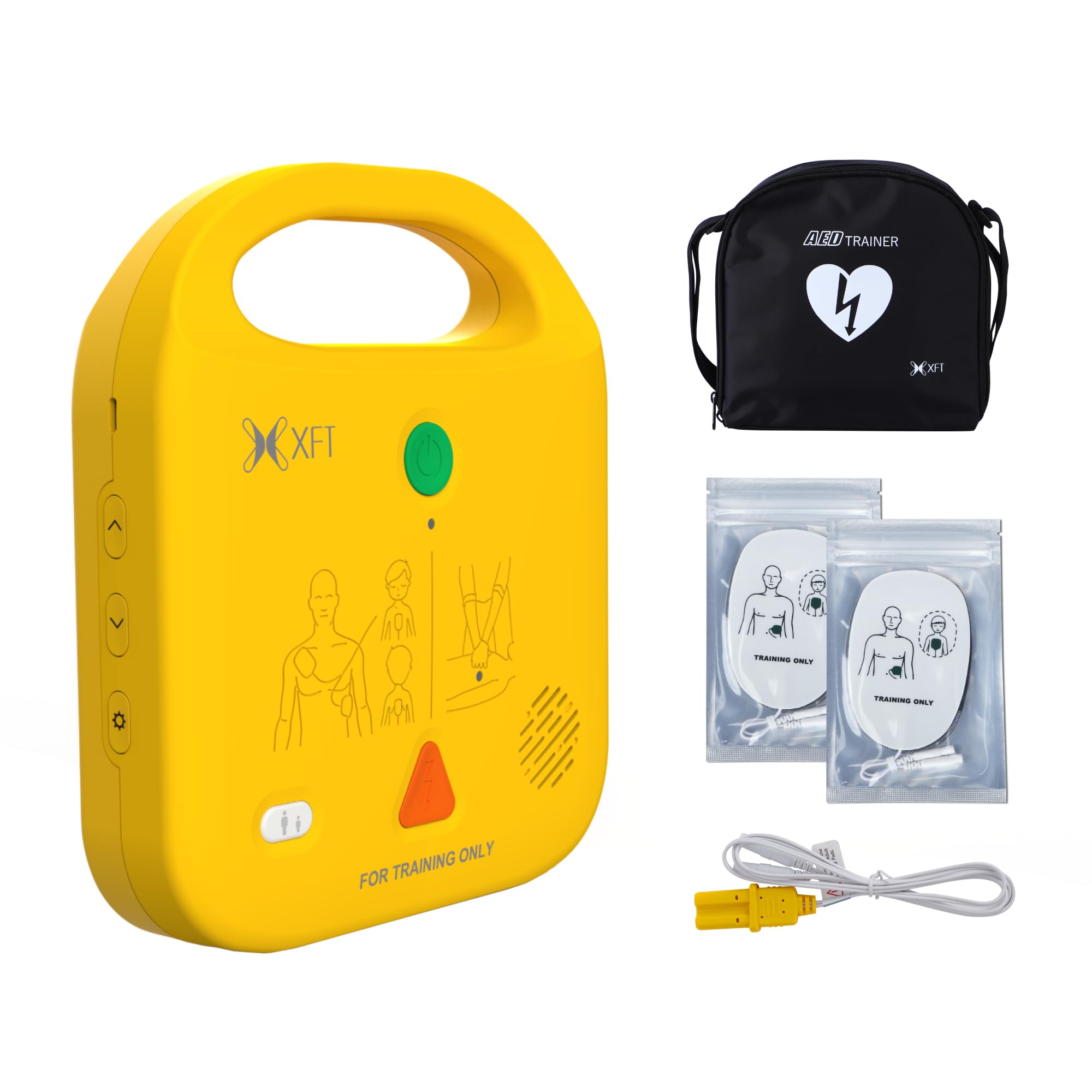
This compact AED trainer packs a surprising number of features into a small footprint, including voice prompts in four languages: English, Italian, French, and Spanish. It’s designed for comprehensive training sessions that require flexibility and scenario variety.
A standout feature is its configuration saving function, which remembers the last selected training mode—such as CPR compression ratio or scenario—for the next use, streamlining back-to-back training sessions. It offers five basic modes and five simulated emergency scenarios.
While its small size might seem toy-like to some, it performs all the essential functions of a larger trainer. The included pads are reported to be extremely adhesive, and the complete kit comes with a storage shoulder bag for easy transport.
Why it’s great
- Four-language support is ideal for multicultural training environments.
- Configuration memory saves time during repeated training setups.
- Includes a variety of realistic scenarios for different training needs.
- Highly portable and comes with a convenient carrying bag.
Good to know
- The very small size may not match the realism of full-sized AEDs for some trainees.
- As a training-only device, it cannot deliver a shock.
7. AdirMed AED Cabinet

The AdirMed cabinet offers a simple, effective storage solution for environments where an alarm might be unnecessary or undesirable, such as in controlled access areas or for monthly checks where a siren would be a nuisance.
Its design focuses on rapid access: a single handle pull latch opens the door smoothly, and a large clear window makes the AED inside instantly visible. The universal size fits most common AED brands, and the steel construction provides solid protection.
This cabinet is easy to wall-mount in a central location, ensuring the defibrillator is both protected and highly accessible. The lack of an alarm makes it a quiet, reliable option for offices, churches, or community centers where security is less of a concern.
Why it’s great
- Silent operation is perfect for locations where false alarms are problematic.
- Large window and easy-open latch prioritize speed in an emergency.
- Sturdy steel build offers good protection without complexity.
- Spacious interior can often accommodate additional items like a first aid kit.
Good to know
- No alarm means less theft deterrence in unsecured public areas.
- Some users note the plexiglass window can be prone to minor scratches.
8. CMXIKJ AED Storage Cabinet

This stainless steel cabinet from CMXIKJ provides a secure, lockable storage option with a clean, modern appearance. The snap lock mechanism offers a balance between security and easy access, requiring a firm press to open.
The cabinet features a transparent PC glass window and bold red “AED” lettering for high visibility. Its industrial-grade steel construction is designed to be durable and easy to clean, suitable for various public places like hotels, restaurants, or offices.
Installation is straightforward with pre-drilled holes in the back. The interior space is sufficient for most AED units and sometimes extra supplies. However, some users have reported that the latch mechanism may require maintenance over time to ensure reliable operation.
Why it’s great
- Robust stainless steel build with a professional look.
- Snap lock provides basic security without needing a key.
- Highly visible design with clear labeling.
- Easy to mount with included hardware.
Good to know
- The latch can potentially stick or fail after prolonged use, which is critical for emergency access.
- Acrylic window instead of glass may be less scratch-resistant.
9. AED Cabinet with Alarm & Light

This cabinet prioritizes security and emergency notification with a combined audible alarm and visual strobe light. When the door is opened, it emits a loud siren (85-120 dBA) and flashes, making it ideal for high-traffic or unsupervised areas.
The alarm serves a dual purpose: it deters theft or tampering, and it signals to everyone in the vicinity that an AED is being accessed, potentially drawing more help to the scene. The steel body is corrosion-resistant and built to withstand years of use.
With dimensions that fit all listed AED brands, it offers versatile application. The alarm system includes a low-battery chirp to ensure it remains functional. Installation is simple, and the cabinet provides a reliable, secure home for your critical equipment.
Why it’s great
- Combined audible and visual alarm maximizes emergency awareness.
- Acts as a theft deterrent while keeping the AED accessible.
- Sturdy, easy-to-clean steel construction.
- Universal fit accommodates a wide range of defibrillator models.
Good to know
- The alarm is always active when opened, which could be disruptive in non-emergency checks.
- Requires monitoring of the alarm’s own battery to maintain function.
10. NLShan AED Cabinet

The NLShan cabinet emphasizes durability and clear identification. Made from high-quality, corrosion-resistant alloy steel, it’s built to last in various environments, from humid indoor pools to dusty warehouses.
A large transparent window and prominent red “AED” icon make the cabinet instantly recognizable on a wall, which is crucial during a high-stress emergency. The snap lock allows for easy opening when needed, and the handle provides a solid grip.
This model is available with or without an alarm device, giving you flexibility based on your security needs. Its universal size fits all major AED brands, and the washable surface makes maintenance simple.
Why it’s great
- Excellent corrosion resistance for long-term durability in harsh conditions.
- Highly visible design ensures quick location of the AED.
- Option to choose between alarmed and non-alarmed versions.
- Easy to clean and maintain.
Good to know
- Like many cabinets, the latch mechanism is a potential point of wear over time.
- Some versions may have “alarmed” text on the front even if no alarm is installed, which could cause confusion.
11. SmartSign AED Projecting Sign
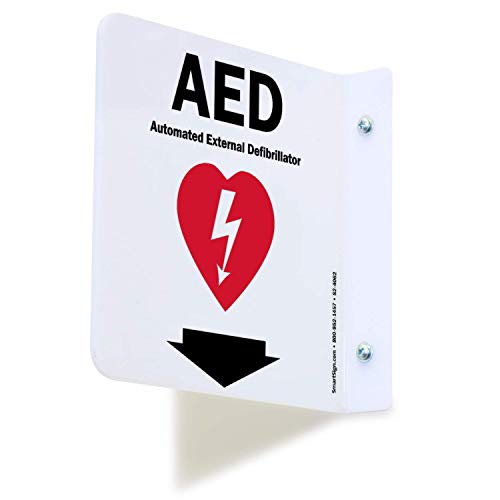
An often-overlooked but critical component of AED readiness is clear signage. This projecting sign from SmartSign ensures that your defibrillator’s location is unmistakable from multiple angles, reducing crucial seconds in a search during an emergency.
Made from thick, durable acrylic with the message directly printed on the material, it’s built to withstand abuse and remain legible for years. The projecting design makes it visible from both directions in a hallway, improving wayfinding.
Installation is straightforward with pre-drilled holes and included screws and adhesive tape. It’s suitable for both indoor and outdoor use, making it a versatile tool for marking AED locations in any facility.
Why it’s great
- Enhances visibility and speeds up location of AED equipment.
- Durable construction holds up in various environments.
- Simple installation with multiple mounting options.
- Universal symbol and text ensure clear communication.
Good to know
- This is a sign only; it does not store or protect an AED.
- Lightweight material may feel less substantial than metal signs.
Understanding the Specs
Real AED vs. Trainer
A genuine Automated External Defibrillator (AED) is a regulated medical device capable of analyzing heart rhythm and delivering a life-saving shock. An AED Trainer is a simulation tool used for education; it mimics the voice prompts and procedures but cannot deliver a shock. Always verify the product type before purchase to ensure it meets your needs for actual emergency response or for training only.
Self-Testing & Maintenance
A critical feature of a real AED is automated self-testing. Look for devices that perform daily, weekly, and monthly checks of battery, circuitry, and pads. Astatus indicator (usually an LED) will show green if all systems are go, providing constant peace of mind. For trainers, look for durable, reusable pads to minimize ongoing costs.
Voice Guidance & Pad Technology
Voice prompts are the primary interface during an emergency. The best devices offer clear, calm, step-by-step instructions in the necessary languages. For pads, focus on shelf life and compatibility. Real AED pads have expiration dates (often 2-5 years) and are model-specific. Training pads use adhesive gel and are designed for repeated use on manikins; their longevity and residue-free removal are key factors.
FAQ
What is the main difference between a real AED and an AED trainer?
Do I need training to use an AED?
How do I maintain an AED to ensure it’s ready?
Final Thoughts: The Verdict
For most people seeking genuine emergency preparedness, the best aed defibrillator winner is the Philips HeartStart Home AED because it delivers proven, life-saving technology with unmatched ease of use and automated reliability. If you want the most secure and professional storage to protect your investment and signal an emergency, grab the AMERICAN HOSPITAL SUPPLY AED Cabinet. And for effective, durable, and portable CPR certification training, nothing beats the Prestan Ultratrainer for its smart features and instructor-friendly design.

Mo Maruf
I created WellFizz to bridge the gap between vague wellness advice and actionable solutions. My mission is simple: to decode the research and give you practical tools you can actually use.
Beyond the data, I am a passionate traveler. I believe that stepping away from the screen to explore new environments is essential for mental clarity and physical vitality.