Our readers keep the lights on and my smoothie glass nicely filled. As an Amazon Associate, I earn from qualifying purchases.
Buying a “3‑in‑1” car seat sounds simple… until you realize you’re not buying a product—you’re buying your daily routine for the next several years. Buckling at daycare drop‑off. Tight parking lots. Snack explosions. Road trips. A toddler who suddenly hates the harness. A big kid who slumps in booster mode. And that one day you have to move the seat into grandma’s car with groceries in your arms.
If you’re shopping for top rated 3 in 1 car seats, you’re doing the right thing. A true 3‑in‑1 can be the “buy once, breathe later” move— but only if you pick a model that works with your car, your kid, and your patience level. This guide is built to prevent the two most common outcomes:
- The “we loved it… for six months” seat: Great early on, then the harness becomes annoying, cleaning becomes a nightmare, and booster mode doesn’t sit right.
- The “features on the box, friction in real life” seat: Looks amazing online, but the install is fussy, it eats back‑seat space, or it’s so heavy you avoid moving it.
I’m not going to waste your time with fluff. I’m going to walk you through the exact friction points that show up repeatedly across owner feedback and real‑world use: how a seat behaves in tight back seats, whether the harness adjusts smoothly without uninstalling, what cleaning feels like after a vomit incident, how cup holders impact three‑across installs, and whether booster mode actually guides the vehicle belt the way it should.
Below are 11 standout picks—ordered intentionally from “premium everyday workhorses” to “smart second seats and budget lifesavers.” You’ll get a quick comparison table, then deep reviews that read like the stuff you wish product pages explained.
In this article
How to Choose Top Rated 3 In 1 Car Seats Without Buyer’s Remorse
A 3‑in‑1 seat is only “worth it” if it keeps working as your child grows—because the hard part isn’t the newborn phase. The hard part is when your child is heavier, wrigglier, opinionated, and you’re doing buckles fast in tight spaces. Use this framework to pick a seat you’ll still like years from now.
1. First, identify what kind of “3‑in‑1” you’re actually buying
Not all “3‑in‑1” labels mean the same thing. Before you fall in love with a model, make sure the seat matches the stage you’re in:
- All‑in‑one 3‑in‑1 convertible: Rear‑facing harness → forward‑facing harness → high‑back booster. These are the classic “one seat for years” picks.
- Combination 3‑in‑1 booster: Forward‑facing harness → high‑back booster → backless booster. These are for kids who have outgrown rear‑facing, and they’re often great as a second seat or carpool seat.
- 3‑in‑1 travel system: Stroller modes + infant car seat. Not a long‑term harness‑to‑booster seat, but a huge lifestyle upgrade in the newborn/infant stage if you want wheels + click‑in convenience.
2. Choose based on your “hardest daily moment,” not your easiest
Most regret comes from choosing for the ideal scenario. Choose for the moment you’re tired and rushed:
- Apartment + street parking: you need easy buckle access and a seat that doesn’t force you to lean at a weird angle.
- Two cars / shared custody / grandparent swaps: you need a seat that installs quickly and predictably in multiple vehicles.
- Daycare drop‑off in a tight lot: you need a harness that adjusts smoothly and doesn’t get caught or twist every morning.
- Road trip family: you need good recline options and a seat that keeps kids from slumping when they sleep.
- Three‑across family: you need a seat that is narrow where it matters (usually at the shoulders and cup holder area), not just “narrow on paper.”
3. Three‑across fit is rarely about the seat width alone
Here’s the thing most guides miss: a seat can be “narrow” and still be a three‑across nightmare if it has cup holders that flare outward, or if the armrest area blocks buckle access for the seat next to it.
That’s why seats with clever cup holder design—like rotating or integrated cup holders—often win in real vehicles. If you’re doing three‑across, look for:
- Cup holders that don’t widen the seat (or that can rotate inward).
- A base that sits flat and stable so you’re not fighting tilt in the vehicle seat.
- Harness access that stays reachable even when another seat is tight beside it.
4. “No‑rethread harness” is a daily happiness feature
A no‑rethread harness (where the headrest and harness height adjust together) doesn’t just save time—it reduces the number of “close enough” harness settings that happen when parents are busy. If you have multiple caregivers or you move seats between cars, it’s even more valuable.
But here’s the deeper truth: no‑rethread is only as good as the seat’s harness friction. Some seats have beautiful height adjustment, but the straps still twist, snag, or tighten unevenly. That’s why you’ll see me talk about “harness smoothness” in the reviews, not just “no‑rethread yes/no.”
5. Cleaning is not a bonus feature—it’s part of safety and sanity
Parents don’t abandon car seats because the seat is unsafe. They abandon seats because:
- They can’t get the cover off easily, so the seat stays dirty.
- They can’t dry the cover quickly, so the seat becomes unusable for a day.
- Crumbs and liquids collect in areas that are impossible to reach.
The seats that earn true loyalty usually have one of these wins:
- Snap‑off covers (so you can remove fabric without uninstalling the harness).
- Machine‑washable pads that go back on without a wrestling match.
- Practical cup holders that remove easily (because “juice happens”).
6. Booster mode is where “3‑in‑1” dreams succeed or fail
Many parents never read booster‑mode details until they get there—years later—then realize the belt fit isn’t great, or the belt guides are awkward, or the kid slumps.
When you’re shopping today, look for:
- Open, clear belt guides that don’t require weird threading.
- Stable headrest support for sleepy rides.
- Good belt positioning behavior so the shoulder belt sits where it should, without rubbing the neck or slipping off the shoulder.
Quick Comparison: Top Rated 3 In 1 Car Seats for Real Families
Use this table to narrow your shortlist fast. Then jump to the reviews for the “real life” details—like how easy the straps are to adjust when you’re in a hurry, and which seats parents say are actually manageable to clean.
On smaller screens, swipe or scroll sideways to see the full table.
| Model | Seat type | Real-life strength | Best match | Amazon |
|---|---|---|---|---|
| Graco SlimFit 3‑in‑1 (Darcie 2.0) | All‑in‑one | Three‑across friendly design + no‑rethread convenience that stays useful for years | Most families who want one dependable “forever” seat | Amazon |
| Graco Turn2Me 3‑in‑1 Rotating (Cambridge 2.0) | All‑in‑one | Rotation saves your back + quick installs that feel “locked in” | Parents who want maximum daily convenience (especially in tight parking) | Amazon |
| Chicco Bravo 3‑in‑1 Trio Travel System (KeyFit 30) | Travel system | One‑hand fold stroller + click‑in infant seat flow that makes outings smoother | Newborn/infant stage families who want stroller + car seat in one set | Amazon |
| Diono Radian 3R | All‑in‑one+ | Legendary slim “3‑across” fit + steel frame + travel‑fold capability | Growing families with tight back seats and long-term plans | Amazon |
| Evenflo EveryFit/All4One (Quick Clean Cover) | All‑in‑one | Quick-clean approach + one-hand headrest/harness adjust for growing kids | Families who value cleanability and a straightforward fit workflow | Amazon |
| Graco TriRide 3‑in‑1 (Redmond 2.0) | All‑in‑one | Extra recline positions + road‑trip comfort vibe + strong booster belt guides | Families who do long drives and want a “sleep-friendly” setup | Amazon |
| Safety 1st Grow and Go All‑in‑One Slim (Alaskan Blue) | Value all‑in‑one | Simple design + easy cover handling + popular “no drama” everyday usability | Parents who want a practical, long-use seat without overcomplication | Amazon |
| Safety 1st Ellaris 3‑in‑1 Convertible (London Blue) | Convertible | Lightweight + travel-friendly + slim fit for three-across situations | Backup/travel families who still want solid comfort and fit | Amazon |
| Baby Trend Trooper™ Slim 3‑in‑1 (Dash Black) | Slim convertible | Very narrow footprint + easy angle help + travel-friendly carry weight | Three-across families and “airport + rental car” travelers | Amazon |
| Graco Tranzitions 3‑in‑1 Harness Booster (Eloise 2.0) | Booster combo | Light + portable + easy strap adjust for carpools and multi‑car life | Older toddlers and big kids who are ready for forward-facing harness/booster | Amazon |
| Baby Trend Hybrid SI 3‑in‑1 Combination Booster (Hoboken Teal) | Booster combo | Side-impact pod design + simple “big kid transition” value | Second seat strategy: grandparents, travel, occasional-use booster setup | Amazon |
In‑Depth Reviews: Top Rated 3 In 1 Car Seats That Earn Trust in Real Cars
Now we’ll go model by model. I’m going to talk like a parent who actually buckles kids daily—not like a box checklist. You’ll see who each seat is perfect for, what tends to annoy people over time, and what you can do to make your seat feel easier from day one.
1. Graco SlimFit 3‑in‑1 (Darcie 2.0) – The “Fits Life” Seat That Most Families Can Grow With

If you want one seat that’s likely to work for a wide range of families, vehicles, and “life seasons,” the SlimFit is the most dependable starting point. It isn’t popular because it’s flashy. It’s popular because it solves the three practical problems that actually make parents hate car seats: space, adjustments, and long‑term usability.
The signature feature—those rotating cup holders—sounds small until you’ve tried to do three‑across or you’ve tried to buckle a neighboring seat. A lot of seats are “narrow” in the middle, then bulge out where the cup holders live. The SlimFit’s ability to rotate cup holders inward is the kind of design that quietly saves families from buying a new car, or from living in daily buckle frustration.
The second big win is “growing without drama.” A no‑rethread harness system is only helpful if it feels smooth enough that you actually use it. With the SlimFit, a lot of owners describe adjustments as quick and intuitive—especially when you’re moving between winter coats and summer tees, or when two caregivers have different “tightness habits.” It’s the difference between “we should adjust this” and “we’ll do it later.”
Third: this seat tends to stay relevant. Some seats feel great rear‑facing, then become awkward forward‑facing. Some do harness mode well, then booster mode feels like an afterthought. The SlimFit is built to live across phases, with a stable frame feel that parents repeatedly describe as “sturdy” and “secure” when installed correctly. That confidence matters, because the most common parent emotion with car seats is second‑guessing.
Now, the expert-level nuance: the SlimFit is not “small.” It’s “smartly shaped.” You still need to think about front‑to‑back space in rear‑facing mode, especially in compact sedans. If you drive a smaller car, the practical move is to test the rear‑facing recline setting that still keeps your child safe and comfortable without forcing the front seat too far forward. A seat can be slim side-to-side and still “reach” forward.
Why it’s the best overall
- Space-smart cup holders – The rotating design is a real three‑across advantage and helps with buckle access.
- No‑rethread adjustment that actually gets used – Quick headrest/harness changes support real life (growth spurts, different caregivers).
- Comfort that holds up – Families often describe kids riding happily without constant complaints on normal and longer drives.
- Long-use practicality – Built to stay relevant through multiple phases, not just the first year.
Good to know
- Rear‑facing front‑to‑back space can be tight in smaller vehicles; plan your seating layout early.
- Because it’s designed to last, it can feel heavier and more “serious” than ultra-light travel seats.
- Like many all‑in‑ones, the easiest ownership experience happens when you install once carefully, then keep the seat in place.
Ideal for: most families who want one trustworthy seat that fits real vehicles, adjusts easily, and doesn’t turn booster mode into a future headache.
2. Graco Turn2Me 3‑in‑1 Rotating (Cambridge 2.0) – The “Face‑to‑Face Buckle” Convenience Upgrade

Rotation seats are polarizing—until you use one in a tight parking lot with a wiggly kid. Then the appeal becomes obvious. The Turn2Me’s real superpower is not “cool factor.” It’s removing the worst physical part of car-seat life: twisting your torso into the car while trying to keep your kid calm.
Parents who love this seat tend to say the same thing: the rotation changes their day. They buckle face‑to‑face, tighten the harness without awkward angles, and then rotate the seat back into position. That is especially valuable if your seat is installed in a middle position (where leaning in is harder), or if you’re tall, pregnant, recovering postpartum, or simply done with daily back strain.
From an expert perspective, rotation seats succeed or fail on one detail: the “confidence click.” You want the seat to rotate smoothly, then lock in a way that feels undeniable. Owners often mention listening for the click and feeling more secure once they learned the motion. This is a seat that rewards a little practice. Do three practice cycles in your driveway and it becomes the kind of product you wonder how you lived without.
Another meaningful win is install workflow. Seats that advertise “fast install” only help if the process is actually easy in different vehicles. The Turn2Me’s approach is built to get you to a tight install without a ton of belt wrestling—helpful for families who swap vehicles or travel often. If you’ve ever fought a seat for 30 minutes, you already understand why this matters.
Now the honest part: rotation seats are rarely lightweight. They have extra structure and mechanisms, and you feel it. So this is not the seat you buy if your plan is “I’ll move it between cars every week.” It’s the seat you buy when you want to install once and make the daily buckling experience so smooth that you stop dreading it.
Why parents upgrade to it
- Rotation reduces daily strain – Face‑to‑face buckling is genuinely easier in tight spaces and awkward seating positions.
- Comfort-first support – Many parents describe babies settling better and falling asleep more easily compared to older seats.
- Quick install workflow – Built for a secure feel without endless strap wrestling.
- No‑rethread growth support – Harness and headrest adjust together, keeping fit easier over time.
Good to know
- Heavier than non-rotating seats—best for families who will keep it installed long-term.
- Rotation becomes effortless after practice; don’t learn it on a rushed morning.
- As with all rotating seats, keep the area around the seat clear so the rotation motion isn’t blocked by bulky winter gear or seat protectors.
Ideal for: parents who value daily convenience and comfort, want a premium “back‑saver,” and prefer a seat that makes buckling feel surprisingly calm.
3. Chicco Bravo 3‑in‑1 Trio Travel System – The “Click‑In, Fold Fast, Go” Lifestyle Win
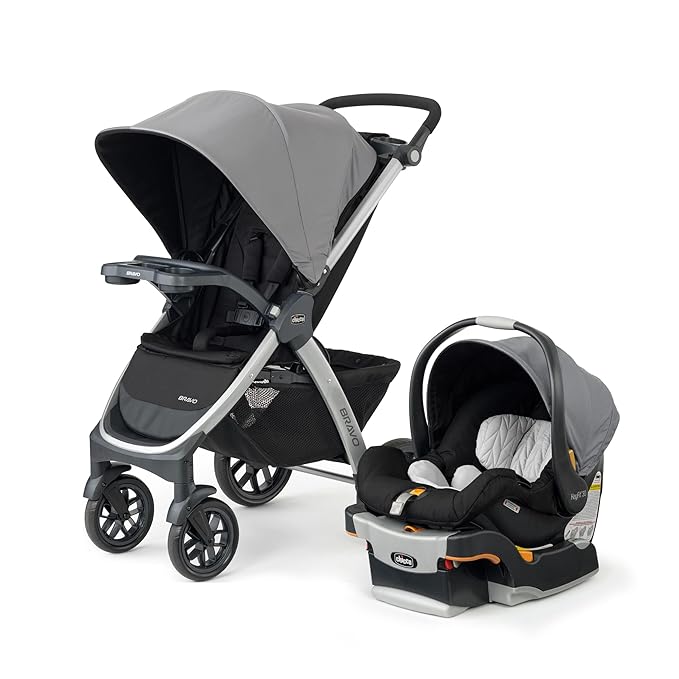
Let’s be clear: this isn’t the same kind of “3‑in‑1” as the all‑in‑one harness seats in this guide. The Bravo Trio is a 3‑in‑1 travel system—and I’m including it because for many families, the biggest decision isn’t only the car seat. It’s whether you want an entire newborn-to-toddler “movement system” that makes daily outings smoother.
If you’ve ever tried to carry a sleeping infant in a carrier, plus a diaper bag, plus a coffee, while also wrestling a stroller open—this is the solution style. Owners love how quickly the KeyFit infant seat clicks into the base and the stroller, and how the stroller folds with one hand and stands on its own. That sounds like a convenience feature; in real life, it’s what makes errands feel doable without turning into a full production.
The Bravo stroller tends to earn praise for “everyday capability.” Big enough wheels and suspension to handle uneven sidewalks, turns that feel smooth, and a build that feels stable, not wobbly. The common honest note is that it’s not a true off‑road stroller—grass and rough terrain are not its happy place. But for neighborhood walks, malls, sidewalks, and normal travel days, it’s a practical sweet spot.
The KeyFit line’s reputation is also a big factor here. Families like that the infant seat feels straightforward to install correctly, and the newborn insert fit is often described as supportive for smaller babies. That matters because newborn comfort isn’t just “nice”—it can affect how calm your baby stays in the car, which affects how calm you stay while driving.
Expert tip: travel systems shine when you match expectations to reality. The Bravo Trio is best if you want a sturdy everyday stroller and a dependable infant seat flow. If your lifestyle includes dirt roads, gravel, hiking trails, or lots of stairs, you may still want a separate jogger or ultra-compact travel stroller later. But as a “first system,” this is a well-balanced choice that saves you time and reduces the number of baby-gear decisions you have to make all at once.
Why it wins for newborn life
- Seamless click-in workflow – Car seat to base to stroller feels fast and predictable.
- One-hand fold practicality – Real-world helpful when you’re holding a baby or bags.
- Smooth everyday ride – Handles sidewalks and routine errands with confidence.
- Supportive infant fit – Many parents describe babies riding calmly and napping well.
Good to know
- Not built for rough terrain—think “everyday city/suburb,” not trails.
- As a full travel system, it’s a larger piece of gear than ultra-compact strollers.
- When your child outgrows the infant seat stage, you’ll transition to a longer-term harness-to-booster seat.
Ideal for: families in the newborn stage who want an easy, dependable car seat + stroller system that makes daily outings feel simpler and more controlled.
4. Diono Radian 3R – The Slim Steel “One Seat for Years” Strategy (with Travel‑Fold Bonus)

The Radian 3R is a very specific type of product: a “solve the back seat forever” seat. Families don’t buy Diono because it’s cute. They buy it because they have a car, a family size, and a reality where most seats simply do not fit. If you’ve ever been told “three across is impossible,” Diono is one of the brands that proves otherwise—again and again.
The steel-reinforced frame is part of the identity here. It creates a seat that feels robust and long-lasting. Parents often describe it as sturdy and high quality, the kind of thing you buy once and keep for years. And if you travel, the fold feature changes the experience: you can store it more compactly, move it more easily, and treat it like a purpose-built travel seat when needed.
Now the real-life truth that matters: the Radian is heavy. That’s the trade. A slim, steel-reinforced seat is not going to feel like a lightweight plastic shell. So if you’re planning to swap between cars weekly, or carry it long distances without a cart, you’ll feel it. But if your goal is “install it tightly and keep it installed,” the weight stops being a problem and starts being part of why it feels so planted.
Another practical nuance: the Radian is tall, especially when rear‑facing. Some families note that it can sit higher and may impact rear visibility depending on your vehicle and placement. This isn’t a universal issue—vehicle geometry matters—but it’s something to be aware of if you drive a smaller sedan and you’re sensitive to sightlines.
Comfort is another area where expectations matter. Some parents say their kids are perfectly happy and love the independence of climbing in and out. Others mention less padding compared with plush seats. In my opinion, that’s why the Radian shines most as a “fit and function” seat: it solves space and longevity, and kids who are fine with a straightforward seat do great in it. If you want a “luxury lounge chair” feel, you might prefer a more padded model—but you’ll likely sacrifice three‑across capability.
Why it’s a problem-solver
- Three‑across friendly – One of the most consistent “it actually fits” solutions for tight back seats.
- Steel-reinforced durability – Built to feel robust and long-lasting through years of use.
- Travel-fold capability – More manageable storage/transport compared to bulky fixed seats.
- Extended rear‑facing potential – Appeals to families who want longer rear-facing use.
Good to know
- It’s heavy—plan a cart strategy if you’ll travel with it often.
- Taller profile can affect rear visibility in some vehicles depending on placement.
- No cup holders on many configurations—great for three-across, less great for snack-heavy kids.
Ideal for: families who need a slim solution that makes three‑across possible, want long-term use, and don’t mind a heavier seat in exchange for fit and durability.
5. Evenflo EveryFit/All4One (Quick Clean Cover) – Built for Real Messes and Fast Adjustments

Evenflo has a very specific philosophy that shows up in the EveryFit/All4One: design for how parents actually use seats. That sounds like marketing until you live it. Because in real life, kids spill, throw snacks, get carsick, and smear sticky hands everywhere. The seat that’s “best” is often the seat you can clean fast enough that you don’t resent it.
The Quick Clean Cover idea exists for one reason: minimize the number of steps between “mess happened” and “seat is usable again.” Parents who love this seat tend to rave about the convenience of removing and washing fabric, and they highlight how nap-friendly the padding feels on longer rides. If you do frequent driving, comfort is not optional—it’s how you avoid the constant “I’m bored and uncomfortable” meltdown cycle.
Another real-life win is adjustment workflow. A one-hand, multi-position headrest paired with a no‑rethread harness means you can keep fit correct as your child grows, without uninstalling the seat or doing a complicated rethread process. That matters when:
- Your child hits a growth spurt and suddenly looks cramped.
- You switch between caregivers and want the harness to match clothing thickness.
- You’re transitioning from rear-facing to forward-facing and want the seat to keep feeling “right.”
Now, the expert honesty: Evenflo tends to get more mixed feedback than some of the “boringly consistent” seats. Most owners love comfort and the everyday practicality. But a small set of reviews describe difficulty stabilizing the seat tightly, and a few report concerns about how parts flex. My guidance is simple and safety-forward: if a seat ever shows unusual flex, cracking, or behavior that makes you uneasy, stop using it and contact the manufacturer immediately. A long-use seat should feel solid when installed correctly.
This is also a seat where installation technique really matters. Some seats “self-correct” because the geometry makes a tight install almost automatic. Others require the installer to be more methodical—press down in the right place, use the right belt path, and tighten in a controlled way. If you want a seat that feels intuitive even for first-time installers, Graco often wins. If you want a seat built around cleanability and day-to-day comfort, Evenflo can be a strong match.
Why families choose it
- Quick-clean mindset – Designed to make messy life more manageable without turning cleaning into a project.
- Comfort-first padding – Many parents describe kids riding happily and napping well.
- Easy growth adjustments – One-hand headrest + no‑rethread harness keeps fit easier as kids grow.
- All-in-one longevity – Built for a long journey from early stages through booster years.
Good to know
- Install tightness can be more technique-sensitive than some “super forgiving” seats—practice matters.
- Mixed feedback exists: most love it, a few report concerns—inspect regularly and follow the manual closely.
- Because it’s long-use, it’s not a featherweight seat for frequent car-to-car swapping.
Ideal for: families who prioritize cleanability and comfort, want long-use value, and are willing to be a little more methodical about installation for the best results.
6. Graco TriRide 3‑in‑1 (Redmond 2.0) – Built for Long Drives, Deep Recline, and Sleepy Heads

The TriRide is the seat you choose when driving is a big part of your life—and you want your kid to be comfortable enough that the car feels calm. This is a “long journey” seat: multiple recline positions, supportive padding, and a shape that tends to encourage kids to settle in rather than constantly squirm.
One common parent observation is that the seat looks deep. Some people worry their child looks “too tucked in.” But in many cases, kids are actually fine—especially once you dial in the recline and harness fit. The deeper seat can help kids feel contained (in a good way), which can reduce the “leaning sideways and pulling straps” behavior some toddlers develop. If you’ve ever dealt with a kid who turns car rides into a gymnastics routine, you’ll appreciate a seat that naturally supports a stable sitting posture.
The recline range is more than comfort—it’s also installation flexibility. In real vehicles, a seat that offers multiple recline options can be easier to level correctly and can help you avoid that annoying “it’s technically installed, but it feels slightly off” sensation. Owners often mention that setup feels easier than some other bulky seats they’ve fought with.
TriRide also makes sense as a long-use pick because it’s designed with booster mode in mind: open-loop belt guides are there to help the vehicle belt sit correctly when your child is ready to ride in booster mode. A lot of cheap “3-in-1” seats treat booster mode like a checkbox. Seats that keep belt routing clear earn loyalty later, when you don’t want to re-shop.
Now, the practical downsides: this is a substantial seat. That “heavy-duty” feel is part of the appeal, but it also means you probably won’t enjoy moving it constantly between cars. And like many seats, cup holders can become a toddler’s favorite toy—some kids try to pull them, others stuff them with everything they can find. If you have a “cup holder obsession” child, you’ll appreciate designs where cup holders stay on securely.
Why it’s road-trip friendly
- Comfort-oriented recline range – Helps with naps and long drives without constant repositioning.
- Secure, substantial feel – Parents often describe it as sturdy and confidence-building once installed.
- No‑rethread growth adjustments – Headrest/harness adjust together for a smoother “growing kid” experience.
- Booster belt guide design – Built to make later-stage belt fit less of a guesswork situation.
Good to know
- It’s a bigger, heavier seat—best as a “main seat” that stays installed.
- Deep seat styling can look intense; correct recline and harness fit usually resolves comfort concerns.
- If you need maximum three‑across slimness, the SlimFit or Diono may fit better.
Ideal for: families who drive often, do longer trips, and want a seat that supports comfort, stable posture, and future booster-mode usability.
7. Safety 1st Grow and Go All‑in‑One Slim – A Practical Long‑Use Seat That Doesn’t Try Too Hard

Some seats win because they’re premium. Others win because they’re realistic. The Grow and Go is a “realistic” seat—built to be used daily by normal humans, not just admired online. Parents who love it often say the same thing: it’s simpler than complicated seats they’ve tried, it fits snugly in the vehicle, and it doesn’t make them feel like they need an engineering degree to get it right.
The QuickFit harness concept is one of those features that improves the daily routine. Instead of dealing with awkward, multi-step adjustments, you can adjust headrest and harness height together in a more natural motion. That’s important because kids don’t grow in neat, predictable stages—they grow in bursts, and then suddenly the harness height looks wrong. Seats that make that adjustment easy are seats that keep kids properly positioned.
Where the Grow and Go becomes a “keeper” for many families is mess management. Parents dealing with carsickness or snack chaos often mention that cover removal and cleaning feel more doable than on seats where everything is tied into a complicated harness system. When cleaning is doable, you actually do it. And when you actually do it, the seat stays pleasant and your car smells like a car—not a science experiment.
Now, the nuanced truth: some owners say installation can be difficult to get extremely tight, depending on vehicle and method. You’ll see two patterns in feedback:
- Install feels easy and secure when technique and vehicle geometry play nicely together.
- Install takes effort when the belt angle or seating surface causes tilt or makes tightening awkward.
The fix is often about leverage: pushing down in the right place (where the child’s weight would be), tightening slowly in controlled pulls, and making sure you’re using the correct belt path for the mode you’re in. If you’re the kind of person who wants “one tug and done,” some Graco installs feel more forgiving. If you want a seat that keeps things straightforward and cleans well, Grow and Go is a strong value play.
Why families stick with it
- Simple, approachable design – Feels less complicated than many “premium feature overload” seats.
- Comfort improvements for many kids – Parents often report happier rides and fewer meltdowns.
- Cleaning feels manageable – Cover removal and maintenance are a real-world win for messy stages.
- Space-conscious feel – Often works well without dominating the back seat.
Good to know
- Some vehicles/methods can make installs feel effort-heavy—practice and correct belt path matter.
- Harness straps can sometimes catch/snare depending on how they’re pulled—smooth, even tightening helps.
- If you demand “instant tight install,” a different base geometry may feel more forgiving.
Ideal for: parents who want a long-use seat that stays practical, feels simple, and is built for the messy reality of growing kids.
8. Safety 1st Ellaris 3‑in‑1 Convertible – Slim, Light, and Surprisingly Travel‑Friendly

The Ellaris is a great example of a seat that’s designed to be useful, not intimidating. It’s slim enough to help with three‑across situations, light enough that travel families actually consider bringing it, and simple enough that it works well as an “extra seat” in a second car without constant complaint.
A theme in owner feedback is “good value for travel.” Parents mention using it as a spare seat, attaching it to a dolly through the airport, and finding that their child stayed comfortable—even falling asleep and staying asleep. That’s important: a travel/backup seat often becomes the seat your child rides in during the most disruptive moments. If your kid sleeps in it, it’s doing something right.
The strap adjustments are frequently described as easy and the fabric feel as surprisingly nice. That matters because budget seats often fail on the “touch points”—scratchy fabric, stiff adjusters, awkward strap geometry. The Ellaris tends to feel more thoughtful than you’d expect at first glance.
Here’s the expert nuance: the Ellaris is a “3‑in‑1 convertible” in the sense of rear‑facing infant mode → rear‑facing toddler mode → forward‑facing harness. It is not a harness‑to‑booster seat. So this is best when you want a lightweight, slim convertible for the earlier years, or when you’re building a “backup seat strategy” for travel and emergencies. If your child is already approaching booster age, look at the Tranzitions or Hybrid SI instead.
Installation feedback is realistic: some people say installs are easy, others say “all car seats stink to install” (which is… fair). The advantage of the Ellaris is that it’s lighter than many seats, so you can apply pressure and maneuver it more easily when tightening. It’s the kind of seat that becomes “easy enough” quickly.
Why it’s a smart backup
- Lightweight, travel-friendly feel – Easier to carry and move compared with heavier all‑in‑ones.
- Three‑across friendly slimness – Helps in tight back seats and family growth situations.
- Comfort that supports naps – Multiple parents report kids sleeping well during travel and longer drives.
- Easy-to-live-with materials – Fabric and strap adjustment feel more premium than expected.
Good to know
- Not a booster mode seat—this is a convertible, not a full “to big kid booster” solution.
- Some installs can still feel annoying; the “lighter seat advantage” makes it easier, not effortless.
- If your primary goal is easiest tight install, you may prefer a seat with a more advanced LATCH/tightening system.
Ideal for: travel families, backup-seat planners, and three‑across households that want a slim, lighter convertible that still feels comfortable and solid.
9. Baby Trend Trooper™ Slim 3‑in‑1 – Narrow, Light, and Built for “We Need It to Fit” Cars

The Trooper is a seat you buy for a very real reason: you need a seat that fits without drama. Whether you’re doing three‑across, driving a smaller car, or planning to travel with a seat through airports and rentals, this “slim and light” category is where practicality wins.
Two details make the Trooper more usable than many slim seats: built‑in angle help (flip foot) and a bubble level indicator. Why does that matter? Because “rear‑facing install” problems are usually angle problems. If the seat is too upright for a young baby, comfort suffers. If it’s too reclined, it can steal front seat space. A seat that helps you find the right angle faster reduces install anxiety—especially in unfamiliar vehicles like rentals.
Parents who love the Trooper often highlight sturdiness and comfort relative to expectations. They mention thick padding, good recline options for long trips, and the fact that the seat doesn’t feel bulky. Some families even describe it as exceeding expectations for the category—especially when they expected “basic” and got “surprisingly solid.”
The nuanced trade-off is install tightness. Slim seats sometimes trade “instant tight install” for “it fits.” A few owners mention it can be harder to get it “super tight” the way they personally prefer. That doesn’t automatically mean it’s unsafe when installed correctly—but it does mean you should expect to practice. The good news: the seat’s lighter weight makes it easier to press down while tightening, and many families find it becomes easy after the first install.
One of the most meaningful signals you’ll see in reviews is how a seat performs in real incidents. Some parents describe serious collisions where the seat did its job and their child was fine, leading them to repurchase (as recommended after an accident). That kind of feedback sticks with families because it’s the outcome everyone cares about: the seat protected the child.
Why it works in tight spaces
- Ultra-slim footprint – Designed to fit three‑across situations and narrow back seats more easily.
- Angle help features – Flip foot + bubble level reduce rear-facing guesswork.
- Travel-friendly weight – Lighter than many seats, making airport/rental strategies more realistic.
- Comfort that surprises – Many parents report kids riding happily on both short and longer trips.
Good to know
- Getting an ultra-tight install may take more technique than with heavier “self-locking” seats.
- Some parents prefer push-button style LATCH connectors; verify what your comfort level is with the install method.
- Rear-facing fit can still vary by vehicle—always test your front-seat comfort and back-seat layout.
Ideal for: families who need slim fit first, travel-friendliness second, and a seat that solves “it must fit” situations without being flimsy.
10. Graco Tranzitions 3‑in‑1 Harness Booster (Eloise 2.0) – The “Second Seat Hero” That Moves Easily

This is one of the most useful seats for real families because it solves a very specific, very common problem: you have a child who is done with rear‑facing, and you need a seat that works in multiple cars without feeling like a massive permanent installation. Carpool parents, grandparents, second vehicles, shared rides, travel—this is where Tranzitions shines.
Owners repeatedly describe it as lightweight and easy to move. That seems like a “nice to have” until you’re transferring seats between vehicles on a busy week. A seat that’s light enough to carry easily becomes the seat you actually use correctly, because you’re not tempted to “leave it behind” or “improvise.”
The no‑rethread harness adjust also matters more in this category than people realize. Older toddlers and young kids can vary a lot in torso height, and they also change clothing thickness more dramatically (puffy coats vs thin summer clothes). Being able to adjust the headrest/harness together quickly keeps the fit more consistent day to day. Some parents describe being able to adjust it in seconds with one hand—exactly what you want in carpool chaos.
Comfort feedback is strong too. Parents mention kids falling asleep quickly and feeling “safe” in it, which is a real signal: a kid who feels secure tends to relax. The seat also earns points for practical cleanup. Many families love the idea of removable pads for accidents and spills, because the older-kid stage is snack-and-drink heavy.
Here’s the nuance that experienced parents appreciate: Tranzitions is not trying to be your newborn-to-big-kid forever seat. It is trying to be a perfect fit for the stage where your child is forward-facing and transitioning toward booster. If you buy it at the right time, it feels like you finally found the seat that makes life easier. If you buy it too early (for a child who still needs rear-facing), it’s simply the wrong tool.
Why it’s a multi-car favorite
- Lightweight and portable – Easier to move between vehicles, ideal for grandparents and carpools.
- Fast harness adjustments – No‑rethread headrest/harness changes support real-life growth and clothing shifts.
- Comfortable for older kids – Many parents report kids riding happily and sleeping well.
- Practical daily features – Cup holders, washable pads, and “big kid friendly” feel.
Good to know
- Forward-facing only—this is not for newborns or rear-facing stages.
- As with all combination seats, booster-mode success depends on your child’s maturity and belt positioning consistency.
- If you need the slimmest three‑across rear-facing solution, this isn’t the category—look at slim convertibles instead.
Ideal for: older toddlers and big kids who are ready for forward-facing harness and booster transitions, especially in families juggling multiple vehicles.
11. Baby Trend Hybrid SI 3‑in‑1 Combination Booster – A Straightforward “Big Kid” Seat with Side‑Impact Pods

The Hybrid SI is a practical seat for a practical moment: your child is big enough for a forward-facing harness booster, and you want a seat that can transition into high‑back and backless booster use without you needing to re-shop. This is a very common need for grandparents, travel weeks, second cars, and families who want a reliable “extra seat” that still feels safe and comfortable.
The standout design element is the side-impact pod structure and cushioned side areas, which give the seat a more protective “wrap” feel. Parents often describe it as sturdy once installed, and they like that their child seems comfortable even on longer rides. That comfort matters because booster-stage kids are more vocal—if they hate it, you’ll hear about it.
Another real-world feature people appreciate: it stays simple. Some seats at this stage add unnecessary complexity—extra pieces, awkward armrest geometry, or fussy adjustments that don’t actually improve safety or comfort. The Hybrid SI tends to be more straightforward: you assemble the main pieces, set the harness height, and you’re ready.
The consistent “good to know” feedback is about strap/harness adjustment and tethering. Some owners mention that tightening can take a bit of learning, or that certain strap routing details feel less intuitive at first. That’s not unusual in budget booster combos. The smart approach is to set it up once calmly (not five minutes before school), and then it becomes easy.
One more expert tip: combination boosters are at their best when your child is mature enough to sit correctly. If your child is a “leaner” or constantly slouches, you may want a seat with stronger posture support or a headrest that better stabilizes sleepy rides. But as a second seat strategy—especially for families who need value without giving up usability—this is a solid pick.
Why it’s a smart second seat
- Forward-facing to booster progression – Covers a huge “big kid” window without multiple purchases.
- Side-impact pod design – Adds a more protective, cushioned feel around the head/torso.
- Simple daily usability – Straightforward setup without unnecessary complexity.
- Convenient cup holders – Practical for snack-heavy ages and long drives.
Good to know
- Installation/strap adjustments may take practice; budget seats can be less “instant intuitive.”
- Best results depend on child maturity (sitting correctly, not leaning out of belt position).
- If you need rear-facing, this is not the right category—choose an all‑in‑one convertible instead.
Ideal for: older toddlers and big kids in the forward-facing/booster transition stage, especially as a second seat for grandparents, travel, or occasional-use vehicles.
The 3 Phases That Decide Whether You’ll Love Your Seat
Most buying guides treat 3‑in‑1 seats like they’re one decision. They’re not. They’re three different experiences: rear‑facing, forward‑facing, and booster mode. The seat you “love” is the seat that keeps behaving well through all three. Here’s how to predict success—before you buy.
Phase 1: Rear‑facing – comfort + angle + front-seat space
- Angle accuracy drives comfort – Babies and young toddlers often fuss when the seat angle isn’t right. Seats with clear level indicators help.
- Front-to-back space is the hidden constraint – In smaller cars, some seats force the front seat forward more than families expect.
- Harness smoothness matters early – You’ll tighten every ride; straps that snag turn daily buckling into a recurring annoyance.
- Newborn inserts should support, not swallow – A good insert positions the baby well without pushing the head forward.
If your car is compact or you need three-across from the start, prioritize slim designs and angle-help features. That’s why the SlimFit, Diono, Ellaris, and Trooper show up so often in “tight car” households.
Phase 2: Forward‑facing – the “toddler test”
- Easy in/out access matters more – Toddlers resist. Seats that let you buckle quickly reduce daily conflict.
- No‑rethread adjust becomes crucial – Growth spurts and clothing changes happen fast in this stage.
- Stability impacts confidence – A seat that feels planted reduces caregiver stress and second-guessing.
- Snack ecology becomes real – Cup holders, removable parts, and wipeable areas start to matter.
This is where rotation seats like Turn2Me feel like “cheat codes,” and where easy-adjust seats like SlimFit and TriRide win loyalty.
Phase 3: Booster mode – where many “3‑in‑1” seats get exposed
- Belt guides must be clear – If it’s confusing, caregivers route it wrong or kids buckle incorrectly.
- Shoulder belt fit should feel natural – A belt that rubs the neck encourages kids to put it behind the back (bad habit).
- Headrest support matters for sleep – Big kids still fall asleep; poor support leads to slumping and sideways lean.
- Booster success depends on kid maturity – The best seat can’t fix a child who won’t sit correctly yet.
If booster mode is the stage you’re buying for right now, focus on combination boosters like Tranzitions and Hybrid SI. If you’re buying earlier, choose an all‑in‑one with strong belt guide design so you don’t regret it later.
One “expert habit” that makes any seat feel easier
- Do a calm install once – Install on a weekend, not on a rushed morning. Tighten in controlled pulls.
- Set harness height checks on a schedule – A quick check monthly prevents “suddenly too small” moments.
- Keep a mini cleaning kit in the car – Baby wipes, a towel, and a small brush make messes manageable.
- Teach your child the routine – Kids who learn “arms in, back flat” reduce your daily buckling effort.
The seat you love isn’t always the fanciest seat. It’s the seat that matches your routine and keeps the process calm.
FAQ: 3‑in‑1 Car Seats (Answers Without the Confusion)
Is a 3‑in‑1 seat really “one seat forever”?
What’s the difference between an all‑in‑one seat and a combination booster?
How do I pick the right seat if I need three‑across?
Do I need a rotating seat, or is it just a luxury?
What should I prioritize if my child gets carsick?
Can I travel with a 3‑in‑1 seat?
Final Thoughts: Buy the Seat That Protects Your Peace
A great seat doesn’t just protect your child—it protects your routine. The best choice is the one that keeps buckling calm, keeps cleaning manageable, and keeps booster mode from becoming a new shopping problem later.
Here’s how to translate everything above into one confident purchase:
- Want the most balanced “main seat” for most families? Start with the Graco SlimFit 3‑in‑1 (Darcie 2.0). It’s the best blend of space-smart design, easy adjustments, and long-term practicality.
- Want the premium convenience upgrade that saves your back? Go with the Graco Turn2Me 3‑in‑1 Rotating. It’s built for daily buckling ease—especially in tight parking or middle-seat installs.
- In the newborn stage and want a full “get out of the house” system? The Chicco Bravo 3‑in‑1 Trio Travel System is the click‑in, fold‑fast setup that makes daily outings smoother and less stressful.
- Need a slim “three‑across” problem solver with travel capability? Pick the Diono Radian 3R. It’s heavy, but it’s one of the most consistent solutions for tight back seats and long-term use.
- Care most about cleanability and a practical long-use workflow? Consider the Evenflo EveryFit/All4One (Quick Clean Cover) for families who want mess management and easy growth adjustments built into the experience.
- Do long drives and want a comfort-forward seat that stays useful later? The Graco TriRide 3‑in‑1 is a strong choice for road trips, naps, and a stable, supportive ride.
- Want a simpler value all‑in‑one that doesn’t feel complicated? Choose the Safety 1st Grow and Go All‑in‑One Slim for a practical, long-use seat that many families find easy to live with.
- Need a lightweight travel/backup convertible for the earlier years? The Safety 1st Ellaris and Baby Trend Trooper Slim are the slim, lighter options that make travel and three‑across life more realistic.
- Shopping for the forward-facing/booster transition stage? Go with the Graco Tranzitions or the Baby Trend Hybrid SI as dependable “big kid” seats that work well in second cars and carpool setups.
If you’ve made it this far, you’re not shopping randomly—you’re shopping smart. Pick the top rated 3 in 1 car seats that matches how you actually live: tight car or roomy car, three‑across or single seat, main seat or second seat, newborn system or big kid transition. When the seat matches your routine, the whole experience becomes calmer—and that’s the real win.

Mo Maruf
I created WellFizz to bridge the gap between vague wellness advice and actionable solutions. My mission is simple: to decode the research and give you practical tools you can actually use.
Beyond the data, I am a passionate traveler. I believe that stepping away from the screen to explore new environments is essential for mental clarity and physical vitality.