Our readers keep the lights on and my smoothie glass nicely filled. As an Amazon Associate, I earn from qualifying purchases.
Buying a car seat for a newborn sounds simple until you do it for real. Then you realize it’s not a “product choice” — it’s a daily system you’ll touch multiple times a day, half-asleep, in bad weather, with a squirmy baby and a parking lot full of opinions.
If you’re searching for a convertible seat for infant use, you’re already thinking like a seasoned parent. You’re trying to skip the “buy it, outgrow it, rebuy it” cycle. You’re trying to get something that works from the very first ride home, stays comfortable through growth spurts, and doesn’t turn installation into a weekly fight.
Here’s the problem: most buying guides are shallow. They recite weight limits, repeat marketing claims, and never talk about the real reasons parents return seats: the harness that never loosens smoothly, the install that feels tight… until it doesn’t, the cup holders your toddler weaponizes, the cover that’s “machine washable” but takes an hour to remove, and the backseat angle that turns a good seat into a bad fit.
This guide is built differently. I’m using the friction points that show up in real-life owner feedback — comfort complaints, car-sickness stories, cleaning nightmares, three-across puzzles, and “this saved my back” rotating-seat love — and turning them into a decision framework you can actually use.
Below, you’ll find 15 standout picks in an order that makes sense for real families: premium “buy-once” all-in-ones first, then space-savers and specialists, then the budget heroes and travel-focused seats that shine in specific situations.
How to Choose the Right Convertible Seat For Infant
A convertible seat can be the smartest “buy once, stop thinking about it” move — but only if you choose one that matches your real life: your vehicle’s backseat geometry, your body (hello, back pain), your baby’s temperament, and your tolerance for fiddly installs. This is the framework I use when helping families choose a seat they’ll still love after the first big mess, the first road trip, and the first growth spurt.
1. Start with your lifestyle, not the label
Car seats don’t live on a shelf. They live in a routine. Identify your routine first:
- One-car family: You want a seat that’s easy to clean and easy to adjust, because you’ll be in it constantly.
- Two-car / caregiver rotation: You want an install method that’s repeatable and obvious (or you’ll end up with “that seat” nobody wants to move).
- City life + tight parking: Rotating seats can be game-changing. Space-saving seats matter more than you think.
- Road-trip family: Comfort, recline options, and easy snack management become “sanity features.”
- Three-across / growing family: Width, cupholder design, and straight belt paths matter more than glossy fabric.
2. Newborn fit is a real skill — and not every seat has it
Most seats can fit a newborn. The question is whether your newborn looks truly supported: head centered, chin not dropping, hips not sliding. That depends on three things you won’t see in a quick marketing photo:
- Insert architecture: Not just “padding,” but whether the insert supports the pelvis and torso without pushing the harness out of position.
- Harness geometry: How low the harness can route for tiny shoulders and whether it stays flat and untwisted during tightening.
- Recline accuracy: Newborns need a safe recline angle; seats with clear leveling indicators and multiple recline positions reduce guesswork.
This is why seats like the Chicco Fit4 (multi-stage FitKit) and Graco’s no-rethread systems earn so much loyalty: they make correct fit easier during the weeks when you’re least interested in complicated adjustments.
3. Rear-facing “longevity” is not about legroom — it’s about consistency
Yes, extended rear-facing is widely recommended, and many parents prefer to keep their child rear-facing as long as their seat allows. But the hidden win is consistency: a seat designed for longer rear-facing use tends to have better recline flexibility, better comfort, and better “fit forgiveness” as your child grows.
That’s why a model like Graco Extend2Fit can feel like a cheat code for tall toddlers: it’s not just a feature; it changes your daily ergonomics. The trick is matching rear-facing goals to your vehicle space — because the best rear-facing seat in the world is useless if it forces your front passenger into the dashboard.
4. Installation isn’t one step — it’s a system of steps
This is the part most guides skip. A seat can be “easy to install” once, and still be a nightmare after month three. Here’s what separates a truly easy seat from a “seems easy at first” seat:
- Clear belt paths: You can see exactly where the belt goes without contorting your hands.
- Lock-offs that do real work: Integrated lock-offs can make seatbelt installs dramatically more consistent.
- Force-multiplying tightening: Systems like Chicco’s SuperCinch can turn “pull harder” into “pull smarter.”
- Stable base footprint: Seats that sit planted on your vehicle seat tend to stay tight longer and wobble less.
- Repeatability: If you reinstall it later, you can recreate a tight install without a 20-minute wrestling match.
5. Daily buckling friction is where parents fall in love… or rage-quit
Two seats can be equally safe and equally rated — and one will still make you miserable because of daily friction. Pay attention to these everyday details:
- Harness loosening button access: Some seats hide it under padding or make it intentionally stiff. That can be fine — until you’re doing it 10 times a day.
- Strap storage: Harness holders and pockets keep straps from falling under your child (which is a daily “why is this so hard?” moment).
- Chest clip behavior: Magnetic or assisted clips can be helpful… or they can reattach at the wrong moment, making removal annoying.
- Cup holders: Fixed cup holders are harder to clean. Removable ones are easier to clean but easier for toddlers to remove. Pick your battle.
This is where you see the personality differences between brands: some prioritize “installer confidence,” others prioritize “everyday parenting speed.” The best seat for you is the one that matches your stress profile.
6. Rotating seats are not a gimmick — but they’re not always the answer
Rotating seats can genuinely save your back and shorten your reach, especially in compact cars. But they come with trade-offs: more weight, more bulk, and sometimes a shorter forward-facing range (depending on the model).
If you’re considering rotation, choose based on how you’ll use it:
- Best “main seat” rotation: Look for stable install tech plus a wide growth range (example: Graco EasyTurn 360).
- Best “second car / grandparent” rotation: Compact footprint and one-time install simplicity matter more than long-term stage coverage (example: Evenflo REO).
7. Space-saving isn’t just width — it’s “shape” and cupholder strategy
Three-across success is rarely about the number on the box. It’s about where the seat is wide: a seat can be narrow at the base but wide at shoulder level, which is exactly where it collides with a neighbor seat. Also, cup holders can sabotage a three-across plan — which is why rotating or fold-in designs (like the Graco SlimFit) can matter more than you’d expect.
Quick Comparison: 15 Convertible Seat For Infant Picks
Use this table to shortlist seats that match your priorities, then jump into the deep reviews to understand the “real-life” difference: how the harness behaves when you’re in a hurry, how the seat feels on long drives, and which designs stay tight without constant re-checking.
On smaller screens, swipe or scroll sideways to see the full table.
| Model | Seat type | Standout strength | Best match | Amazon |
|---|---|---|---|---|
| Graco 4Ever DLX 4-in-1 (Maven) | 4-in-1 all-in-one | “Buy once” longevity + RapidRemove cover + lock-off install confidence | Families who want one seat to carry them through years with minimal drama | Amazon |
| Chicco Fit4 4-in-1 (Element/Black) | 4-in-1 all-in-one | Installer-friendly “confidence features” + multi-stage FitKit comfort | Parents who want the most repeatable, low-guesswork installs | Amazon |
| Graco EasyTurn 360 2-in-1 (Cyran) | Rotating 2-in-1 | 360° rotation + SnugLock fast install + slim footprint feel | Parents who want rotation without sacrificing “main seat” durability | Amazon |
| Evenflo REO by Revolve360 2-in-1 (Brookline) | Rotating compact | One-time install + compact 17″ footprint + easy caregiver seat | Grandparents, second cars, or anyone who wants “simple rotation” | Amazon |
| Maxi-Cosi Kani 4-in-1 (Caspian Caviar) | Luxury 4-in-1 | Premium eco fabrics + magnetic ClipQuik + slim “growing family” shape | Parents who want a luxe feel and three-across-friendly design | Amazon |
| Joie Saffron SI 4-in-1 (Dove) | 4-in-1 all-in-one | Under-the-radar comfort + newest safety standard focus + easy clip feel | Parents who want premium vibes without the “complicated seat” energy | Amazon |
| Graco Grows4Me 4-in-1 (West Point) | 4-in-1 all-in-one | Long-use practicality + easy adjustments + “grandparent-proof” basics | Families who want longevity without overthinking features | Amazon |
| Maxi-Cosi Pria All-in-One (Sea Shadow) | Comfort-first all-in-one | Plush ride feel + simple 1-hand harness/headrest adjustment | Kids who fuss in “hard” seats + parents who prioritize comfort | Amazon |
| Graco Extend2Fit (Gotham) | Extended rear-facing | Legroom extension panel + higher rear-facing range + easy install reputation | Tall toddlers and families determined to rear-face longer comfortably | Amazon |
| Graco SlimFit 3-in-1 (Silas) | Space-saver 3-in-1 | Rotating cup holders create slimmer profile + surprisingly comfy for kids | Three-across setups and smaller vehicles that still need growth room | Amazon |
| Graco TriRide 3-in-1 (Redmond) | Road-trip 3-in-1 | Comfort-first recline options + durable “tank” feel + kid-friendly storage | Families who want a sturdy seat for long drives and daily use | Amazon |
| Safety 1st Grow and Go All-in-One (Alaskan Blue) | Value all-in-one | Simple design + comfy padding + easy snap-off cover strategy | Budget-focused families who still want a long-use seat | Amazon |
| Safety 1st TriMate 3-in-1 (Sharkskin) | Slim 3-across value | Under-19″ width without cup holders + easy-clean cup holder setup | Three-across on a budget (especially in vehicles that “like” slim seats) | Amazon |
| Maxi-Cosi Romi 2-in-1 (Sea Shadow) | Travel-ready convertible | Ultra-lightweight carry strategy + airplane-certified design | Frequent travelers who want a lightweight convertible seat | Amazon |
| Diono LiteClik 30 R SafePlus Infant Seat (Black) | Infant travel seat | Very light carry + steel core feel + baseless install option | Parents who want an infant carrier before switching to a larger convertible | Amazon |
In‑Depth Reviews: 15 Seats That Feel Good in Real Life
Now we go model by model. I’m not going to talk like a brochure. I’m going to talk like a parent who has installed seats in real cars: angled backseats, tight shoulder belt geometry, crumbs in every seam, and kids who can somehow unmake your “perfectly adjusted” harness in 12 seconds.
1. Graco 4Ever DLX 4-in-1 (Maven) – The “Buy Once, Breathe Easier” Seat

If you want the seat that feels like the “adult decision” — the one that reduces mental load — the Graco 4Ever DLX earns its reputation. Yes, it’s a long-use, multi-stage seat. But the real reason families stick with it is simpler: it behaves predictably. It installs without drama in a wide range of vehicles, it adjusts without requiring you to re-engineer the harness each time, and it’s built to survive years of daily use without feeling flimsy.
The RapidRemove-style cover concept is one of those features you don’t fully appreciate until you need it. Real life includes vomit, blowouts, spilled milk, and mystery sticky spots. A seat that lets you remove and wash the cover without uninstalling the entire thing is not a “nice extra.” It’s the difference between “we can handle this” and “I’m buying a new seat because I can’t look at this anymore.”
Owners also consistently describe the install experience as surprisingly cooperative for a big seat: less strap chaos, fewer “wait… did I route that right?” moments, and a tight feel that inspires confidence. One detail I love for busy families: the rubberized harness storage approach keeps straps accessible and prevents that classic problem where the buckle tongues disappear under your child and you end up fishing around while your toddler kicks your forearm like it’s their job.
The honest truth: it’s not a featherweight, and it’s not the narrowest seat on Earth. But as a “main seat” for daily driving and long-term use, it’s the most balanced blend of durability, convenience, and “this just works” energy in the lineup.
Why families love it
- Long-use versatility that feels practical – Not just stages on paper; it actually stays usable as your child changes.
- RapidRemove cover strategy – Cleaning feels doable without uninstalling and re-installing everything.
- Confidence installs – Many parents describe installation as smoother than expected for a full-size all-in-one.
- Everyday convenience – Harness storage and cup holders reduce daily “small battles.”
Good to know
- It’s a substantial seat; if you move seats between cars often, you’ll feel the weight.
- In some vehicles, seatbelt installs can feel finicky if you don’t use the lock-off correctly — the manual matters here.
- If you need a true three-across specialist, you’ll likely prefer a slimmer-profile model.
Ideal for: families who want one dependable “main seat” that stays comfortable, stays installable, and stays worth it year after year.
2. Chicco Fit4 4-in-1 (Element/Black) – The Seat That Makes Installs Feel Obvious

Some parents want comfort first. Some want longevity first. But there’s a third type — the parent who wants certainty. If that’s you, Chicco’s Fit4 is the kind of seat that can lower your stress immediately, because it’s built around install feedback and repeatable steps. Premium LATCH connectors, clear leveling indicators, a multi-position leveling system… this is “make it hard to mess up” engineering.
What makes Fit4 special isn’t any single feature — it’s how the pieces work together when you’re tired. The bubble level indicators are quick visual reassurance. The force-multiplying tightening approach reduces the need to brute-force a strap into submission. And the FitKit concept (multi-stage layers you remove as your child grows) helps prevent that awkward “they technically fit but look uncomfortable” phase. That’s why you’ll see so many parents describe a change in their child’s mood after switching: fewer tears, faster settling, more peaceful rides.
The biggest “real life” note I want you to know: Fit4 is built like a tank. That’s wonderful for protection and stability, but it also means it’s heavier and more substantial than budget seats. This is not the seat you buy if you plan to swap between cars every weekend. It’s the seat you install and then happily leave installed because it feels so planted and secure.
One small daily friction point that shows up in feedback: buckle tongues can slide down under a child, and you may find yourself fishing for them. The fix is simple — use the harness holders/pockets consistently and build a tiny routine: open harness, park buckles in their “home,” then load your child. It sounds silly, but it’s how you turn a good seat into an effortless seat.
Why it stands out
- Installer confidence – Level indicators and tightening systems reduce guesswork and “re-check anxiety.”
- FitKit comfort strategy – Layers support newborns, then remove cleanly as your child grows.
- Solid, stable build – Feels planted once installed, which helps it stay tight over time.
- Space-saving cup folder design – Helps keep the seat footprint more manageable without losing comfort.
Good to know
- It’s heavy — best as a “main car” seat rather than a frequent transfer seat.
- The manual is worth reading because it’s feature-rich; once learned, it’s very straightforward.
- If you want the narrowest possible three-across solution, a dedicated slim seat may fit better.
Ideal for: parents who want installs to feel obvious and repeatable, plus a comfort system that adapts cleanly from newborn through kid stages.
3. Graco EasyTurn 360 2-in-1 (Cyran) – Rotation That Feels Smooth, Not Fussy

Rotating seats earn intense loyalty for one simple reason: they remove the “car seat gymnastics” phase of parenting. The EasyTurn 360 is a standout because it combines rotation with Graco’s install-friendly approach, including SnugLock-style quick installs. Translation: it’s not just convenient once your child is in the seat — it’s also easier to get the seat installed correctly in the first place.
Owners frequently describe the rotation as a true daily-life upgrade: easier loading in small cars, easier unloading when a baby falls asleep, and fewer awkward angles that strain your back and shoulders. The detail I love for real families is the “listen for the click” guidance: it pushes you to confirm the seat is locked back into travel position, which is the kind of simple habit that boosts confidence.
This seat also does something important that many rotating seats struggle with: it doesn’t feel like a novelty mechanism bolted onto a seat. It feels integrated. The structure feels solid, the harness adjustment feels familiar if you’ve used Graco, and the slim profile helps in smaller cars. Families mention using it successfully in compact sedans and still feeling like the seat is substantial enough to be trusted.
Here’s the honest trade-off: rotating seats tend to be bulkier and more awkward to carry if your hospital requires bringing it inside. You’re not buying this as a “carry it around” seat. You’re buying it as the daily-use workhorse that makes loading and unloading dramatically easier. Also remember it’s a 2-in-1 (rear-facing + forward-facing harness), so you’ll eventually transition to a booster later — that’s normal and not a downside, but it’s good to plan for mentally.
Why it’s a game changer
- One-hand 360° rotation – Saves backs, reduces awkward angles, and speeds up daily routines.
- SnugLock install approach – Helps the seat get tight quickly without “pull harder forever.”
- Surprisingly good for small cars – The slim design helps it feel more manageable in compact backseats.
- Comfort-first interior – Plush infant supports and a cozy feel that many babies settle into easily.
Good to know
- It’s not the seat you want to carry around; it’s awkward to transport compared to non-rotating seats.
- Rotation becomes effortless after a few practice cycles — don’t learn it for the first time in a rush.
- Because it’s a 2-in-1, you’ll plan for a booster transition later.
Ideal for: parents who want rotation as a true daily feature, not a gimmick — especially in smaller cars or for anyone managing back strain.
4. Evenflo REO by Revolve360 (Brookline) – The “Second Car Hero” That Saves Your Back

The Evenflo REO is the rotating seat for people who want practicality over perfection. It’s compact, it installs once, and it rotates with one hand — which is exactly what you want for grandparents, babysitters, and second vehicles. It’s also a smart option for families with special physical needs: several parents highlight how rotation reduces strain and makes loading easier for children who need more support.
Where this seat shines is “daily usability.” The headrest and harness adjust together, the padding is generous, and the rotation makes it easier to keep your child’s body aligned while buckling — something that matters for many kids, not just medically complex ones. Real owners describe it as sturdy, comfortable, and surprisingly easy to install, even for people who don’t consider themselves “car seat pros.”
There’s also a subtle psychological win here: when a seat is easy to use, caregivers are more likely to buckle correctly and tighten correctly. That’s one reason rotating seats are so beloved — they reduce the rushed, awkward buckling that leads to “eh, that’s probably fine” harness tension.
The key limitation to understand: this specific model’s forward-facing range is shorter than long-haul forward-facing seats. So think of it as a brilliant rear-facing + early forward-facing solution, especially for a second car. If you want one seat to cover absolutely everything, a 4-in-1 all-in-one might be a better fit. But if your goal is an easy-to-use rotating seat that doesn’t dominate your backseat, REO is a strong, sensible pick.
Why it works so well
- Compact footprint – Helps in smaller vehicles and keeps backseat space usable.
- Rotation that simplifies everything – Faster buckling, less strain, easier daily routines.
- One-time install mindset – Great for caregivers who don’t want to uninstall/reinstall to switch directions.
- Comfort-focused padding – Many kids look calm and supported, even on longer trips.
Good to know
- Forward-facing use range is shorter than some long-haul forward-facing seats — plan for a future transition.
- As with any rotating seat, confirm it clicks and locks into travel position every time.
- Not the best choice if you want a dedicated three-across specialist seat for a growing family lineup.
Ideal for: second cars, grandparents, and parents who want compact rotation that makes everyday loading feel easier and safer.
5. Maxi-Cosi Kani 4-in-1 (Caspian Caviar) – Luxe Materials, Slim Shape, Real Convenience
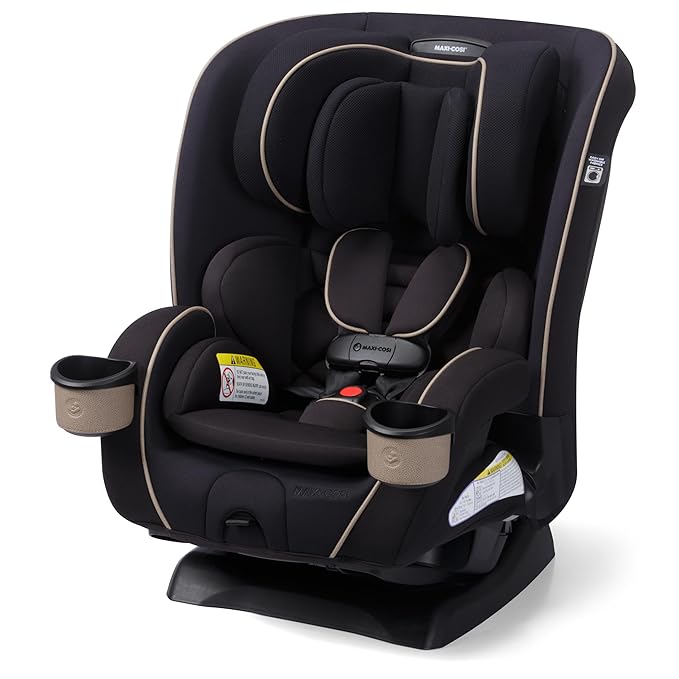
The Kani is the seat for parents who want their “daily safety item” to feel genuinely premium: soft, cushioned, breathable fabrics, little design touches that look high-end, and a slim profile intended to play nicely in crowded backseats. It’s also built for families who want one seat to carry them through multiple stages without feeling like a plastic brick.
The standout everyday feature is the magnetic ClipQuik chest clip concept: one-handed convenience when you’re juggling a diaper bag, a snack cup, and a baby who suddenly hates being buckled. For some parents, that tiny reduction in buckling friction is huge. The seat also uses a no-rethread harness/headrest system, so you’re not pulling straps through slots every time your child grows. That’s the kind of feature that keeps your harness fit correct because it’s easy to adjust instead of being a chore.
Where real-life feedback gets interesting is in the “all-in-one conversions” part. Some caregivers love the idea of converting all the way to booster mode, but mention that the conversion steps can feel bulky, heavy, or just more annoying than expected. A particularly common theme: the seat is incredible as a harness seat (rear and forward), but some families prefer buying a dedicated booster later because they want boosters that feel simpler and more stable in that specific stage.
My expert take: that’s not a failure — it’s a strategy. If you buy Kani for its comfort, slim shape, and premium daily feel, it can be fantastic. Just treat the later conversions as a bonus, not the entire reason you buy it. And if you’re a “read the manual once, then never again” person, give yourself a calm setup session when the seat arrives — the manual is thicker because the seat does more.
Why it feels premium
- Luxury fabric experience – Plush, breathable materials that feel “nice” every day.
- Magnetic ClipQuik convenience – One-handed buckling/unbuckling can speed up daily routines.
- Slim shape for growing families – Designed to fit better in busy backseats and three-across setups.
- Easy adjust no-rethread system – Helps you keep harness height correct as your child grows.
Good to know
- Conversion steps can feel bulky; many families love it most as a harness seat and add a separate booster later.
- Some users find harness loosening controls less obvious at first — learn the “feel” once and it becomes easy.
- As a premium, feature-rich seat, it rewards a careful initial setup session.
Ideal for: families who want a premium, slim-feeling all-in-one with thoughtful fabrics and a smoother everyday buckling experience.
6. Joie Saffron SI 4-in-1 (Dove) – Cozy, Modern, and Shockingly Loved

The Joie Saffron SI is one of those seats that feels like it should be “just another option” — and then you read real parent feedback and notice something: people are genuinely excited about it. They describe it as cozy, sturdy, well made, easy to clean, and comfortable enough that babies who disliked other seats suddenly tolerate car rides again. That’s the kind of real-world performance signal I take seriously.
The seat’s strongest “daily win” is the GrowTogether no-rethread headrest + harness adjustment. This matters because harness height is one of the most common “we forgot to adjust it” issues as kids grow. When adjustment is easy, parents actually do it. Parents also consistently mention the chest strap being easy to clip and unclip — a small detail that becomes a big deal when you buckle daily.
Comfort is the second theme: padding feels substantial without being squishy in a way that compromises harness fit. Kids look supported. They settle. Some caregivers even compare the comfort experience to more expensive “status” seats — which tells you this isn’t just a marketing product. It’s a seat that’s winning the everyday comfort battle.
The friction point to know about: the harness release button can be hard to press if you have long nails or limited thumb strength. That’s not a dealbreaker, but it’s worth knowing — because a stiff release button is the kind of tiny annoyance that stacks up. Also, some parents wish cup holders were more removable for deep cleaning. If you’re a “my kid leaks everything” household, that might matter.
Why parents rave
- Cozy, supportive fit – Many kids seem calmer and more comfortable compared to other seats.
- Easy no-rethread adjustments – Quick harness/headrest changes help maintain correct fit through growth spurts.
- Strong build quality feel – Owners describe it as sturdy and confidence-inspiring once installed.
- Great “value feel” at a premium tier – Feels more luxurious than expected for many families.
Good to know
- Harness release can be stiff; practice the best finger angle so it’s not annoying day to day.
- Depending on your vehicle and other seats, side-impact structure can make it feel snug in multi-seat setups.
- Cup holders may not be as easy to deep-clean as fully removable designs.
Ideal for: parents who want a modern, cozy all-in-one with a strong reputation for comfort and everyday usability.
7. Graco Grows4Me 4-in-1 (West Point) – The “Simple Longevity” Option

Some families don’t want a seat that feels like a spaceship. They want a seat that’s safe, comfortable, adjustable, and easy to live with for years. That’s the Grows4Me personality. It’s a long-use, multi-stage seat with Graco’s familiar adjustment system and a sturdy build that many grandparents love because it feels “solid” and confidence-inspiring.
In real owner feedback, two themes show up: stability and comfort. People mention that kids look comfortable and don’t seem bothered on longer drives, and the seat feels durable enough to survive daily abuse. It also helps that the recline settings make it easier to match your vehicle seat angle — which is one of those “silent” factors that affects both comfort and installation success.
Where families sometimes struggle is strap loosening. A few owners mention it can feel a bit difficult to loosen the harness at first. This is a classic “learn the exact hand position” issue: many harness release buttons feel easier once you learn the pressure point and the best angle to lift the strap while pressing the button. If you have limited hand strength, test that motion early and decide whether it fits your daily comfort.
If you want the absolute easiest cleaning strategy, Graco’s 4Ever DLX has an edge with its RapidRemove concept. But if you want a long-use seat with straightforward adjustments and a very “normal family” feel — no hype, no gimmicks — Grows4Me is a dependable pick.
Why it’s a reliable choice
- Long-use seat that feels straightforward – A practical multi-stage option without needing a learning curve.
- Comfort-forward recline settings – Helps match vehicle geometry and keeps kids comfortable.
- Sturdy, durable feel – Many families buy it specifically because it feels strong and secure.
- Easy install for many owners – Often described as quick to install and stable once tightened.
Good to know
- Harness loosening can feel stiff for some users; learning the best technique helps.
- It’s not the lightest seat for transferring between vehicles often.
- If you want a “slim three-across” specialty seat, SlimFit or TriMate may fit better.
Ideal for: families who want a long-use, practical seat that feels sturdy and comfortable without overcomplicating daily adjustments.
8. Maxi-Cosi Pria All-in-One (Sea Shadow) – The “My Kid Finally Stops Complaining” Seat

The Pria is famous for one thing: comfort. And yes, comfort matters — because an uncomfortable child turns every drive into a negotiation. Real-world parent feedback often reads like this: “We switched from a seat that felt wobbly or hard, and suddenly my kid is content.” That’s not just about softness. It’s about contouring, support, and a seat shape that allows kids to relax rather than brace.
Maxi-Cosi also does a good job with “parent ergonomics.” The QuikFit headrest and harness adjustment means you can raise height quickly as your child grows, and strap holders help keep the harness from becoming a tangled mess under your child’s back. Those little details save minutes, which saves patience, which saves your whole day.
Here’s the real-life downside you need to know: Pria can be bulky and it can eat front-seat space in rear-facing mode, especially in sedans. If you’re tall or you drive a compact car, you should think carefully about placement (often the passenger side works better). Some parents also describe the initial install as confusing until they learn the belt path and the best way to access and tighten the strap — sometimes you need to lift or shift parts of the cover to get the best leverage. Once installed, many owners describe it as solid and stable. The learning curve is mostly front-loaded.
My best tip: if your child is transitioning from an infant carrier and suddenly seems “angry in the car,” comfort-focused seats like Pria often work because they change the posture experience. That’s also why many families happily use it for years, even if it takes a bit more space.
Why it’s loved
- Comfort that kids notice – Many families report calmer rides and fewer complaints.
- Easy no-rethread adjustments – Quick harness/headrest changes keep fit correct through growth.
- Stable once you learn it – Owners often describe a very solid feel after the initial install learning curve.
- Thoughtful daily usability – Strap holders, plush inserts, and easy access reduce buckling friction.
Good to know
- Bulky in rear-facing mode; can reduce front-seat legroom in smaller cars.
- Initial install can feel confusing; the reward comes after you learn the belt path technique.
- Cup holder sizing can be smaller than some families prefer (test your favorite bottles/cups).
Ideal for: families who prioritize comfort and want a seat that kids genuinely enjoy riding in — especially after a rough experience with a less comfy seat.
9. Graco Extend2Fit (Gotham) – The “Tall Toddler Peace Treaty” Seat

If you’ve ever watched a tall toddler fold their legs into a rear-facing seat like a pretzel, you understand why Extend2Fit has a cult following. The adjustable extension panel isn’t a gimmick — it changes how rear-facing feels once your child gets bigger. It creates a posture option that can reduce “my legs are weird” complaints and can make rear-facing feel more sustainable for families who want it.
But the reason parents keep recommending Extend2Fit isn’t only legroom. It’s how installable it is. Many experienced caregivers describe it as one of the easier convertibles to install tightly, with clear leveling feedback and a LATCH system setup that helps avoid twisted straps. That last detail matters more than most people realize: twisted straps and weird routing are a top cause of “it never feels tight.” A seat that naturally guides you into correct routing reduces error.
Another underappreciated advantage: the seat can work better for taller front-seat occupants than you’d expect, depending on vehicle geometry. Some families report that the front-to-back space is surprisingly manageable compared to other rear-facing seats, even when installed next to another rear-facing model. That makes Extend2Fit a smart “main seat” if you have a tall driver who refuses to drive with their knees in the steering wheel.
The trade-off: it can be wider than three-across specialists, and the styling is more practical than boutique. If you’re trying to fit three kids across a tight row, you may struggle. But if your priority is rear-facing longevity + day-to-day install success, this seat is one of the most proven “real families actually use it” picks.
Why it’s a parent favorite
- Extension panel changes rear-facing comfort – Helps taller toddlers ride rear-facing with less fuss.
- Easy install reputation – Clear leveling, repeatable tightening, and fewer “why won’t this stay tight?” stories.
- No-rethread adjustments – Quick headrest/harness changes help keep fit correct without reinstalling the seat.
- Practical daily features – Harness storage pockets and washable cover help with everyday life.
Good to know
- Not always the easiest seat for three-across; width can limit tight-row configurations.
- The extension panel is amazing, but it’s still important to confirm front-seat space in your specific vehicle.
- Because it’s popular, you’ll find many how-to videos — but don’t let that replace the manual for your exact model.
Ideal for: families who want to rear-face longer with fewer comfort battles — especially with taller toddlers and long-legged kids.
10. Graco SlimFit 3-in-1 (Silas) – The “Rotating Cup Holder” Seat That Actually Solves Space

When parents say “I need a slim seat,” they usually mean one of two things: (1) I need to fit multiple seats in one row, or (2) I need to keep my backseat usable for passengers. SlimFit addresses both in a smart way — not by making the entire seat tiny (which can sacrifice comfort), but by solving a specific space culprit: cup holders.
Those rotating cup holders matter because they’re often the widest point on a seat. In three-across situations, that extra width is what breaks the puzzle. The SlimFit’s design gives you flexibility: rotate away when you need space, rotate back when you need snacks. Real parents repeatedly mention that it’s one of the few seats that can fit three across in vehicles where other seats simply won’t. That’s not a “nice detail.” That’s the difference between keeping your vehicle and buying a new one.
Comfort also gets a surprising amount of praise. Some owners describe their kids climbing into it happily, even when the seat is removed and brought inside briefly. That’s a good sign: kids don’t “love” uncomfortable seats. Parents also mention airflow/ventilation being noticeably better than expected, which matters on hot days.
Installation tends to be straightforward, and the InRight LATCH setup is designed to reduce the most common LATCH failure: half-attached connectors and twisted straps. Once it’s tight, it feels sturdy. The only “heads up” I’ll give: rotating cup holders can collect crumbs in their mechanism area. If your child is a snack tornado, keep a small brush in your car and do a quick clean-out once a week.
Why it’s a space saver
- Rotating cup holders – A clever space solution for three-across or tight backseats.
- Comfort that kids accept – Owners often praise padding and airflow for longer rides.
- Easy adjust headrest/harness – No-rethread system helps keep fit correct without hassle.
- Strong “multi-seat household” reputation – Many families buy multiple SlimFits because it solves their layout problem.
Good to know
- Crumbs can collect around cup holder mechanisms; quick maintenance keeps it feeling nice.
- As a three-stage seat, it’s not as “luxury cushy” as premium comfort-focused seats.
- Always confirm where your vehicle’s buckle stalk sits — buckle geometry can affect any three-across plan.
Ideal for: families who need three-across capability or want a slimmer backseat footprint without sacrificing too much comfort.
11. Graco TriRide 3-in-1 (Redmond) – Built for Long Drives and Real Kid Chaos

TriRide has a very specific vibe: sturdy, durable, and “built for real life.” Parents often describe it as heavy-duty and well padded, with recline options that make it easier to dial in both comfort and installation. If you do long drives — or if your child falls asleep in the car a lot — recline options matter because they influence head position and nap comfort.
One real-world detail that comes up: the seat can feel “deep.” Some parents look at their child and think “they look uncomfortable,” even though the child is actually fine. A deeper seat can be a comfort win for some kids because it supports thighs better, but it can also make smaller toddlers look more “nested.” If your child is on the small side, keep the inserts and harness position dialed in carefully so they don’t look swallowed.
TriRide is also a seat that tends to earn praise for being relatively easy to install compared to other seats parents have battled. That said, it’s not immune to kid behavior. One of the funniest consistent complaints is cup holders: some toddlers treat removable cup holders like toys and will pull them off. Whether that’s a dealbreaker depends on your child’s personality. If your kid is a “rip everything off” type, you may prefer a seat with more secure built-in cup holders.
My best use-case for TriRide: families who want a durable, comfortable seat and don’t mind something a bit heavier and more substantial. It’s especially good when the seat will live in one vehicle most of the time, because once installed, it tends to feel very stable and reassuring.
Why it’s road-trip friendly
- Comfort-forward recline options – Helps kids nap and ride comfortably on longer drives.
- Sturdy build – Many parents describe it as heavy-duty and confidence-inspiring.
- Easy adjust headrest/harness – No-rethread style adjustments make growth changes simpler.
- Kid-friendly organization – Cup holders and storage reduce snack chaos in the backseat.
Good to know
- Can feel deep; smaller kids may look “sunken” unless inserts and harness are dialed in carefully.
- Some kids can pull off cup holders; whether that’s a problem depends on your toddler.
- Heavier seat; not ideal for frequent car-to-car transfers.
Ideal for: road-trip families and anyone who wants a sturdy, comfortable seat that feels built for years of real kid use.
12. Safety 1st Grow and Go All-in-One (Alaskan Blue) – Simple, Comfy, Surprisingly Loved

The Grow and Go is a great reminder that “simple” can be powerful. A lot of parents overpay for complicated seats that they eventually resent because the install is fussy and the adjustments feel annoying. Then they switch to something like Grow and Go and realize: you don’t need complicated — you need repeatable. This seat earns praise for being straightforward, comfy, and less mentally taxing than some higher-tier options.
Comfort is a major theme in real feedback: parents describe kids being noticeably happier on long drives, fussing less, and even falling asleep more easily. That matters because ride comfort isn’t just “nice.” It affects whether your child fights the car, whether you dread leaving the house, and whether you feel calm enough to buckle correctly every time. The included pillows help smaller babies feel snug, and the seat’s overall design doesn’t feel like it’s trying to do too much.
Cleaning is another practical win. The cover is designed to snap off more easily than many seats, and families love that it can go through the washer and dryer. That sounds boring until you’ve waited two days for a cover to air dry while your kid uses a backup seat with a scratchy towel under them. Dishwasher-safe cup holders also help — though note: removable cup holders are always a tugging temptation for some toddlers.
The “hard truth” to know: some owners find installation and strap tightening requires strength, especially in vehicles with steeply angled seat belts. A common technique parents use: put weight into the seat (literally using your body) while tightening, and pull the strap from the best leverage point (occasionally by lifting a small part of the cover for access). Once you learn the technique, many families get a solid install — but this seat rewards patience at setup.
Why it’s a value winner
- Simple design that reduces stress – Less complicated means easier daily use for many families.
- Comfort that improves car rides – Many kids seem calmer compared to less padded seats.
- Cleaning feels doable – Snap-off cover and dishwasher-safe parts reduce mess panic.
- Doesn’t eat your whole backseat – Often described as not overly space-hogging for an all-in-one.
Good to know
- Install/tightening can require strength; the “push down while tightening” technique helps.
- Some vehicles don’t love certain seatbelt geometry; LATCH may feel easier for many families.
- Harness straps can sometimes catch; keeping straps flat and using holders helps.
Ideal for: families who want a long-use seat with simple daily operation and a reputation for comfort — without paying for premium complexity.
13. Safety 1st TriMate 3-in-1 (Sharkskin) – The “Under-19-Inch” Three-Across Tool

TriMate is built for a specific problem: “How do I fit multiple seats across a row without sacrificing comfort?” With a slim profile (especially when cup holders are removed), it’s designed for families who need space more than luxury. That makes it relevant for growing families, carpool situations, and foster households managing multiple age ranges.
Real-world feedback is mixed in a way that’s actually useful if you interpret it correctly. Some families describe it as easy to install with a tight, wiggle-free result and praise how easy it is to clean — notably, some say they can wash fabrics without undoing the harness system, which is a massive win if you’ve ever fought with harness routing after laundry. Others praise the padding and say their kids find it surprisingly comfortable.
But there’s also an important subset of feedback describing the seat as difficult to install tightly in certain vehicles, with excessive movement when installed incorrectly or in an incompatible setup. This is not unique to TriMate — slim seats can be more sensitive to vehicle seat shape and belt geometry because you’re squeezing more function into a tighter footprint. So my expert guidance is: TriMate can be excellent in the right vehicle, but it is not a “blind buy” seat if your vehicle seats are very sloped or your buckle stalks sit at awkward angles.
If you’re considering it, do one smart thing: plan to do a calm, deliberate install the first time. Use the visible belt paths, confirm you’re at the correct recline for your child’s stage, and check movement at the belt path (not at the top of the seat). When it’s installed correctly, many families love it — especially for three-across. When it’s not, it’s frustrating. TriMate rewards correct technique more than some bulkier “forgiving” seats.
Why it can be a win
- Slim profile for three-across – Designed to solve the “we can’t fit everyone” problem.
- Comfortable insert strategy – Memory-foam style infant insert helps smaller babies feel supported.
- Cleaning convenience – Removable pad and dishwasher-safe cup holders reduce mess stress.
- Great for multi-seat households – Many foster/caregiver households praise ease of use once installed.
Good to know
- Vehicle compatibility matters; some users report difficulty achieving a stable install in certain cars.
- Cup holders can come out easily for some kids; consider whether your child will treat them like toys.
- Because it’s a slim design, careful installation technique makes a bigger difference than with bulkier seats.
Ideal for: families who need a slim three-across solution and are willing to prioritize a careful initial install for a stable, long-term setup.
14. Maxi-Cosi Romi 2-in-1 (Sea Shadow) – Lightweight Travel Seat With a Shoulder-Carry Trick

Romi is a niche seat — and when it matches your niche, it can feel brilliant. It’s designed to be lightweight, travel-ready, and easier to move between cars (or onto a plane) than typical convertibles. For frequent flyers or families bouncing between vehicles, weight matters because you’re not just installing a seat — you’re carrying it through airports, up stairs, and across parking lots.
The most interesting design detail is the shoulder-carry idea: you can attach the top tether to the shell and use it like a carry strap. That’s a very “real world” engineering choice, because it acknowledges something most brands ignore: parents do not carry car seats like product designers imagine. They sling them, they balance them, they juggle them with bags. A seat that plans for carrying is a seat that understands travel reality.
The honest caution: because this model is newer with fewer reviews, feedback includes both enthusiastic travel success stories and strong complaints about installation difficulty and fabric wear (like pilling). That tells me two things: (1) it can work beautifully for some travel situations, and (2) it might be less forgiving in certain vehicles or for certain installation preferences. If you want a seat that feels “effortless” to install across many cars, a more established mainstream model may feel safer emotionally.
My expert recommendation is to treat Romi as a “tool,” not a universal solution. If your top priority is lightweight travel convenience and you’re comfortable practicing installation, it can be a smart pick. If your top priority is a seat that installs tight in every vehicle without you thinking, choose a more established all-in-one and leave travel to a separate strategy.
Why travelers like it
- Very lightweight for a convertible – Easier to carry, move, and travel with compared to typical convertibles.
- Airplane certified design – Built with travel use in mind, including multi-vehicle flexibility.
- Shoulder-carry tether trick – A surprisingly helpful detail when moving through airports.
- Washable fabrics – Practical for travel messes and daily spills.
Good to know
- Mixed early feedback on installation ease; practicing at home first matters.
- Some users report fabric pilling quickly; consider whether that would bother you.
- Because it’s a travel tool, it may not feel as plush or “luxury stable” as heavier seats.
Ideal for: frequent travelers who want a lightweight convertible seat and are willing to practice installation for a smoother on-the-go experience.
15. Diono LiteClik 30 R SafePlus – The Ultra-Light Infant Seat Some Families Prefer First

This guide focuses on convertible seats, but I’m including LiteClik 30 for one real-life reason: some parents still prefer an infant carrier for the first phase, then switch to a convertible when baby gets heavier. If you’re doing that, the best infant carrier is the one you’ll actually carry — and LiteClik’s lightweight feel is the entire point.
The “Diono personality” is also relevant here: the brand is known for steel-reinforced construction in its other seats, and LiteClik borrows that “built like it matters” energy. Parents frequently describe it as lightweight yet durable, with materials that feel soft and well padded. It also earns praise for ease of use: clicking in and out, installing the base without drama, and feeling secure once tightened. That combination — lightweight + confidence — is rare in infant seats, which often force you to choose one or the other.
A travel-focused detail: the seat is designed to support baseless installation in rideshare vehicles using lock-off style guidance. That matters because many infant seats are technically baseless-installable but not emotionally comfortable to do quickly. Owners who like LiteClik often mention feeling more confident doing installs compared to other basic infant carriers they previously disliked.
If you’re deciding between “start with a convertible” and “start with an infant carrier,” here’s the honest truth: a convertible simplifies purchasing, but an infant carrier can simplify the newborn months because you can move a sleeping baby without unbuckling them. If that matters to you, a lightweight infant seat like this can be a smart first step — then you can transition to one of the long-use convertibles above when you’re ready.
Why it’s included
- Lightweight carry advantage – Easier on wrists and shoulders, especially for solo parents.
- Durable construction feel – Steel-reinforced mindset gives many parents extra confidence.
- Easy base installation – Owners often describe a secure install without excessive wrestling.
- Rideshare-friendly options – Lock-off style guidance supports baseless installs for on-the-go families.
Good to know
- This is an infant seat, not a long-use convertible; you’ll still switch later.
- Some families want a second base for a second car; availability can vary by listing.
- If you want one seat for years without switching, choose a 4-in-1 all-in-one instead.
Ideal for: families who want a lightweight infant carrier first — especially for travel and daily carrying — before moving into a long-use convertible later.
Installation Power Moves That Prevent Regrets (and Returns)
Most “car seat regret” is not about safety standards. It’s about frustration: the seat that never feels tight, the harness you can’t loosen with one hand, the recline that seems right until your baby’s head slumps, the seatbelt path you can’t reach without removing half the cover. Here’s how experienced parents make almost any good seat work — and how they choose seats that make these steps easier.
The 3-minute “tight install” checklist
- Check movement at the belt path – Grab where the belt or lower anchors run through the seat and test for wiggle there, not at the top.
- Match recline to stage – A too-upright newborn recline can cause head slump; too reclined wastes front-seat space and can reduce stability.
- Use your body weight – Push down into the seat (knee or forearm pressure) while tightening for a truly planted install.
- Keep belts flat – Twists in LATCH straps or seatbelts can prevent a seat from tightening fully.
- Lock the seatbelt correctly – If your seat has a lock-off, use it as designed; if not, confirm your vehicle’s belt locking behavior.
- Finish with a harness reset – After installation, loosen and retighten the harness once to ensure it moves smoothly and isn’t snagged.
Seats that “win” in real life tend to make these steps easier: clear leveling (Chicco Fit4), straightforward belt paths (many Graco models), and features that reduce effort (SnugLock-style installs, integrated lock-offs, force-multiplying LATCH).
Common headaches and the quick fix
- “It’s still wiggly.” Re-check that you’re testing at the belt path, not the headrest. Add body weight while tightening.
- “Seatbelt install tilts sideways.” Some vehicles have aggressive shoulder belt angles. Try a different seating position or use the seat’s lock-off correctly.
- “Harness won’t loosen.” Learn the pressure point and lift angle. Some buttons are stiff by design; technique changes everything.
- “Straps get stuck behind the seat.” Use harness holders/pockets every time so straps don’t disappear under your child’s back.
- “Three-across isn’t working.” Solve for cupholders and shoulder-width shape, not just base width. Rotate/fold cupholders when possible.
- “My kid gets carsick.” Recline, posture, and head position matter. A more supportive seat shape can reduce discomfort (and cleanup is easier with fast-remove covers).
The goal isn’t perfection. The goal is a setup you can repeat under stress. The best seat is the one that keeps you calm enough to use it correctly, every time.
FAQ: Convertible Seats, Newborns, Rotation, and Real Life
Can I start with a convertible seat from day one?
How do I know if my seat is truly “tight enough”?
Are rotating seats worth it?
Which seats are best for three-across?
What’s the fastest way to clean a seat after a mess?
Why does my child hate one seat but love another?
Final Thoughts: Choose the Convertible Seat For Infant That Matches Your Real Life
The best seat isn’t the one with the loudest marketing. It’s the one that makes your daily routine easier while keeping your child properly secured. When parents feel confident, they install better, buckle better, and adjust fit more consistently. That’s the hidden superpower of choosing the right model.
Here’s how to convert this guide into a clear decision:
- Want the most balanced “main seat” that does everything well? Start with the Graco 4Ever DLX 4-in-1. It’s the seat that families keep for years because it stays practical — especially when mess happens.
- Want installs to feel obvious and repeatable? Choose the Chicco Fit4 4-in-1. It’s built for low-guesswork setups and staged fit comfort from newborn onward.
- Need rotation to save your back in daily life? For a “main seat” rotating pick, grab the Graco EasyTurn 360. For a compact second-car rotating hero, look at the Evenflo REO by Revolve360.
- Trying to rear-face longer with a tall toddler? The Graco Extend2Fit is the legroom-and-longevity favorite.
- Need three-across capability? Start with Graco SlimFit and consider the slim-friendly Safety 1st TriMate if your vehicle geometry plays nicely with slim seats.
- Want premium comfort and a luxe feel? The Maxi-Cosi Kani and Maxi-Cosi Pria are the “my kid actually relaxes” picks, with different strengths.
- Want a simple, comfy budget all-in-one? The Safety 1st Grow and Go is a comfort-forward value pick that many parents say improved their daily rides.
- Travel a lot and want lightweight flexibility? The Maxi-Cosi Romi is the lightweight travel convertible option, and the Diono LiteClik 30 is the lightweight infant-carrier alternative for families who start with a bucket seat first.
If you take one thing from this guide, let it be this: choose the seat that reduces your daily friction. When your seat is easy to install, easy to adjust, and comfortable enough that your child settles quickly, you’ll use it correctly every time. Pick the convertible seat for infant that matches your vehicle, your family layout, and your real routine — and you’ll stop second-guessing your decision.

Mo Maruf
I created WellFizz to bridge the gap between vague wellness advice and actionable solutions. My mission is simple: to decode the research and give you practical tools you can actually use.
Beyond the data, I am a passionate traveler. I believe that stepping away from the screen to explore new environments is essential for mental clarity and physical vitality.