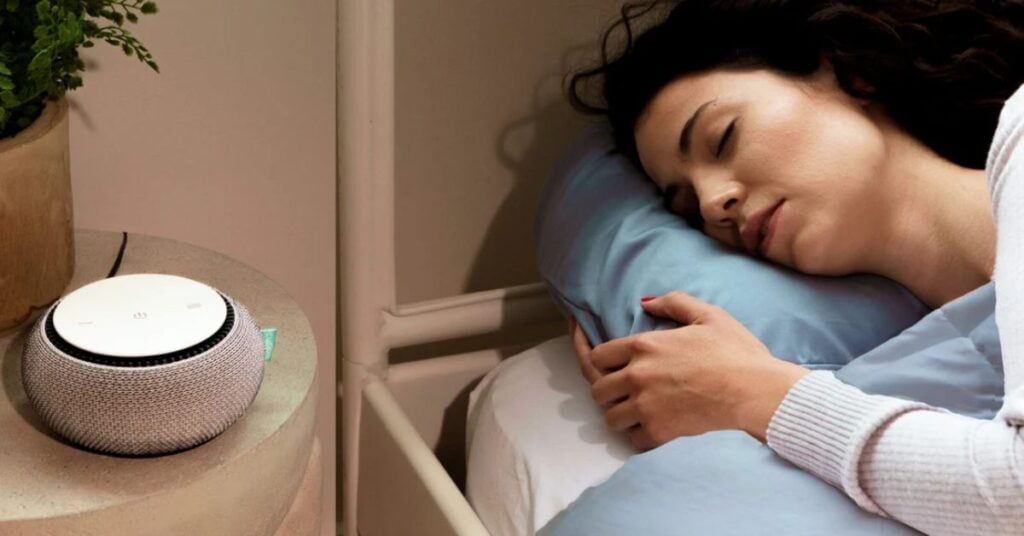
White noise machines can help many sleepers by masking sudden sounds, when volume stays modest and the speaker sits away from your head.
If you’re asking, Do White Noise Machines Work?, you’re usually chasing fewer wake-ups from random noise. Maybe it’s the neighbor’s door, a car outside, or a partner’s snore. A steady sound can soften those spikes and make the night feel smoother.
You’ll get a plain-English take on why white noise can help, where it falls flat, and how to set it up for comfort.
Do White Noise Machines Work? What The Research Says
White noise is a broad-band sound that spreads energy across many frequencies at once. In everyday terms, it’s the steady “shhh” you hear from a fan, an air purifier, or a dedicated noise unit. The point isn’t entertainment. The point is consistency.
Why steady sound can feel calmer
Sleep gets disrupted by contrast. A quiet room makes a small sound feel sharp. When a constant sound is present, that same event often lands with less punch because it blends into a wider sound bed. This is sound masking: you’re not deleting noise, you’re reducing the jump between “silent” and “sudden.”
Masking has limits. If bass is shaking the wall or a window rattles, you still hear it. Still, fewer spikes feel urgent, so you may stay asleep.
What published studies show
Studies vary because rooms and sleepers vary. In a bedroom with irregular noise events, a steady sound can reduce awakenings for some sleepers and speed sleep onset. A 2021 systematic review in PubMed summarizes mixed results across study designs. Noise as a sleep aid: A systematic review maps the evidence.
The usable takeaway is simple: white noise tends to work best when it has a job to do. If the problem is random sound spikes, it can help. If the problem is pain, reflux, or an inconsistent sleep schedule, the machine is less likely to move the needle on its own.
When White Noise Helps Most
White noise isn’t one-size-fits-all. It shines in a few common situations. You can often predict success by naming what keeps waking you.
Shared walls and stop-start noise
Many homes have “little” noises that still ruin sleep: hallway voices, footsteps overhead, a closing cabinet, a neighbor’s TV that turns on early. These are short, uneven events. A steady sound can soften them enough that you roll over instead of fully waking.
Snoring that comes in bursts
Snoring tends to be rhythmic, then suddenly louder, then quiet again. That on-off swing is what grabs attention. A noise machine can reduce the contrast so each burst feels less sharp. This won’t cure snoring, and it won’t always mask loud snoring, but it can make the room feel steadier for the person trying to sleep.
Ringing ears at bedtime
Some people with tinnitus use low-level sound to make ringing less dominant when the room is quiet. A gentle noise can blend with the ringing and make it harder to lock onto. If ringing is new, one-sided, or paired with hearing changes, a hearing professional can check what’s going on.
How To Set It Up So It Works
The setup matters more than the brand. The two dials that decide your result are placement and volume. Aim for “steady background,” not “loud blanket.”
- Pick the noise you want to mask. Street bursts, hallway voices, or snoring.
- Put the device between you and that noise. If the hallway is the issue, place it closer to the door side of the room.
- Start low. Turn it down until it’s barely audible, then raise it one small step.
- Check it from your pillow. The sound should feel even and soft, not hissy or sharp.
- Use a timer if you want flexibility. A 30–90 minute timer can help you fall asleep without running all night.
- Keep it steady for a week. One night can mislead you.
If you share the room, start with placement. Put the machine closer to the person who wants it so the volume can stay lower.
Common Problems And What To Try First
This table links real sleep problems to the first change that tends to help. Use it to avoid trial-and-error that drags on for weeks.
| Sleep Disrupter | What To Try | Small Setup Note |
|---|---|---|
| Hallway voices | Place the unit near the door side | Lower volume can work when placement is right |
| Random car doors | Run steady noise through your usual wake window | A timer that ends too early can backfire |
| Snoring bursts | Put the unit closer to your side | Try pink or brown noise if white feels hissy |
| Upstairs footsteps | Place the device on a dresser | Hard floors can amplify floor-placed speakers |
| Hotel room noises | Use a portable unit with memory settings | Apps can stop when alerts arrive |
| Light sleeper in a quiet room | Start at the lowest audible level | Too loud can keep you alert |
| Ringing ears at bedtime | Choose a softer noise color | Keep it gentle and consistent |
| Early-morning chores in the home | Ask for quieter routines plus masking | Soft-sole slippers can change a lot |
Noise Levels And Safe Habits
White noise feels gentle, so volume creep is the main risk. Set a target range and check it now and then.
What official noise limits can teach you
Public standards are written for jobs, but they’re still useful guardrails. NIOSH explains that long exposure around 85 dBA averaged over an eight-hour workday can raise hearing loss risk. Noise-Induced Hearing Loss (NIOSH) lays out how level and time add up. OSHA’s legal workplace limit is higher, with an eight-hour permissible exposure level of 90 dBA. Occupational Noise Exposure (OSHA) summarizes how time-weighted exposure is handled in regulation.
For sleep, you want far below workplace limits. Many adults do well with a modest background level that still lets an alarm cut through. If you can’t hear your alarm at a normal setting, the noise is too loud.
Babies and young kids
For infants, keep devices away from the crib and keep volume low. A Pediatrics paper measured infant sleep machines and found all tested devices could exceed 50 dBA at close range, with some capable of much higher output. Infant Sleep Machines and Hazardous Sound Pressure Levels also points to safer habits: more distance, lower volume, and shorter run time when possible.
If a child relies on all-night noise, taper it down slowly. Lower the volume one small step every few nights, or use a timer that shuts off after the child is asleep.
Placement And Volume Targets
You don’t need lab gear to get close to a good setup. A basic decibel meter app can give a rough read. It won’t be perfect, but it can keep you out of the “too loud” zone and stop volume creep.
| Placement | Target At The Pillow | What This Does |
|---|---|---|
| Across the room | 35–45 dBA | Good starting point if you’re sound-sensitive |
| On a dresser near the door | 40–50 dBA | Softens hallway spikes without blasting your ears |
| On your side of the bed | 40–50 dBA | Helps with snoring bursts and uneven room noise |
| Near a window | 40–50 dBA | Reduces contrast from traffic bursts |
| Portable unit in a hotel | 40–50 dBA | Stabilizes a new room with odd building sounds |
| Kid room with device away from bed | Lower than adult targets | Keeps output gentle while still smoothing household noise |
Choosing A Machine Without Overthinking It
Most devices can generate usable noise. The difference is consistency and comfort. These are the features that tend to matter.
Real noise generation vs loops
Some machines generate noise in real time. Others play a loop. Loops can work, but some people notice a repeating seam. If you’re sensitive to patterns, test the device in a quiet afternoon. If you catch the seam then, you’ll catch it at night.
Noise color and tone
White noise carries more energy in higher frequencies, which can feel hissy in some rooms. Pink noise tilts lower and often feels softer. Brown noise tilts lower still and can feel like a distant rumble. If white noise bothers you, try pink or brown before turning the volume down until masking fails.
Timer, memory, and power choices
A timer helps if you want the sound only for falling asleep. Memory settings save you from re-tuning the machine after a power flicker. If you use a phone app, keep the phone in airplane mode so alerts don’t cut through the noise.
Room Tweaks That Let You Run Lower Volume
A noise machine works best when it doesn’t have to fight a loud baseline. A few room tweaks can reduce spikes, so you can keep masking gentle.
- Seal door gaps. A door sweep and weather stripping cut hallway leaks.
- Move the bed. Put a little space between the headboard and a shared wall.
- Add soft surfaces. Rugs and thicker curtains tame echo and sharp reflections.
- Pad the rattles. Felt pads stop small clacks from frames and vents.
- Block a thin wall. A full bookcase adds mass between you and voices.
Lower peaks let you run lower volume, which feels better over long nights.
A One-Week Test To Know If It’s Worth Keeping
Try the same setup for seven nights, then judge it with three questions:
- Did you fall asleep faster on most nights?
- Did you wake up less from random sounds?
- Did you feel more rested in the morning?
If you get two “yes” answers, keep it. If you get zero or one, change one thing and retest: noise color, placement, or volume. If it still annoys you, skip it.
References & Sources
- U.S. National Library of Medicine (PubMed).“Noise as a sleep aid: A systematic review.”Summarizes research on continuous noise and sleep outcomes across many study designs.
- Centers for Disease Control and Prevention (NIOSH).“Noise-Induced Hearing Loss.”Explains how sound level and exposure time link to hearing loss risk.
- Occupational Safety and Health Administration (OSHA).“Occupational Noise Exposure.”Summarizes workplace noise limits and the time-weighted exposure concept.
- U.S. National Library of Medicine (PubMed).“Infant Sleep Machines and Hazardous Sound Pressure Levels.”Reports measured output levels from infant sleep machines and notes safer placement and volume habits.

Mo Maruf
I created WellFizz to bridge the gap between vague wellness advice and actionable solutions. My mission is simple: to decode the research and give you practical tools you can actually use.
Beyond the data, I am a passionate traveler. I believe that stepping away from the screen to explore new environments is essential for mental clarity and physical vitality.