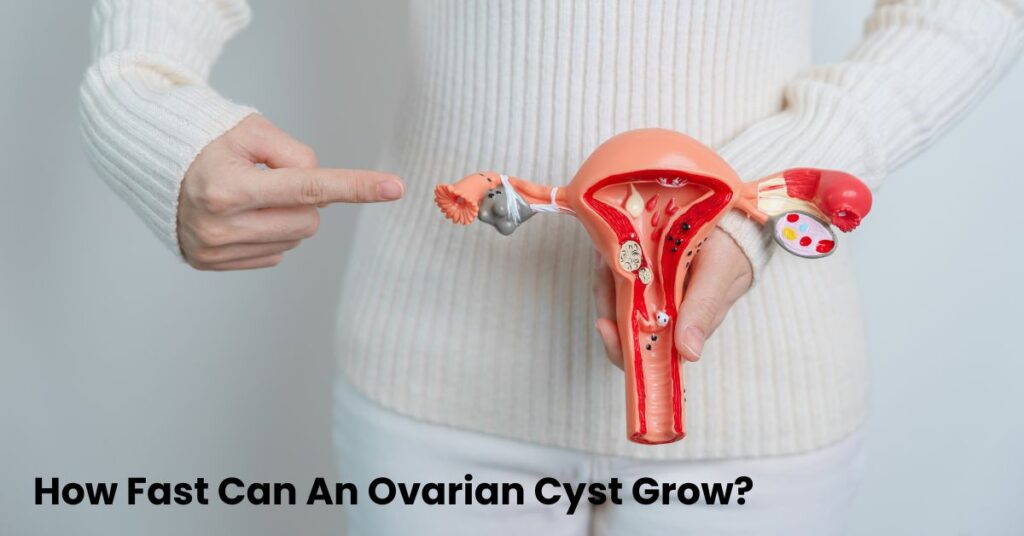
Most fluid-filled cysts on the ovary change over weeks, while some types grow over years; sudden size jumps can follow bleeding.
If you’ve been told you have an ovarian cyst, it’s easy to latch onto one detail: the size. You may be wondering if it can change fast or drift up over time. The answer starts with the cyst type and what’s inside it.
This article gives you a grounded way to think about speed, then shows how clinicians track changes on ultrasound. You’ll also see clear signs that call for urgent care, since the way you feel can change faster than the size on a report.
What “Fast Growth” Means In Real Life
Speed is easiest to grasp when it’s tied to a time window. A cyst that changes within one menstrual cycle is usually a different category than a cyst that keeps enlarging over several follow-up scans.
Weeks
Changes over weeks are common with functional cysts, which form around ovulation. A follicle can keep filling with fluid, then later shrink. A corpus luteum cyst can enlarge early in a cycle, then resolve. A scan done at a different point in your cycle can show a different size even when nothing is “wrong.”
Days
A jump over days is more likely when a cyst bleeds into itself or ruptures. Bleeding can make a cyst look larger and more complex on ultrasound, and it can bring on sudden pain. The size change is real, yet it often reflects blood and clot, not a new mass of growing tissue.
Months To Years
Persistent cysts that contain tissue, such as dermoid cysts and endometriomas, tend to change more slowly. Some stay stable for long stretches, then drift upward. Others grow steadily. In these cases, the plan is shaped by cyst type, symptoms, and your stage of life.
How Fast Can An Ovarian Cyst Grow? Week-To-Week Clues
People ask this question because they want a number. Real-world ranges are messier than a single rate, so it helps to sort cysts by their usual rhythm.
Functional Cysts And The Monthly Cycle
Functional cysts are tied to ovulation. They can grow as fluid builds, then shrink as the cycle moves on. Many resolve without treatment in a short window. MedlinePlus notes that functional ovarian cysts often go away on their own within 8 to 12 weeks, and a repeat ultrasound in 6 to 8 weeks is a common way to check that trend (MedlinePlus ovarian cysts: treatment and follow-up).
What This Can Look Like On A Report
A cyst can be smaller on the next scan, or disappear on the scan after that. That pattern can still fit with a functional cyst.
Hemorrhagic Cysts And Sudden Changes
A hemorrhagic cyst can expand when blood fills the cyst cavity. Some people feel a sharp, one-sided pain that starts suddenly. Others notice a dull ache that comes and goes. On ultrasound, the cyst can look more complex because blood creates internal echoes.
Why “Bigger” Doesn’t Always Mean “Worse”
If the scan features fit with a hemorrhagic cyst, clinicians often recheck after a short interval to confirm it is clearing. The time window depends on symptoms and the exact scan findings.
Dermoid Cysts And Slow Drift
Dermoid cysts tend to be slow growers. In a study of expectant management of ultrasonically diagnosed ovarian dermoid cysts, the mean growth rate during follow-up was 1.67 mm per year (PubMed study on dermoid cyst growth rate). That rate can still add up over time, which is why ongoing monitoring is common when surgery isn’t chosen right away.
Cysts That Can Reach Large Sizes
Some benign cysts, such as cystadenomas, can keep enlarging and cause pressure, bloating, or urinary frequency. A cyst that grows across multiple scans usually triggers a more active plan.
How Clinicians Track Growth On Ultrasound
Tracking comes down to three pieces: measurement, appearance, and timing.
Measurement Is An Estimate
Ultrasound reports often list three dimensions instead of a single number. Small shifts can come from angle and shape changes.
Appearance Drives The Plan
A simple cyst has a thin wall and clear fluid. A complex cyst may have internal echoes, septations, or solid-appearing parts. Appearance can drive follow-up even when size is steady.
Timing Is Chosen On Purpose
During years with regular periods, a follow-up scan is often scheduled after a short interval, since many functional cysts resolve within a couple of cycles. The NHS notes that if a cyst is found, a repeat ultrasound in a few weeks may be used to monitor it (NHS overview of ultrasound monitoring).
After menopause, follow-up tends to be closer. During pregnancy, timing is shaped by pregnancy stage and symptoms.
Cyst Types And Typical Growth Patterns
The table below groups common cyst categories by the pattern many clinicians expect to see. It’s a practical map, not a diagnosis. Your own plan should be based on your scan details and how you feel.
| Cyst Category | Usual Time Pattern | Common Next Step |
|---|---|---|
| Follicular (functional) | Can enlarge within one cycle, then shrink | Repeat ultrasound after a short interval if it persists |
| Corpus luteum (functional) | May enlarge early, then resolve over weeks | Observation if stable and symptoms are mild |
| Hemorrhagic cyst | Can look larger quickly after bleeding | Follow-up imaging to confirm it is clearing |
| Endometrioma | Often persists and changes slowly | Monitoring; treatment tied to pain and fertility plans |
| Dermoid (mature teratoma) | Often slow, with growth in millimeters per year | Periodic scans or surgery based on size and symptoms |
| Cystadenoma | Can keep enlarging and reach large sizes | Often removed if persistent or causing pressure |
| Paraovarian cyst | May stay stable or slowly enlarge | Monitoring or removal if symptomatic |
| Suspicious adnexal mass | Speed varies; scan features matter most | Specialist review and specific testing |
A pattern over time is usually more useful than one isolated measurement. If you have older scans, bring them. Trend context often changes the plan.
If you track cycle dates and when pain hits, you give your clinician a timeline that matches the scan. That can cut down on extra testing.
When Pain Or Symptoms Mean “Get Help Now”
Most cysts don’t lead to an emergency. Still, a cyst can rupture or twist an ovary. Those problems can cause sudden symptoms that should not be waited out at home.
Mayo Clinic lists sudden severe abdominal or pelvic pain, pain with fever or vomiting, and signs of shock as reasons to get immediate medical help (Mayo Clinic: when to seek urgent care).
If you’re pregnant, sudden pelvic pain needs prompt evaluation since several conditions can feel similar. If you are postmenopausal, a new cyst also tends to get closer follow-up, even when you feel fine.
| What You Notice | What It May Signal | What To Do Next |
|---|---|---|
| Sudden severe one-sided pelvic pain | Torsion or rupture | Seek same-day urgent care or emergency care |
| Pain with nausea or vomiting | Torsion, rupture, or bleeding | Get evaluated quickly, even if pain comes in waves |
| Fever with pelvic or belly pain | Infection or another acute cause | Urgent medical evaluation |
| Lightheadedness, weakness, clammy skin | Blood loss or shock | Call emergency services |
| Rapid belly swelling | Bleeding, fluid build-up, or another cause | Same-day clinical advice |
| New trouble urinating or passing stool | Pressure from a large mass | Contact a clinician soon |
| New severe pain during sex | Pelvic irritation that needs evaluation | Book a medical visit |
| Persistent bloating and getting full quickly | Needs evaluation, especially after menopause | Arrange a prompt medical visit |
What Clinicians Often Do Next
After a scan shows a cyst that is larger than before, the next step is sorting out type, stability, and whether removal is needed.
Repeat Imaging
If the cyst is simple and you feel okay, many clinicians recheck after a short interval. The timing can depend on cycle timing, size, and scan appearance.
Cycle-Suppressing Medicine
Hormonal birth control can lower the chance of forming new functional cysts. It does not shrink every existing cyst, so it’s usually offered as a prevention tool when cysts keep recurring.
Surgery
Surgery is more likely when a cyst persists, keeps enlarging, causes ongoing pain, looks complex, or reaches a size where twisting becomes more likely. The goal is often to remove the cyst while leaving as much ovarian tissue as possible. The approach depends on the cyst type and the surgical setting.
Fertility Planning
Many ovarian cysts don’t block pregnancy. Still, some cyst types and some surgeries can affect ovary function. If pregnancy is on your mind, say it early, since it can shape timing and the balance between monitoring and removal.
Questions To Bring To Your Appointment
Visits can feel rushed. A short list helps you leave with a clear plan.
- What type of cyst does the scan description point to?
- Is it described as simple or complex?
- What size change would count as true growth, not measurement drift?
- When should the next scan happen, and why that timing?
- Which symptoms should trigger urgent care for me?
- If surgery is on the table, what would be removed: cyst only, ovary, or both?
- Will this plan change if I want pregnancy soon?
Practical Next Steps
Start by saving your scan report and any prior reports. Write down your cycle dates and symptom pattern, since timing often explains shifts in size. If your pain pattern changes suddenly, seek care even if your last scan looked steady.
Most cyst stories end with the cyst shrinking, settling, or being removed safely. A good plan matches the cyst type, the scan appearance, and how you feel, so you spend less time guessing and more time getting on with your day.
References & Sources
- MedlinePlus (U.S. National Library of Medicine).“Ovarian cysts: MedlinePlus Medical Encyclopedia.”Notes on common cyst symptoms, typical ultrasound follow-up timing, and natural resolution for functional cysts.
- PubMed (U.S. National Library of Medicine).“Expectant management of ultrasonically diagnosed ovarian dermoid cysts: is it possible to predict outcome?”Reported mean growth rate for ovarian dermoid cysts during follow-up.
- NHS.“Ovarian cyst.”Overview of symptoms, diagnosis, and the use of repeat ultrasound scans for monitoring.
- Mayo Clinic.“Ovarian cysts: Symptoms and causes.”Urgent warning signs, including severe pain and signs of shock.

Mo Maruf
I created WellFizz to bridge the gap between vague wellness advice and actionable solutions. My mission is simple: to decode the research and give you practical tools you can actually use.
Beyond the data, I am a passionate traveler. I believe that stepping away from the screen to explore new environments is essential for mental clarity and physical vitality.