Our readers keep the lights on and my smoothie glass nicely filled. As an Amazon Associate, I earn from qualifying purchases.
Specs are compiled from manufacturer listings and verified buyer reviews and can change over time — please confirm the key details on the product page before buying.
If you camp or grow in a tent, you already know the problem: a cold snap hits at 2 a.m. and everything you planted or packed is at risk. The right electric tent heater keeps that space above freezing without fumes, without a flame, and without dragging a propane tank into a sealed space. This guide covers nine models built specifically for tents, greenhouses, grow rooms, and workshops, and tells you which one to plug in first.
I’m Mohammad Maruf — the founder and writer behind WellFizz. This guide is built by comparing the manufacturers’ published specifications and the patterns across verified customer reviews, so you get each pick’s real strengths and trade-offs instead of marketing spin.
You will see wattage, heat coverage, safety shutoffs, and thermostat behavior side by side, so you can match a unit to your tent size before you order. Here are the nine picks that matter, ranked by what they actually do for an electric tent heater setup.
Our Picks at a Glance


How To Choose The Best Electric Tent Heater
Most buyers get this backwards. They buy the most powerful heater they can find, then discover their tent circuit trips the moment it kicks on. The correct order is: match the heater to your space and your power source first, then worry about smart features.
Match Wattage to Your Actual Tent Volume
Watts are the raw heat output number, and it decides whether a unit can hold a temperature on a freezing night. A 1500W heater draws heavy current, so it needs a dedicated circuit. Meanwhile a 250W personal heater sips power — roughly 2.1 amps — and will not trip a shared breaker. For a sealed grow tent of a few dozen cubic feet, a 530W or 700W PTC unit often maintains temperature better than a blasting 1500W model that overshoots and cools in cycles.
Thermostat Knob or Smart App
A basic rotary thermostat cycles the heater on and off mechanically to hold a temperature band. It is simple and never loses a Wi-Fi signal. A smart sensor and app let you set day and night targets, log temperature swings, and get alerts on your phone — genuinely useful if your greenhouse sits outside your house. The trade-off is that app reliability varies by brand, and a few app features need a subscription to open up.
Safety Shutoffs Are Not Optional in a Sealed Space
Any heater going into a tent, greenhouse, or chicken coop needs two things: an overheat cutout and a tip-over switch. The overheat sensor kills power when internals get too hot, and the tilt switch cuts power the instant the unit tips. A grounded three-prong plug and ETL or UL listing are worth insisting on, since tents and greenhouses are often placed on damp ground or concrete.
Quick Comparison
| Model | Best For | Heat Output | Coverage | Safety Shutoff | Amazon |
|---|---|---|---|---|---|
| GiveBest Portable Electric Space Heater★ Best Overall | Small tents and desks | 1500W / 750W | 200 sq ft | Overheat + tip-over | Amazon |
| VEVOR Greenhouse Heater 1500W PTCGreenhouse Champ | Greenhouses and grow tents | 5100 BTU / 1500W | 150–200 sq ft | Overheat protection | Amazon |
| Fanspex 1500W Portable Electric HeaterBuilt Like a Tank | Garages and sheds | 1500W / 750W | Small spaces | Overheat + tip-over | Amazon |
| Performance Tool W5011 250W | Off-grid and van camping | 250W / 853 BTU | Personal pocket | Tip-over | Amazon |
| shinic 1500W Milkhouse Heater | Barns and workshops | 1500W / 1300W | 200 sq ft | 158°F overheat + 360° tip-over | Amazon |
| Spider Farmer 530W Grow Tent Heater | Small grow tents | 530W | Small grow spaces | Hardware + over-temp protection | Amazon |
| DR. INFRARED HEATER DR218-3000W | Large garages and greenhouses | 3000W | 600 sq ft | Enclosed element | Amazon |
| VIVOSUN AeroFlux 700W PTC Heater | Climate-tracked grow rooms | 700W | Compact grow spaces | V0 flame-retardant + tip-over + overheat | Amazon |
| Kiroto 1500W Greenhouse Heater with App | Remote greenhouse monitoring | 1500W | 150 sq ft | 149°F overheat + 10-second tip-over | Amazon |
In‑Depth Reviews
1. GiveBest Portable Electric Space Heaters for Indoor Use
Our pick — over 4★ from 14,500+ verified ratings; the strongest balance of quality and price.
The default pick for a small tent because the safety switch works the instant it moves.
Two heat settings give you a real decision rather than a token choice. The high setting runs at 1500W for fast warm-up, and the low setting drops to 750W for overnight maintenance. There is also a cool-air fan mode, so the same unit circulates air in July. A built-in thermostat turns the heater off once it hits your set temperature and back on when the air cools again, which is what keeps it from baking a small tent.
That tip-over system deserves a callout because it is the reason this model tops the list for tent use. It will not run unless it sits on a firm flat surface, and it cuts power the moment it is lifted or shifted. GiveBest buyers describe the same behavior: “Very safe to use because it will only work when set on a firm flat surface. Stops immediately when picked up for any reason or moved.” That matters enormously in a tent, where gear gets knocked around in the dark.
At the core of it, owners rate it 4.4 out of 5 stars across a pool of 14,000+ ratings, and the crowd’s read is consistent: it heats small rooms fast and moves easily between them. The 200-square-foot coverage is the ceiling, not the promise, and a tent or cubicle is right in its wheelhouse. A few users note the fan can rattle and the thermostat is not perfectly accurate at the low end, so treat it as a small-space specialist. If your tent is vast or you are fighting single-digit cold, look at the 3000-watt DR. INFRARED HEATER below instead.
Where it earns its keep
- Instant tip-over cutoff makes it usable in a tent around restless sleepers and pets.
- Dual 1500W/750W modes plus a cool-fan mode cover winter and summer.
- Thermostat cycles on and off so it does not overheat a sealed space.
- Quiet enough for sleeping, under 45 decibels — roughly the level of a soft conversation.
What to weigh before you buy
- Effective up to 200 square feet; a big or uninsulated tent will feel underwhelming.
- Small sliver of feedback flags a rattling fan and a thermostat that drifts at the low end.
- Needs a sturdy flat surface to run at all.
Plug it in if: you need a safe, no-fuss heater for a compact tent, a desk, or a cold bathroom.
Step up if: your space runs larger than 200 square feet or drops into single-digit temperatures.
2. VEVOR Greenhouse Heater, 1500W PTC Fast Heating With Overheat Protection
A plant-first heater that keeps a small greenhouse above freezing without cooking the leaves.
The number worth knowing on this VEVOR is 5,100 BTU. That is a measure of heat energy output, and it is enough to warm a space of 150 to 200 square feet. The PTC ceramic element — a self-regulating element that warms up fast and cuts down on heat loss — reaches temperature in seconds rather than minutes. Three speed settings let you dial the airflow up or down, and it runs on both hot and cool-air modes for year-round use.
Owners bought this specifically for plants and tents, and it delivers on that front. It is IP20 rated, meaning it resists foreign-object intrusion like dust and small debris, and it carries ETL certification with overheat protection. A VEVOR owner reports it warmed a 1970s metal sunroom in ten minutes: “Plugged into a 1970s metal sunroom, warmed the entire space within 10 minutes (had to turn heat down). Prevents frozen houseplants; not terribly noisy.” It also weighed in at 3.6 pounds, which makes it 9% lighter than the Fanspex, so it moves around easily.
Here is the honest catch: there is no true thermostat. You get three manual levels — high, medium, and low — rather than a temperature you set and forget. That reads as “No thermostat… Not just high – medium – low” from one greenhouse owner, and it is the most-flagged limitation on this model. If you need exact temperature control or app alerts, the VIVOSUN AeroFlux or Kiroto below are the smarter fit. If you just want reliable warmth for plants in a compact greenhouse or grow tent, this is a strong and steady performer.
Built for the season: This is the heater that keeps a modest greenhouse alive through winter nights without a triple-digit bill, and the durability holds up under continuous use.
One limitation to know: No thermostat means you manage the temperature by hand, which is fine for a small space and frustrating for a large one.
This is your pick if: you want a lightweight, plant-friendly heater with 5,100 BTU of output and no thermostat fuss.
Look elsewhere if: you need a unit that hits an exact temperature on its own.
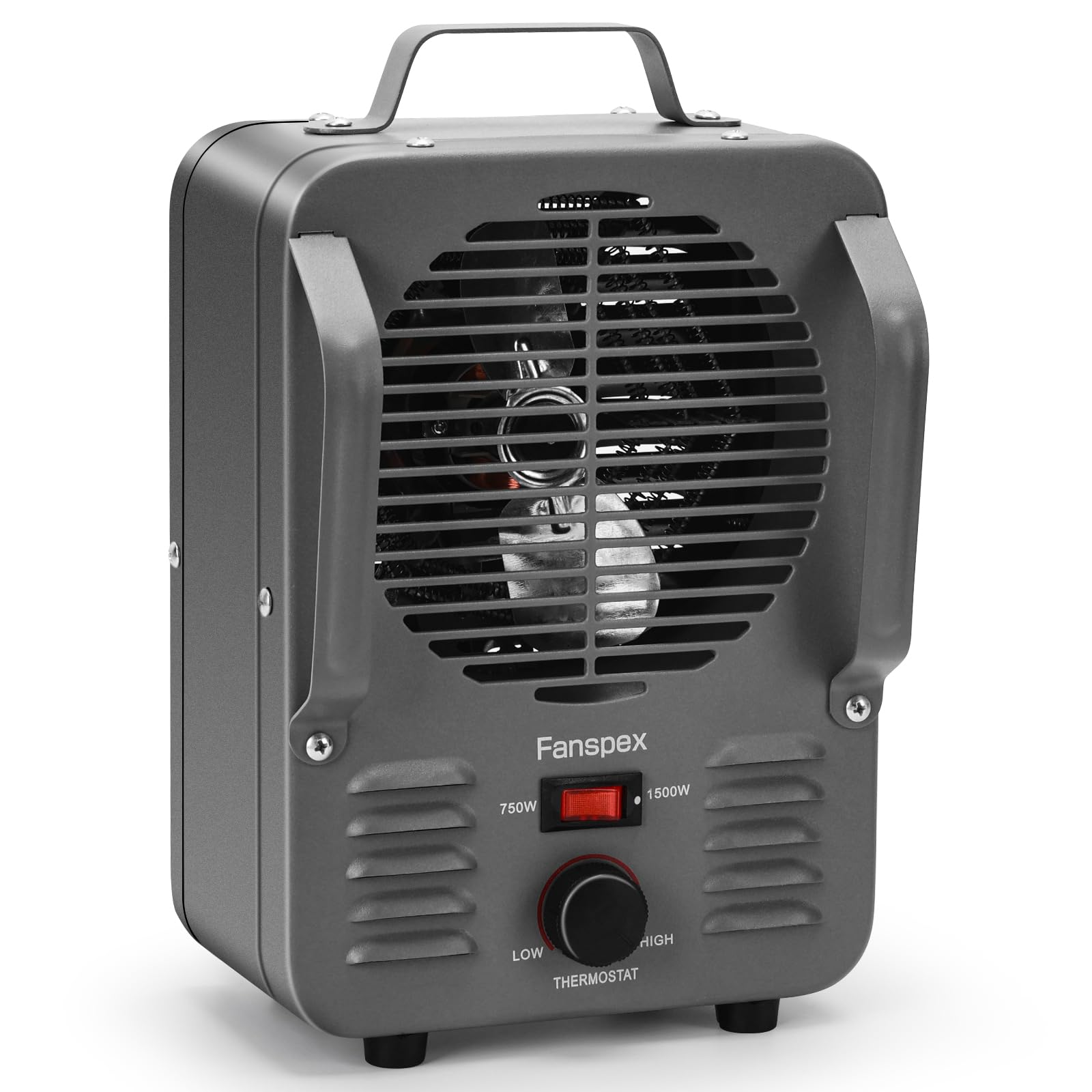
3. Fanspex 1500W Portable Electric Space Heater for Milk-house Home Indoor
The all-metal workhorse that shrugs off dust, damp, and a chilly pump house.
The defining feature here is the body: an all-metal frame rather than plastic, wrapped around a quality heating wire and fan. The thermostat knob sets your target temperature and then cycles the heater on and off to hold it, which is the feature that keeps a pump house or shed from freezing overnight. Two heat settings — 1500W and 750W — cover both fast warm-up and low-power overnight running.
The numbers that matter for a tent or small outbuilding are 12.1 by 7.7 by 4.3 inches and 3.3 pounds, which makes this the second-lightest unit here after the tiny Performance Tool. Buyers report it handles a variety of real spaces: an enclosed garage, a 12-by-16-foot shed, and greenhouse applications all come up. One buyer summarizes the appeal of the low setting plainly: “Good low Selection wattage for capping off the high selection and good price for quality junior milkhouse heater.”
Buyers keep flagging the same two things. There is no frost-proof setting, and the temperature dial is vague about what temperature it is holding — one owner noted it is “unclear what temp dial maintains.” It also ships in a size smaller than some people expect, so check the dimensions before ordering and do not rely on the product photos. For a space that needs honest, durable heat with a simple dial, this is the right tool; if you need precise temperature bands or remote alerts, a smart heater is the better route.
Why the metal matters: An all-metal body and heating components hold up where plastic-shell heaters crack or warp, which is why this gets chosen for garages, workshops, and sheds.
The trade-off: A manual dial with no frost-protection target, so you cannot dial in an exact overnight temperature.
Reach for this if: you want rugged, dial-simple heat for a garage, shed, or pump house.
skip it if: you need a precise set-and-hold thermostat or app notifications.
4. Performance Tool W5011 250W Personal Space Heater, White

A 250-watt mini heater you can run off a portable power station on a cold camping night.
Most heaters in this group pull serious current, but this one draws a fraction of it. At 250 watts and 2.1 amps, it runs off a big portable power bank and will not flip a shared breaker. It puts out 853 BTU of radiant heat, angled as a personal warmer rather than a room heater. Think of it as taking the edge off the air right around you, not heating the whole tent.
Owners use it exactly that way. It warms a small camper, a bathroom, or an under-desk pocket of air, and it is popular with van lifers and off-grid campers who are powering it from a battery box. A camper running it off a battery box reported: “Warmed small Aliner Scout Lite on 50°F camping night; had to turn off to avoid overheating.” It also has a tip-over safety feature, and the low draw is easy on an electrical bill.
Two honest limitations apply. First, it is not designed for a large tent — a 250W heater simply will not raise a whole canvas space. Second, the fan divides opinion; some find the noise fine and others find it loud for the output, with one unhappy camper calling it “extremely loud.” Buy this if your priority is low-power, ultra-portable warmth for a small, well-sealed space, or as a personal warmer next to a sleeping bag. Buy something bigger if you need to hold a whole tent above freezing.
The low-wattage advantage: At 2.1 amps this is the safest choice for a weak circuit or an off-grid power station, where a 1500W heater would immediately overload the source.
The ceiling to accept: It warms a personal pocket of air, not a room, and the small fan is noisy for how much air it moves.
Best matched to: off-grid campers, van dwellers, and anyone heating a tiny sealed space on limited power.
Not the right tool if: you expect it to warm an entire tent or large room.
5. shinic 1500W Milkhouse Heater, Utility Heater with Adjustable Thermostat

A milkhouse utility heater with a 158°F cutout built for barns, basements, and workshops.
The safety story here is more specific than most. The improved internal tilt-ball switch delivers 360-degree tip-over protection — no matter which way it falls, it cuts power. On top of that, an overheat sensor trips at 158°F and shuts the heater down automatically before anything gets risky. A three-prong grounded plug adds another layer, which matters when the unit sits on a damp concrete floor in a barn or garage.
For raw heating, the 1500W element pushes a forced-air blast that the maker says takes the chill out of spaces up to 200 square feet. Three settings give you real flexibility: high at 1500W for a quick warm-up, low at 1300W for steady maintenance, and a fan-only mode for circulating air on milder days. The adjustable rotary thermostat cycles the heater on and off to hold your setting and, in practice, doubles as a way to keep pipes from freezing.
Owners in garages, basements, and workshops report it heats quickly and safely, and the adjustable dial is the feature that comes up most. One note of caution: the thermostat accuracy is not its strength — one owner flatly said “The thermostat isn’t trustable.” Treat the dial as a rough warm-up control rather than a precision instrument, and pair it with a separate thermometer in a greenhouse. For a durable, safety-forward workshop or barn heater, this is a solid choice.
Safety-first build: The 360-degree tilt switch and 158°F overheat sensor combine with a grounded plug to make this a sensible choice for outbuildings and unheated floors.
Know the limit: The rotary thermostat holds a rough band rather than an exact temperature, so for anything temperature-critical add your own monitoring.
Made for: garages, basements, workshops, and farms where durability and hard safety cutoffs matter most.
Consider other options if: you need a heater that holds an exact temperature on its own.
6. Spider Farmer Heater, 530W 10-Level PTC Heating for Grow Tent
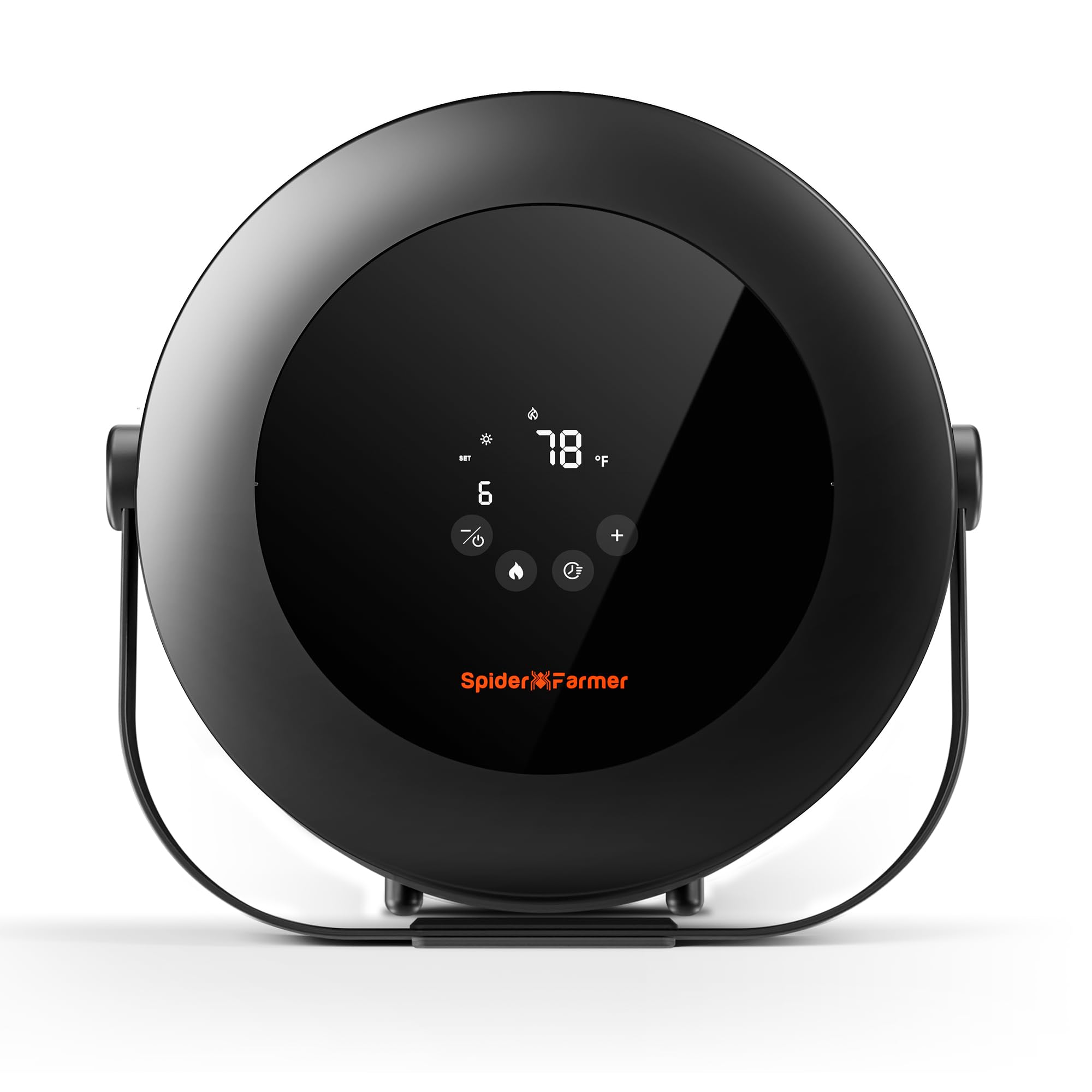
Precision climate control for a grow tent, with a hose that keeps heat off the leaves.
If growing is the goal, this is the most plant-aware heater on the list. It runs at 530 watts with PTC heating and PWM control (a precise method of regulating power to the element), and it gives you 10 adjustable levels for both temperature and fan speed. The zone-regulation design uses a built-in dead band — turning on 3°F below your set temperature and off 3°F above it — so the unit is not constantly clicking on and off. A 24-hour countdown timer handles overnight and away days.
The standout accessory is a 160 cm adjustable hose, which lets you direct warm air around the canopy instead of blowing it straight onto the plants. The panel auto-dims after 30 seconds of no activity, so it stays dark at night and does not disturb a light-sensitive grow cycle. It runs quietly and adds only about 3 amps, which keeps the draw gentle on a tent circuit. For temperature sensing, it runs a dedicated sensor to track the grow space in real time.
The honest catch is the manual. A number of growers found setup less intuitive than expected — one owner put it bluntly: “Five stars for quality of unit but only one star for ease of use.” The temperature-zone feature is genuinely useful once configured, but budget a little reading-up time. Also note, this is a lower-wattage unit at 530 watts, so it suits smaller grow tents rather than cold garages. For precision in a compact, sealed grow space, it is a strong pick.
Why growers like it: The dead-band temperature control and 160 cm hose let you hold a stable climate without blasting plants directly, and the auto-dimming panel keeps the dark cycle dark.
What to plan for: Setup takes patience, and 530 watts is best suited to a small, well-insulated grow tent.
Ideal for: small grow tents where stable temperature and gentle, directed airflow matter more than raw watts.
Pass on it if: you need to heat a large cold space or want zero learning curve.
7. DR. INFRARED HEATER DR218-3000W Greenhouse Garage Workshop Infrared Heater

The big-gun option: 3000 watts of infrared heat for a full garage or large greenhouse.
When you need to heat a genuinely large space, this is the one that brings the muscle. It runs at 3000 watts and covers up to 600 square feet, far beyond the 150-to-200 square foot range of most units here. It is a radiant heater, meaning it warms objects and surfaces directly rather than just blowing hot air, with a fan assisting air circulation. It has high and low settings and an IPX4 structure, which means it is protected against water splashing, so light dampness in a greenhouse is not a problem.
Owners put it to serious work. Owners mention it holding an insulated garage above 40°F through sub-zero North Dakota winters and keeping a small greenhouse alive through hard freezes. One cold-weather test held an 8-by-12-foot greenhouse at a stable 38 to 39°F through a 17°F night. That is the kind of capacity you buy this for — real, sustained cold-weather duty.
There are two things to plan for before you order. This unit needs a dedicated 220-volt, 20-amp circuit, so you cannot run it off a standard household outlet. And one owner reports the heater “BURNT UP twice” on that wiring, so have an electrician confirm your circuit and gauge are up to the job. For anyone with the right power setup and a large space to heat, the DR. INFRARED delivers very real performance.
The heavyweight advantage: At 3000 watts and 600 square feet of coverage, this is the pick when a single small heater cannot keep up with a large garage or greenhouse.
The setup cost to accept: It requires a dedicated 220V/20A circuit, and getting that wiring right is not optional.
Buy this for: large garages and greenhouses where nothing else will hold temperature.
Choose a smaller unit instead if: you only have a standard outlet or a compact space.
8. VIVOSUN AeroFlux 700W PTC Grow Tent Heater with Thermostat, APP & VPD
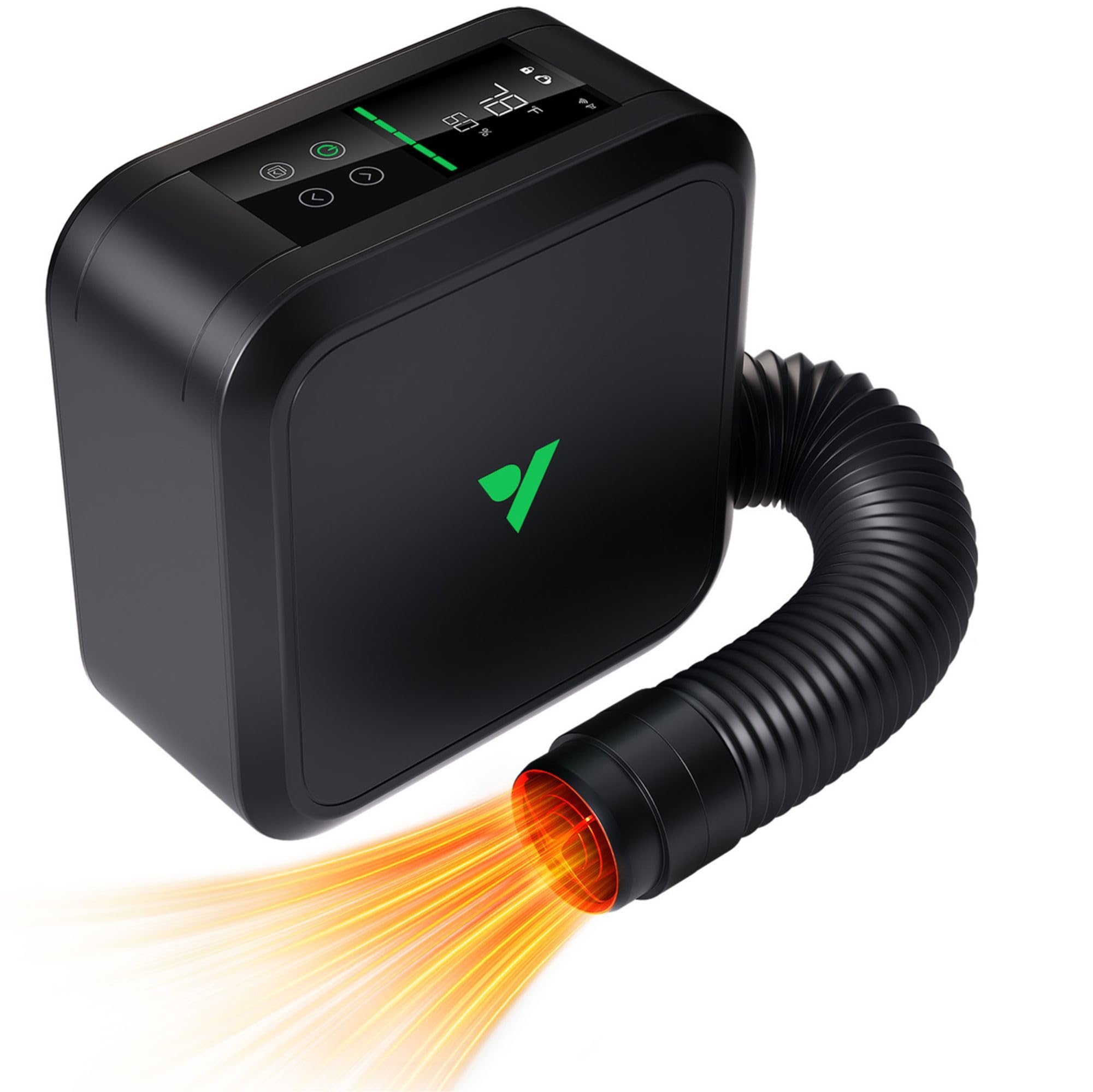
A grow-tent heater that tracks VPD, not just temperature, and adjusts itself over Wi-Fi.
Most grow heaters watch temperature alone. This one watches VPD, or vapor pressure deficit — the balance between moisture in the air and what a plant can actually draw from it, which is what growers care about most. A high-precision sensor tracks temperature and VPD together in real time and adjusts heat output to match. With 700 watts of PTC power, the maker says it is 40% stronger than standard models, and it gives you 5 adjustable heat levels.
Where the smart features shine is scheduling. You can set a target temperature and a minimum on the local controls, or fine-tune both from the app, and the Recipe function programs separate day and night modes. One grower wrote: “This incredible little heater helps you dial in your vpd no matter what season it is, wouldn’t recommend growing without it.” Safety is covered by V0 flame-retardant materials, a tip-over switch, and an overheat shutoff.
Two caveats to keep in mind. The app connectivity, while useful, is the feature that draws the most mixed feedback — pairing failures come up, and one unit arrived with thin plastic in the view of its buyer. That is a minority report, but for a unit priced in the premium tier, it is worth a mental note. If you are serious about dialing in a grow environment and want app control over day/night cycles, this is a strong, feature-rich choice.
The VPD edge: Tracking vapor pressure deficit — not just temperature — makes this the pick for a grower chasing a precise, stable climate.
Minority gripe: Its build and app pairing get more mixed feedback than the price tier would suggest.
Make it your pick if: you want app-based day/night scheduling and VPD tracking in a compact grow space.
Keep hunting if: you would never use an app and want simple, dial-only operation.
9. Greenhouse Heater 1500W with APP Remote Control, Portable Smart Electric Heater
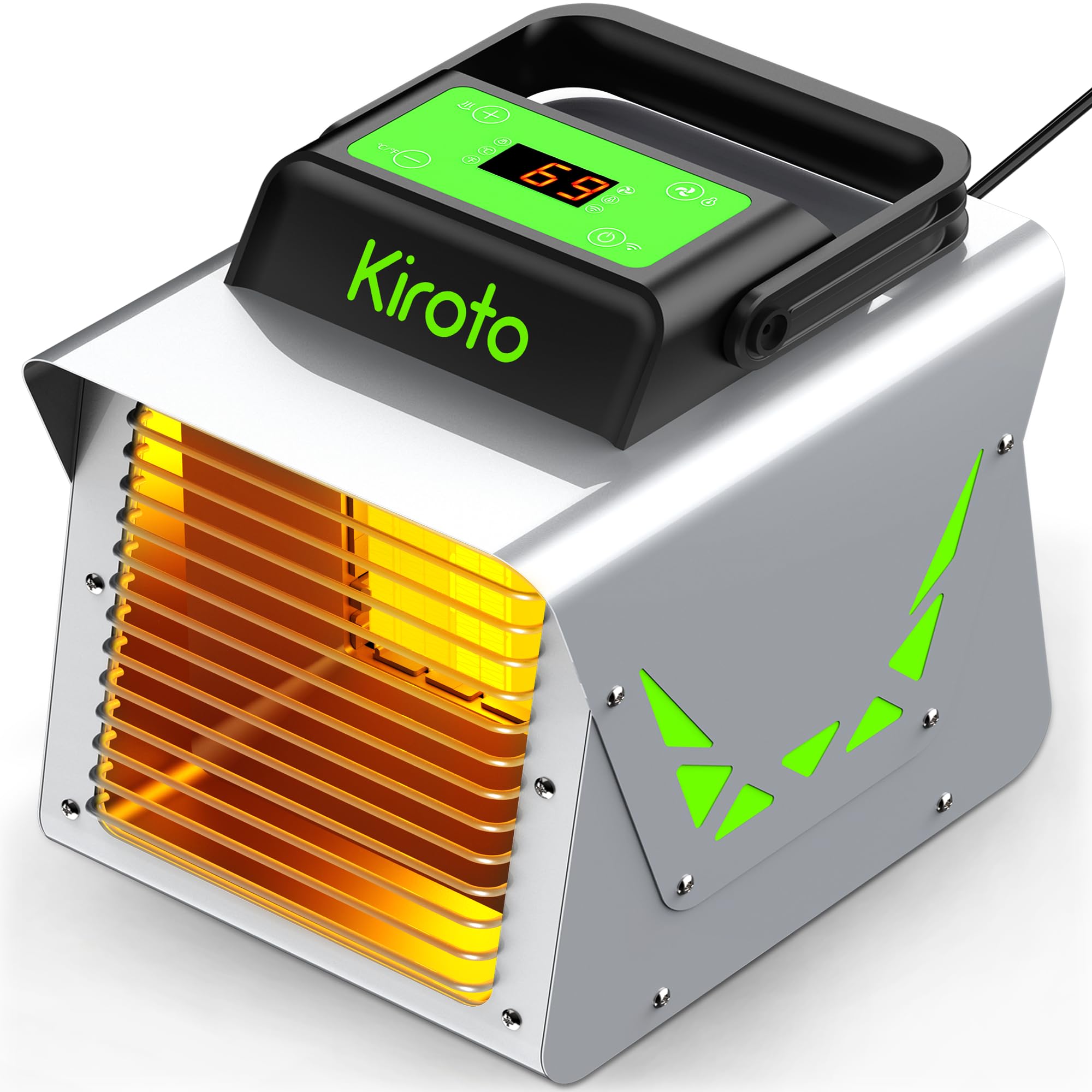
A smart greenhouse heater that texts you when temperatures climb or fall.
If your greenhouse or grow tent sits far from where you sleep, this heater is built for exactly that distance. It pairs with your phone through the “Smart Life” app over Wi-Fi, so you can adjust settings and check the real-time temperature from anywhere — work, a trip, or the house. The part that separates it is the alert system. You set high and low temperature thresholds in advance (the high range is 70 to 113°F, and the low range is 0 to 68°F), and if the greenhouse crosses them, you get an SMS on your phone.
For coverage, the 1500-watt element quickly warms up to 150 square feet, and a swing mode oscillates 70 degrees from side to side to spread heat more evenly across your plants. It runs two operating modes: heating for winter and a fan-only mode for summer air circulation. Safety is addressed with an overheat cutout that triggers when internals hit 149°F and a tip-over protection that cuts power 10 seconds after the unit is knocked over.
The honest reality is that app reliability is mixed. One owner had it “shut off randomly and disconnect from app,” and another noted the app’s accuracy could drift. When it works, it works well — one grower reported it “worked great all winter long in my 8 foot by 40 foot long greenhouse,” holding everything just above freezing. Treat the app as a helpful extra rather than a guaranteed remote control, and this unit remains a strong, well-featured heater for the right buyer.
The remote advantage: SMS temperature alerts and Wi-Fi control make it the best choice when your greenhouse is out of sight and you cannot babysit it.
The honesty note: App reliability divides owners, so do not buy it purely for the phone connectivity.
Pick this when: your greenhouse or grow tent is off-site and you want SMS alerts when temperatures slip.
Consider the simpler route if: you would rather manage heat with a knob than fight a flaky app.
Understanding the Specs
Watts and BTU: The Real Heat Number
Watts measure how much electricity a heater pulls, and BTU (British Thermal Units) measure how much heat it produces. A 1500W unit puts out the most heat, but it also pulls roughly 12.5 amps, which needs a dedicated circuit. A low-wattage unit like the 250W personal heater draws only about 2.1 amps, so it runs off a power station or a shared breaker — but it only warms the air right around you. Match the number to your space and your power source, not the other way round.
PTC Ceramic vs Radiant Infrared
PTC ceramic heating warms a self-regulating element and blows the heat outward; it is quick to reach temperature and gentle on plants. Radiant infrared heads warm objects and surfaces directly, which suits large, open spaces where you cannot contain the air. Neither is better in the abstract — PTC is the better fit for a sealed grow tent or small greenhouse, and infrared is the better fit for a big uninsulated garage or workshop.
FAQ
What size electric heater do I need for a tent?
Can I use a space heater in a tent?
Do electric tent heaters need a special outlet?
Will a greenhouse heater keep plants from freezing overnight?
Is a PTC heater or an infrared heater better for a grow tent?
Can I run an electric tent heater off a portable power station?
Why does my electric heater smell or make noise when it first runs?
Does an electric tent heater need a thermostat?
How much electricity does a 1500W tent heater use?
Final Thoughts: The Verdict
The electric tent heater that suits the widest range of buyers is the GiveBest Portable Electric Space Heater, because the instant tip-over cutoff and dual 1500W/750W modes make it safe and flexible in a compact tent. If you are growing plants in a sealed tent and want precise climate control, step up to the VIVOSUN AeroFlux and its VPD tracking. For a large garage or greenhouse where nothing else can keep up, the DR. INFRARED HEATER DR218-3000W brings 3000 watts and 600 square feet of coverage — just make sure you have the dedicated circuit to run it. Whichever you choose, confirm the wattage matches your space and your power source before you plug in.
How We Picked
We do not accept paid placement. Every pick is matched to a real buyer and a real use-case; we do not hands-on test units.
Sources & Methodology
Specifications: manufacturer listings and product documentation. Review insights: verified customer reviews, as of September 2026. Pricing: not shown on this page (it changes often); check the current price via the retailer link.
As an Amazon Associate, WellFizz earns from qualifying purchases. This does not affect which products we feature.
Related Guides

Mo Maruf
I created WellFizz to bridge the gap between vague wellness advice and actionable solutions. My mission is simple: to decode the research and give you practical tools you can actually use.
Beyond the data, I am a passionate traveler. I believe that stepping away from the screen to explore new environments is essential for mental clarity and physical vitality.