Our readers keep the lights on and my smoothie glass nicely filled. As an Amazon Associate, I earn from qualifying purchases.
Specs are compiled from manufacturer listings and verified buyer reviews and can change over time — please confirm the key details on the product page before buying.
An electrician’s scissors has one real job: to cut through tough jacketing, Kevlar yarn, and solid copper without folding, chipping, or going dull mid-job. A quality pair prevents costly cable damage and conductor nicks from the first cut. We compare nine top-rated models, focusing on blade steel, edge type, and weight to find the best value.
I’m Mohammad Maruf — the founder and writer behind WellFizz. This guide is built by comparing the manufacturers’ published specifications and the patterns across verified customer reviews, so you get each pick’s real strengths and trade-offs instead of marketing spin.
From serrated blades that grip copper to stripping notches that save you a tool swap, these are the electrician scissors worth carrying on every job.
Our Picks at a Glance


How To Choose The Best Electrician Scissors
Most buyers grab the first heavy pair they see, but the real differences are in the edge geometry, the steel, and how the tool fits a gloved hand. Choosing the right blade edge for your daily cable type ensures years of reliable service.
Match the blade edge to the material
A serrated blade grips round copper and slippery jacketing so the wire does not slide out mid-cut. Straight stainless blades suit cleaner slicing on softer materials but can skate off a stiff cable. If you cut Kevlar or aramid yarn for fiber work, a micro-serrated edge is the one that prevents fraying.
Quick Comparison
| Model | Best For | Blade Steel | Edge Type | Weight | Amazon |
|---|---|---|---|---|---|
| Klein Tools 2100-7★ Best Overall | All-around electrical & datacom | Alloy Steel | Serrated | 3.2 oz | Amazon |
| Jonard ES-1964ERGBest Value | Ergonomic comfort & Kevlar | Chrome Vanadium | Serrated | 0.15 kg | Amazon |
| Beta 1128BMXPrecision Pick | Precision wire stripping | Stainless Steel | Straight | 80 g | Amazon |
| Miller KS-1 | Fiber optic & Kevlar yarn | Molybdenum-Vanadium | Micro-Serrated | 3.52 oz | Amazon |
| C.JET TOOL 6″ | Heavy soft cable up to 1/0 AWG | 4034 Stainless | Serrated | 0.1 kg | Amazon |
| Klein Tools 2100-9 | Daily EDC & heavy use | Stainless Steel | Serrated | 3.4 oz | Amazon |
| ARES 70105 | Glove-friendly cutting | Stainless Steel | Serrated | 3.2 oz | Amazon |
| Milwaukee w/ Storage | On-the-belt convenience | Stainless Steel | Serrated | — | Amazon |
| Fluke D-Snip | Technician-grade sharpness | Alloy Steel | Serrated | 140 g | Amazon |
In‑Depth Reviews
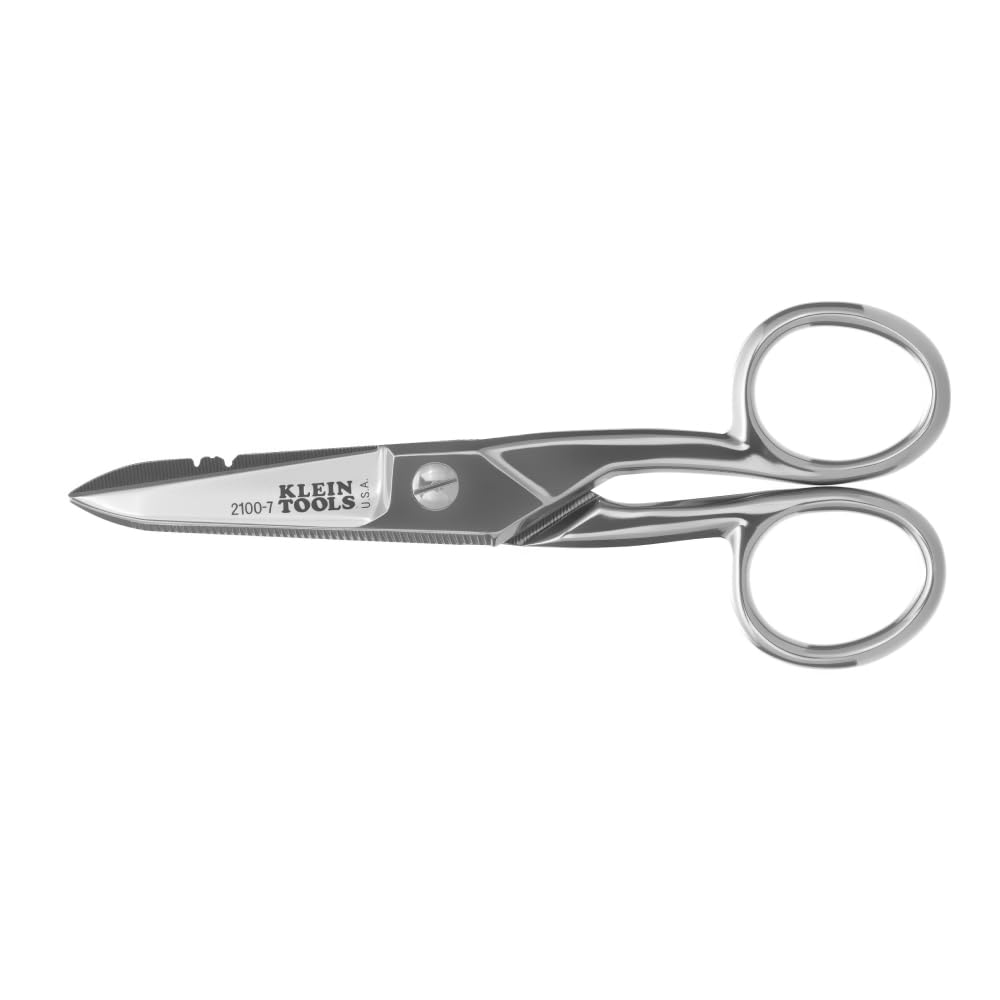
1. Klein Tools 2100-7 Electrician Scissors
Our pick — over 4.5★ from 850+ verified ratings; the strongest balance of quality and price.
The pocket-sized snip that outcuts a knife and still bites through a penny.
The defining trait here is a corrosion-resistant, nickel-plated finish over tough tempered steel, so the edges shrug off the kind of damp-jobsite abuse that rusts lesser tools. It is the category’s crowd favorite — 4.8 stars across 800+ owners — and the praise is almost monotonous: “I’ve been snipping away for months now and still no issues with sharpness.”
For datacom, telecom, electrical, and heavy-duty use, the serrated edge grabs CAT5/6 and shielded cable without slipping, and the built-in stripping notches handle 19 and 23 AWG wire so you drop the separate stripper. A scraper and file rides on the outside of both blades to knock oxidation off copper before a splice. At 3.2 ounces and a 1″L x 1″W footprint, it is the lightest-feeling pick here — dramatically more compact than the Jonard’s 6″L x 2″W body — which is why restoration hobbyists call it perfect for tight spaces.
The only realistic gripe is that the nickel plating is not stainless, so the rare owner treats it to a wipe-down after wet work. That is a small ask for a tool this capable.
What wins people over
- Serrated edge grips round wire and cuts through pennies without dulling
- Strips 19 and 23 AWG with built-in notches
- Scraper and file on both blades for cleaning copper
- US-made alloy steel with nickel finish resists corrosion
What to know
- Nickel plating needs occasional care in wet conditions
- Compact 1″ x 1″ size means small finger loops for bulky gloves
Reach for this if: you want one proven snip for datacom, telecom, and everyday electrical work that stays razor sharp for months.
Look elsewhere if: you wear thick work gloves all day and need a larger handle opening.
2. Jonard Tools ES-1964ERG Electrician Scissors
The ergonomic pair that performs like a premium brand for a fraction of the outlay.
You get Fluke D-Snip performance without the Fluke price tag — buyers report these are “just as good as the fluke brand and half the money.” The blades are chrome vanadium steel (a tough alloy that holds an edge), hardened through a special process so they resist chipping on tough cable jackets. The ergonomic handle shape fits small hands comfortably, which matters when you are cutting cable all day.
One blade carries a serrated edge that holds wire in place for cleaner cuts, and the stripping notches handle 18-20 AWG and 22-24 AWG wire. On Kevlar, the verdict is emphatic — “This is probably the best kevlar shear there is.
The pivot may loosen under heavy use, but a simple re-tightening with grease fixes it. Still a fixable maintenance item, not a failure.
Comfort-first cutting: the ergonomic handle plus the serrated holding edge make repetitive datacom work far less fatiguing than a standard snip, and the price leaves room to buy a backup pair.
3. Beta 1128BMX Electrician’s Scissors
The European favorite that replaces every other snip in the bag.
Beta’s straight stainless blades use a micro-serrated finish to grip wire for clean, precise cuts, and the built-in stripping notch removes insulation without a tool swap. Owners across Europe report it “Replaced all electrician scissors; only Beta 1128BMX lasted,” with a comfortable insulated grip that reduces fatigue. The straight edge makes this the better choice than a serrated-only pair when you want a clean slice on softer materials.
It strips 1.5-6mm² wire without damaging the copper underneath, though the cautions are honest: go slow on cable sheaths until you learn the feel, and this is not for hardened materials. At only 80 g and a brushed stainless finish, the compact pair disappears into a tool belt, and the scratch-resistant handle keeps it looking sharp.
The mild downsides are a slightly heavier feel than its size suggests and a blade that benefits from periodic sharpening. Both are minor for a tool this well-built.
Built for precision
- Micro-serrated straight edge grips and cuts cleanly
- Strips 1.5-6mm² wire without nicking copper
- Insulated grip reduces hand fatigue on long jobs
- Only 80 g for easy belt carry
A few honest notes
- Not intended for harder or hardened materials
- Blade needs occasional sharpening to stay optimal
Choose it for: precise wire stripping and clean cuts on soft cable, with an insulated grip that keeps you working longer.
skip it if: your daily diet is Kevlar or heavy armored cable — you want a serrated shear instead.
4. Miller KS-1 Kevlar Scissors

The fiber-tech’s secret weapon that slices Kevlar yarn without a single fray.
Miller built the KS-1 specifically for fiber optic prep, where the precision micro-serrations grip tough aramid fibers and stop them from slipping or fraying. The high-carbon molybdenum-vanadium steel keeps an edge through daily use, and at 5.5 inches and 2.8 oz it is the most field-ready of the dedicated Kevlar cutters here — noticeably lighter than the 3.52-ounce class it competes with. Owners who prep splices daily say trimming strands becomes a breeze.
Owners consistently praise its build quality and cutting performance. One buyer even keeps a pair for flower stems and small household wire because it is that sharp. The trade-off is that the serrated blade is hard to sharpen yourself, and the carbon steel wants a drop of oil now and then to fend off rust.
If your work is all about fiber, this is the specialist that earns its place.
Fiber-first sharpness: the micro-serrated edge and hardened steel make Kevlar and aramid prep clean, fast, and fray-free — just keep it oiled and it will outlast the job site.
5. C.JET TOOL 6″ Electrician Scissors

The whole-steel brute that chews through 1/0 AWG soft cable.
Most electrician scissors tap out well before heavy feeder cable, but the C.JET’s notch blade is rated to cut soft cable up to 1/0 AWG — that is an 8.5mm diameter with a 50mm² cross-section. The whole steel frame gives it high resistance to twisting under load, and the anti-slip serrated edge keeps wire from skating away mid-cut. Ergonomically designed handles with anti-slip TPR ridges stay grippy even with sweaty palms.
Owners call the build quality excellent and very sturdy, and the 4034 stainless steel holds up for CAT cable and general wire work. The honest mixed note: sharpness divides opinion, with some buyers finding it very sharp from the start while others report it dulls faster than premium steel. The serrated edge also handles 16-12 AWG aluminum and copper wire up to 3.5mm diameter for lighter tasks.
This is the value play for anyone who needs occasional heavy-cable capacity without stepping up to the premium tier.
Raw cutting power
- Notch blade cuts soft cable up to 1/0 AWG (8.5mm)
- Whole steel frame resists twisting under load
- Anti-slip TPR handle ridges improve grip
- Stainless blade also handles 16-12 AWG wire
Where it compromises
- Sharpness is a mixed bag — some dull quicker than expected
- Value opinion splits between great deal and just okay
Grab it for: heavy soft cable up to 1/0 AWG and a solid steel frame that won’t flex on the job.
Think twice if: you need guaranteed long-term edge retention — the premium stainless pairs hold sharpness longer.
6. Klein Tools 2100-9 Stainless Steel Scissors

The stainless upgrade that AV techs keep in their pocket every single day.
Klein’s 2100-9 upgrades the classic 2100-7 with a stainless steel body and a fully serrated blade that owners mention stays sharp and cuts through anything — one buyer even sliced chicken bones as easily as thick cable. The free-fall handle design lets gravity open the blades, so your thumb does not have to work during hundreds of repetitive cuts. Ergonomic grips complete the daily-driver feel.
Owners rate this as the top pick for overall quality and sharpness. An AV and drone tech calls it their most-used EDC tool, sharp enough for everyday work yet small enough for a pocket pouch.
It strips the same 19 and 23 AWG wire and carries the scraper/file on both blades. The minor QC gripe — an occasional missing blade stamp — does not affect function.
Daily-driver durability: the stainless build and free-fall handle make this the premium Klein pick for anyone who lives out of a pocket tool kit and wants the edge that does not quit.
7. ARES 70105 Heavy Duty Electrician Scissors

The 5.5-inch shear with handle loops big enough for a gloved hand.
ARES designed the 70105 around a simple field reality: you wear gloves on the job, and most snips are too tight to use comfortably. These handles are large enough to accommodate gloves easily, and the 5.5-inch high carbon stainless blades carry fine serration to prevent slippage plus a wire cutting notch for on-the-go shearing. You can adjust the blade tension to your preferred feel, and it stays put through heavy use.
Owners who run low-voltage cable daily call these the best shears they have used — clean cuts on coax and CAT without fraying, with reduced hand strain. One tech spent nine months on heavy Cat6/6a work, survived multiple ladder drops, and only noticed dulling after cutting old cable bundles. The stripper notch handles insulation removal, and it cuts soft cable up to 22 square mm. Quality and sharpness are the most frequently praised features.
The one genuine caveat: the serrated edge is not for paper, and a few owners noted durability that is otherwise excellent can dip if you abuse it on hardened materials.
Built for the field
- Handle loops fit gloved hands comfortably
- Adjustable blade tension holds its setting
- Cut soft cable up to 22 square mm
- Survives drops and heavy daily use
Keep in mind
- Serrated edge is not suited to paper cutting
- A few customers note dulling after cutting old cable bundles
Pick it for: gloved, gloved-heavy low-voltage work with a tension you can dial in and forget.
Pass on it if: you need a clean straight-edge cut on soft materials — go with the Beta instead.
8. Milwaukee Electrician’s Scissors with Storage
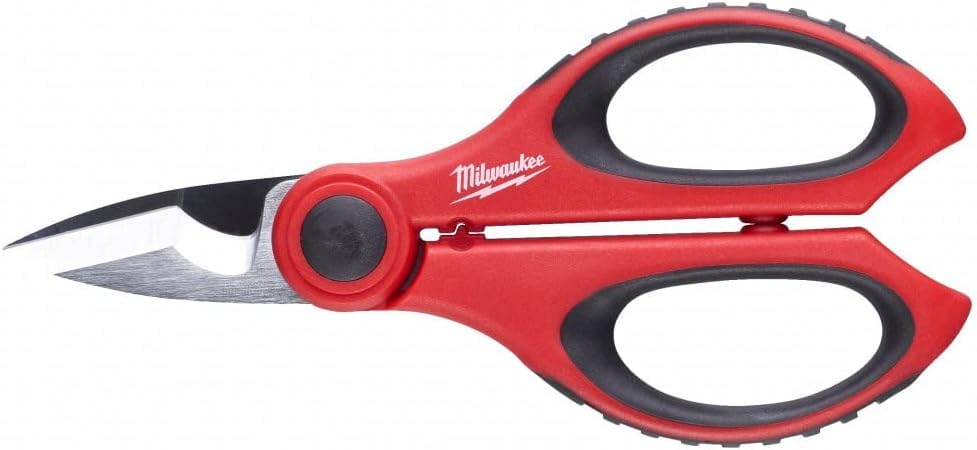
The red-handled snip that clips to your belt and pulls double duty as a crimper.
Milwaukee packs more than cutting into this one: the tool holder with a belt strap keeps the scissors within reach all day, and the built-in cable crimper turns a single carry into two jobs. The stainless serrated blade handles the cutting, and an adjustable tightening screw lets you dial in the pivot tension as it wears. Owners call the exterior grip very helpful — comfortable and grippy even with gloves on.
The build quality gets consistent praise, with owners calling it sturdy and noting it “cuts like a dream.” The cable cutting groove handles electrical work cleanly, and the whole package is ambidextrous for either hand. This is the pick for someone who wants their scissors to live on their belt, not lost in a bag.
The trade-off is simplicity: there are no stripping notches or scraper/file here, so it is a cutting and crimping tool rather than a full wire-prep station. That focus keeps it light and purposeful.
Belt-ready utility: the integrated storage and crimper make this the easiest carry in the lineup, ideal for quick cuts and field crimps without a tool bag.
9. Fluke Networks D-Snip Cable Scissors
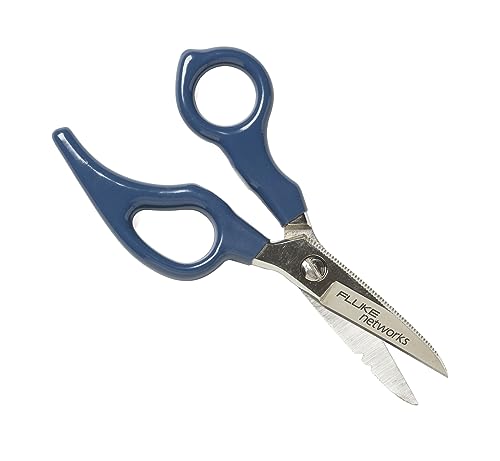
The field-grade snip with a micro-serrated edge that grabs copper instead of slipping.
Fluke forged these from high-quality alloy steel, and the micro-serrated edge is the real differentiator — it grabs the wire so you can cut substantial gauge copper that a straight blade would skate off. The notched blade strips 19 and 23 gauge wire, and it cuts up to 16 gauge solid and 12 gauge stranded wire. Both blades carry a file and scraper for cleaning wire before termination.
Sharpness is the standout feature, with daily users reporting long-lasting edge retention. The ergo grip earns consistent compliments for comfort during long sessions. That said, durability is genuinely mixed — some owners replace theirs every 6-8 months of heavy daily use, and a minority report breakage around the three-month mark, while comfort divides opinion with some finding the grip almost painful.
At 140 g and a compact 4″L x 1″W body, this is the technician’s classic that the Jonard replicates for less money. The premium price buys the brand and the proven edge geometry.
Field-proven edge
- Micro-serrated blade grips copper for clean cuts
- Strips 19 and 23 gauge wire
- Cuts up to 16 gauge solid and 12 gauge stranded
- File and scraper on both blades
Honest trade-offs
- Durability splits opinion — some fail around three months of heavy use
- Comfort is mixed, with some finding the grip almost painful
Reach for this if: you want the proven Fluke edge geometry that grabs wire instead of slipping, and you value sharpness above all.
Consider the Jonard instead if: you want the same class of cut for roughly half the money and a more comfortable grip.
Understanding the Specs
Serrated vs. Straight Blades
Serrated edges have small teeth that grip round, slippery wire and cable jacketing so the material does not slide out mid-cut. This makes them ideal for copper, coax, and CAT cable. Straight edges give a cleaner slice on softer materials but can skate off a stiff cable. For Kevlar and aramid yarn, a micro-serrated edge prevents fraying during fiber prep.
Stripping Notches & AWG Ratings
Stripping notches are cutouts along the blade that let you pull insulation off a wire without switching to a separate stripper. The AWG number (American Wire Gauge) tells you which wire thickness the notch fits — lower numbers mean thicker wire. Klein’s 2100-7 handles 19 and 23 AWG, while the Beta strips 1.5-6mm², and the C.JET notch cuts soft cable up to 1/0 AWG for heavy feeders.
FAQ
What is the difference between electrician scissors and regular scissors?
What does the AWG rating on stripping notches mean?
Can these scissors cut Kevlar or fiber optic cable?
How long do electrician scissors stay sharp?
Will these scissors fit my hand if I wear work gloves?
Can I use electrician scissors to strip wire without a separate tool?
Why do some blades rust and others do not?
Is a serrated blade better for cutting copper wire?
What is the difference between the Klein 2100-7 and 2100-9?
Final Thoughts: The Verdict
If you want one dependable pick, the electrician scissors winner is the Klein Tools 2100-7 because it pairs a proven serrated edge with months of sharpness and a US-made build at a fair price. If you want the ergonomic comfort and Kevlar capability at a bargain, grab the Jonard ES-1964ERG. And for fiber optic work that demands fray-free cuts, the Miller KS-1 is the one to reach for.
How We Picked
We do not accept paid placement. Every pick is matched to a real buyer and a real use-case; we do not hands-on test units.
Sources & Methodology
Specifications: manufacturer listings and product documentation. Review insights: verified customer reviews, as of August 2026. Pricing: not shown on this page (it changes often); check the current price via the retailer link.
As an Amazon Associate, WellFizz earns from qualifying purchases. This does not affect which products we feature.
Related Guides

Mo Maruf
I created WellFizz to bridge the gap between vague wellness advice and actionable solutions. My mission is simple: to decode the research and give you practical tools you can actually use.
Beyond the data, I am a passionate traveler. I believe that stepping away from the screen to explore new environments is essential for mental clarity and physical vitality.