Our readers keep the lights on and my smoothie glass nicely filled. As an Amazon Associate, I earn from qualifying purchases.
Specs are compiled from manufacturer listings and verified buyer reviews and can change over time — please confirm the key details on the product page before buying.
Your fig tree’s harvest—whether it drips with sweet fruit or just sulks—often depends on one decision: what you feed it. The right fertilizer balances leaf growth, root strength, and fruit production without burning delicate roots. Here are six proven formulas, from quick liquid feeds to slow-release granules, so you can match a product to your tree’s size, your pot, or your orchard.
I’m Mohammad Maruf — the founder and writer behind WellFizz. This guide is built by comparing the manufacturers’ published specifications and the patterns across verified customer reviews, so you get each pick’s real strengths and trade-offs instead of marketing spin.
Here is how to pick the best fertilizer for fig trees, whether you are nursing a potted patio fig or a backyard tree that needs a bigger harvest this season.
Our Picks at a Glance
How To Choose The Best Fertilizer For Fig Trees
Fig trees are forgiving, but they do have a favorite diet. The three numbers on any fertilizer bag — the NPK ratio — tell you how much nitrogen, phosphorus, and potassium is inside, and each one drives a different job. Nitrogen pushes out green leaves, phosphorus builds roots, and potassium firms up fruit quality. A balanced feed keeps all three working together.
Liquid feed versus slow-release granules
Liquid concentrates are the fastest way to get nutrients into a stressed or container-grown tree, because the roots can drink them right away. Granules and powders break down slowly, which makes them a better fit for in-ground trees that need steady food across a whole season without you mixing a batch every week.
Match the dose to the tree’s size
A tiny potted fig needs a tiny dose, and a mature landscape tree needs a lot more. Most products give clear per-plant instructions, like a teaspoon for an indoor pot versus a half-teaspoon for a ground plant, so measure carefully — more is not better and can actually stress the roots.
Quick Comparison
| Model | Best For | NPK Ratio | Form | Unit Size | Amazon |
|---|---|---|---|---|---|
| Wellspring Gardens Fig Fuel Liquid★ Best Overall | Quick recovery & potted figs | 3-3-3 | Liquid | 32 fl oz | Amazon |
| TreeHelp Premium FertilizerRoot Builder | In-ground trees & root growth | 1:0:0 | Solid | 52.9 oz | Amazon |
| Gardenera 10-10-10 Slow Release | All-purpose garden feeding | 10-10-10 | Granules | 32 oz | Amazon |
| Wellspring Gardens Fig Fuel 20-20-20 | High-intensity fruit production | 20-20-20 | Granules | 14 oz | Amazon |
| Down To Earth Organic Fruit Tree | Organic backyard orchards | 6-2-4 | Powder | 5 lb | Amazon |
| TPS Nutrients Fig Tree Fertilizer | Leaf growth & fruit set | — | Liquid | 32 fl oz | Amazon |
In‑Depth Reviews
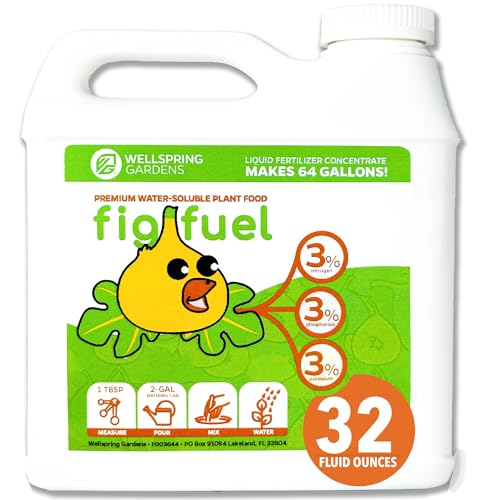
1. Wellspring Gardens Fig Fuel Liquid Fertilizer (32 fl oz)
Our pick — over 4.5★ from 350+ verified ratings; the strongest balance of quality and price.
The crowd favorite that revives stressed trees in about a week, straight from a 32-ounce bottle.
This liquid concentrate is the definition of a balanced diet for a fig tree, with a 3-3-3 formula that gives equal parts nitrogen, phosphorus, and potassium. The benefit of that even split is simple: strong roots, lush foliage, and productive fruiting all at once, without pushing one job at the expense of another. It is a crowd favorite, holding a strong rating across hundreds of owners, which makes it the safest bet for most gardeners.
The thing that wins people over is the speed of the recovery they see. Buyers report that a heat-stressed banana plant bounced back in one week, with leaves perking up and fresh growth appearing, and another owner described their plants “growing like crazy” after switching to this. The mixing routine is genuinely simple — 1 tablespoon of concentrate into 2 gallons of water, applied during active growth — which makes it an easy weekly habit even for beginners.
It works for both potted patio figs and in-ground landscape trees, so you are not locked into one setup. The balanced 3-3-3 blend makes it a dependable all-purpose feed for the entire growing season, and owners describe it as a staple in their gardening routine. One buyer did note they had not noticed a drastic change, so results can vary if your tree already has rich soil, but the consensus is overwhelmingly positive.
What wins owners over
- Fast visible results — heat-stressed plants recovered within a week
- Simple 1-tablespoon-per-2-gallons mixing ratio
- Balanced 3-3-3 nutrition suits potted and landscape figs
- Easy, mess-free liquid application
Fair trade-offs
- A 32-ounce bottle is a mid-size buy, not a year’s supply for many trees
- Liquid feeding means you mix a fresh batch each time
Grab this for: quick, balanced feeding of potted figs or stressed trees that need a fast comeback.
Think twice if: you want a set-once-and-forget feed for a large in-ground orchard — a slow-release granule suits that better.
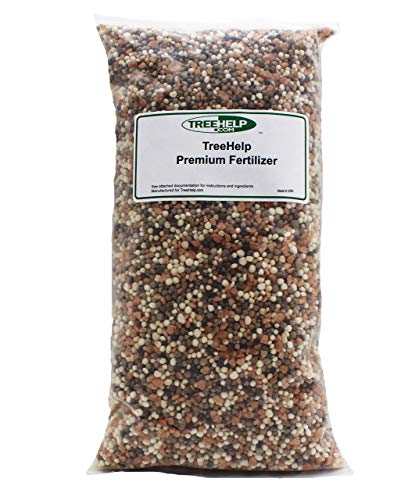
2. TreeHelp Premium Fertilizer for Fig
A solid, slow-release feed built around one job: deep root development that pays off for years.
Unlike the liquid feeds above, this solid, specially formulated fig tree feed builds long-term vitality through sturdy root development. Its slow-release nitrogen (a form that feeds gradually over months) keeps nourishing the tree all season instead of in one quick burst—ideal for an in-ground tree you want to strengthen at the foundation.
The real-world proof is in the harvest. Owners mention the simple outcome that matters most: “It has increased the fig production.” Another owner, growing a fig tree indoors, called it exactly what they needed, and the general chorus is that it is easy to use and effective. The bag is generous at 52.9 ounces—nearly four times the size of the 14-ounce Wellspring Gardens 20-20-20 granule above—a meaningful advantage if you have a large tree or several smaller ones to feed.
A single application treats one large tree, or 2-3 smaller or newly planted trees, and complete instructions come in the box. The 1:0:0 ratio means it is essentially a nitrogen-focused root feed rather than a balanced fruit feed, so pair it with your normal feeding routine if you also want a phosphorus and potassium boost for fruiting. It is the most targeted pick here for getting a young or struggling tree established.
The strength: a 52.9-ounce solid feed that works on the roots first, with slow-release nitrogen carrying the tree across a full season.
The honest catch: the nitrogen-only ratio is about root and leaf vigor, so fruit-focused gardeners may want a balanced partner feed.
Reach for this if: you are planting new trees or rehabilitating an in-ground fig that needs a stronger root system.
Look elsewhere if: you want a single all-purpose bottle for potted figs, where a balanced liquid is easier to dose.
3. Gardenera 10-10-10 Slow Release Fertilizer
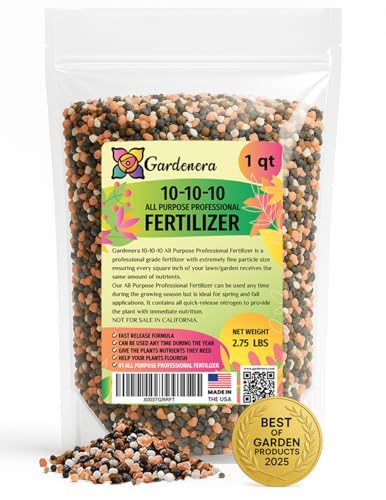
A budget-friendly granule that feeds the whole garden, not just the fig tree, from one 32-ounce tub.
This one earns its place on versatility. It is a balanced 10-10-10 NPK fertilizer (nitrogen-phosphorus-potassium, the three main plant nutrients) that supports strong root development, lush foliage, and vibrant blooms across vegetables, flowers, trees, shrubs, and lawns—so the same tub you use on your fig can feed your tomatoes and roses. The slow-release granule form means you sprinkle it around the plant and let it break down over time.
Owners describe the routine in refreshingly simple terms: “Just need a few pellets around the plants and they grow healthy with lots of new growth and blooms.” The quality gets the most praise, and ease of use is a close second. The smaller 32-ounce size is actually a feature for some—one owner specifically loved having no storage worries compared to a giant bag.
Note that effectiveness reviews are mixed, with some owners seeing great results and others reporting little change, and a few felt the value was lacking for the amount you get. That makes it a solid entry-level pick rather than a specialist fig feed. For a single potted fig or a small garden, though, the 10-10-10 balance is exactly the all-purpose nutrition a fig wants.
What earns its keep
- Balanced 10-10-10 feeds figs, vegetables, and ornamentals alike
- Slow-release granules mean less frequent application
- Compact 32-ounce tub is easy to store
- Simple sprinkle-and-go application
Where it is weaker
- Effectiveness reports are mixed, so results vary by soil
- Some owners felt the quantity was small for the money
Best for: the gardener who wants one affordable product that feeds the whole yard, including the fig.
Not the pick for: a serious fig orchard needing a tree-specific, high-intensity fruit formula.
4. Wellspring Gardens Fig Fuel Fertilizer (20-20-20)
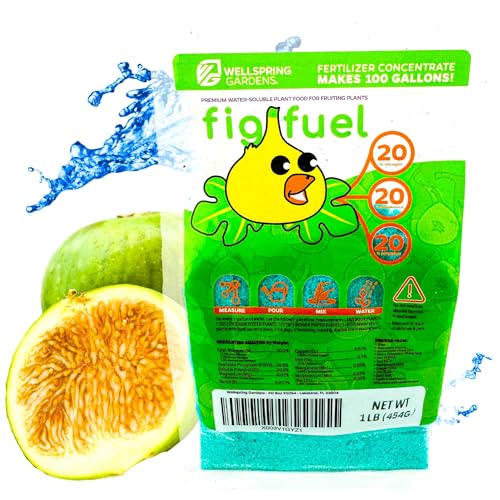
A concentrated 20-20-20 granule that revived a 5-year-old transplanted fig after spring dieback.
This is the high-octane option in the Fig Fuel family. While the liquid above uses a gentle 3-3-3, this water-soluble granule packs a 20-20-20 blend — roughly twice the nutrients of typical fertilizers, per the maker — designed specifically for fruiting fig trees. That intensity is for gardeners who want aggressive growth and vibrant foliage.
The owner stories are the most dramatic in this list. Customers note that it revived a 5-year-old transplanted fig tree after spring dieback, leaving it “bigger/stronger” than before, and that a new tree thrived through its first winter. Even a Bird of Paradise that had not bloomed in 7 years finally flowered after feeding. The dosing is precise and simple: 1/8 teaspoon for indoor pots, 1/4 teaspoon for outdoor pots, or 1/2 teaspoon for landscape plants, mixed with warm water every 1-2 weeks.
The trade-off is the small 14-ounce bag size, which is a 3.8x gap versus the 52.9-ounce TreeHelp solid above — so you will buy more often if you have several trees. But the concentrated nature means a little goes a long way, and the granular form is easy to store. This is the pick for a fig owner who wants maximum fruit production and is happy to feed on a strict biweekly schedule.
The headline: a potent 20-20-20 water-soluble feed that produces the most dramatic recovery and bloom stories in this lineup.
The trade-off: a 14-ounce bag is small, so high-volume orchard growers will repurchase frequently.
Choose this when: you want maximum strength for a fruiting fig and do not mind a precise biweekly feeding routine.
skip it if: you prefer a large, set-and-forget bag — the 5-pound organic option below covers more ground.
5. Down To Earth Organic Fruit Tree Fertilizer (6-2-4)

A 5-pound organic powder with added calcium that has tripled trees and revived frost-bitten branches.
For the organic grower, this is the heavyweight. It is a five-pound box of all-natural fertilizer with a 6-2-4 formula, and it is listed by the Organic Materials Review Institute (OMRI) for use in organic production—so you know exactly what you are putting in the soil. The ingredients are straightforward: feather meal, fish bone meal, calcium carbonate, langbeinite, potassium sulfate, alfalfa meal, and kelp meal.
The calcium carbonate is the standout feature here, since added calcium supports proper fruit development rather than just leaf growth. Reviewers point out a tree that “tripled in size” and a mango tree producing more fruit than ever, while another credited it with revitalizing trees after a harsh cold frost. One buyer sums up the natural advantage: “No harsh smell like synthetic fertilizers,” and the powder blends into soil quickly without that synthetic sting.
Because it is a 5-pound bag, it easily covers a backyard orchard of apples, pears, plums, citrus, and figs. It does not expire if stored in a cool, dry place, which makes it a smart stock-up for multi-season use. The powder form needs a little more effort to work into the soil than sprinkling granules, but for long-term tree health and organic confidence, this is the one the home orchard crowd trusts.
Why organic growers love it
- OMRI-listed for certified organic production
- Added calcium improves fruit development
- 5-pound bag covers an entire backyard orchard
- No harsh synthetic smell, blends into soil fast
The honest friction
- Powder form needs working into the soil, not just scattering
- 6-2-4 ratio is fruit-focused, lower in nitrogen than balanced feeds
Reach for it if: you garden organically and want one big bag that feeds every fruit tree in the yard for the season.
Pass it by if: you have a single potted fig on a patio and want a small, quick-dissolving feed.
6. TPS Nutrients Fig Tree Fertilizer (32 oz)
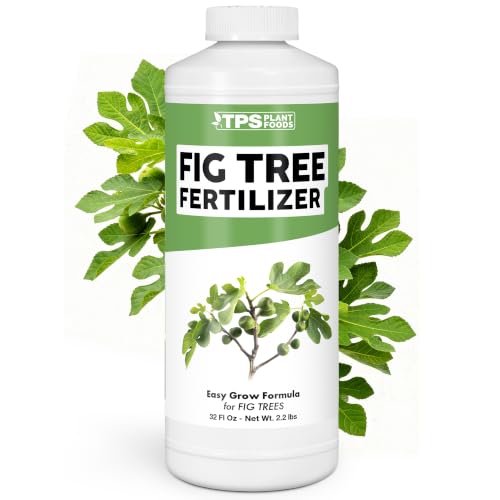
A liquid lifeline that turned cold-damaged fig trees into leaf-filled producers with fruit on the branch.
This is the specialist’s liquid feed, made in the USA and designed explicitly for fig trees, with the marketing promise of boosting fruit set and sweetness. It delivers balanced nutrition without overfertilizing or stressing fig tree roots, which is the exact worry most fig owners carry when they reach for a bottle. The 32-ounce liquid form makes it a direct competitor to the Wellspring Gardens liquid at the top of this list.
The best owner story here is about resilience. A gardener in Zone 6b (a region with cold winters) planted Common Fig trees in April, got hit by a huge cold spell, and was sure the trees had not survived. After feeding with this fertilizer as it warmed up, the trees became “incredibly leaf-filled, and one tree even has figs on it.” That is the recovery scenario this product is built for, and the directions were clear enough to follow without guesswork.
It is ideal for backyard figs, patio containers, and home orchard plantings, with a feed-every-2-weeks rhythm. The formula supports vigorous branches, healthy foliage, and improved fig production, and it strengthens roots without the burn risk that comes with stronger synthetic mixes. It is the pick for a gardener who wants a dedicated fig feed that goes easy on the roots while still pushing visible weekly growth.
The strong suit: a root-gentle liquid that visibly revived cold-stressed trees, with one owner reporting figs on the branch in the same season.
The limitation: a single 32-ounce bottle is a season-long supply for one or two trees, not an orchard-sized quantity.
Best for: the patio fig grower who wants a dedicated, root-friendly liquid and a simple biweekly routine.
Not for: large in-ground orchards that need a bulk 5-pound organic feed — grab the Down To Earth instead.
Understanding the Specs
NPK Ratio — the three numbers
The three numbers on a fertilizer bag — like 10-10-10 or 6-2-4 — stand for nitrogen, phosphorus, and potassium, in that order. Nitrogen drives green leaf growth, phosphorus builds the root system, and potassium improves fruit quality and plant vigor. A balanced ratio like 10-10-10 gives equal attention to all three, while a fruit-focused formula like 6-2-4 leans on phosphorus and potassium to boost the harvest.
Liquid vs. slow-release form
Liquid concentrates are absorbed almost immediately by the roots, which makes them ideal for reviving a stressed tree or feeding a potted fig on a patio. Slow-release granules and powders break down over weeks or months, giving an in-ground tree a steady supply of food across the whole season without mixing a batch every week. Your choice depends on how fast you need results versus how often you want to apply.
FAQ
What is the best NPK ratio for fig trees?
Should I use liquid or granular fertilizer for a potted fig tree?
How often should I feed a fig tree during the growing season?
Can I use a regular all-purpose fertilizer on fig trees?
Will fig fertilizer help a tree that suffered cold damage?
Is organic fertilizer better than synthetic for fig trees?
How much fertilizer does a young fig tree need?
Can fig fertilizer help other fruit trees and plants?
Final Thoughts: The Verdict
For most buyers, the fertilizer for fig trees winner is the Wellspring Gardens Fig Fuel Liquid because its balanced 3-3-3 formula and fast owner-visible results make it the safest, most effective choice for potted and in-ground figs alike. If you want a set-once organic feed for a whole backyard orchard, the Down To Earth 6-2-4 is the one to reach for. And for maximum fruit production with a concentrated boost, the Fig Fuel 20-20-20 delivers the strongest owner stories in this lineup.
How We Picked
We do not accept paid placement. Every pick is matched to a real buyer and a real use-case; we do not hands-on test units.
Sources & Methodology
Specifications: manufacturer listings and product documentation. Review insights: verified customer reviews, as of August 2026. Pricing: not shown on this page (it changes often); check the current price via the retailer link.
As an Amazon Associate, WellFizz earns from qualifying purchases. This does not affect which products we feature.
Related Guides

Mo Maruf
I created WellFizz to bridge the gap between vague wellness advice and actionable solutions. My mission is simple: to decode the research and give you practical tools you can actually use.
Beyond the data, I am a passionate traveler. I believe that stepping away from the screen to explore new environments is essential for mental clarity and physical vitality.