Our readers keep the lights on and my smoothie glass nicely filled. As an Amazon Associate, I earn from qualifying purchases.
Specs are compiled from manufacturer listings and verified buyer reviews and can change over time — please confirm the key details on the product page before buying.
Your greenhouse can hit 115°F by mid-afternoon, and one such day can wilt seedlings and stress mature plants beyond recovery. The right fan pulls out hot, humid, stagnant air and drags in fresh air—your biggest lever on temperature. This guide ranks fans that move enough air per minute (CFM, or cubic feet per minute) to keep your space livable, and it explains the specs that matter so you can match one to your square footage.
I’m Mohammad Maruf — the founder and writer behind WellFizz. This guide is built by comparing the manufacturers’ published specifications and the patterns across verified customer reviews, so you get each pick’s real strengths and trade-offs instead of marketing spin.
Whether you’re venting a hobby hoop house or a commercial grow room, these are the fan for greenhouse picks that hold up to real heat and humidity without draining your wallet.
Our Picks at a Glance


How To Choose The Best Fan For Greenhouse
Greenhouse ventilation is about volume, not just breeze. You are trying to replace the hot air inside your structure with cooler outside air, and the fan’s CFM rating tells you how many cubic feet of air it can move every minute. A fan that is too small will spin all day and never drop the temperature, so start by measuring your greenhouse’s length, width, and height to calculate your total cubic footage.
Match CFM to Your Greenhouse Volume
Standard advice: pick a fan that exchanges your greenhouse’s entire air volume roughly once per minute for good summer cooling. Small sheds and hobby greenhouses around 8×12 feet can get away with fans rated around 600-800 CFM, while larger structures need 3000 CFM or more. If your space is long, you may need two fans at opposite ends to create proper cross-flow.
Exhaust Fan vs. Circulating Fan
An exhaust fan mounts in a wall or window and physically pushes hot, humid air out of the greenhouse, often with shutters that close when it’s off to keep weather out. A circulating fan just stirs the air already inside, which helps even out temperature but does nothing to remove heat. For a greenhouse, prioritize an exhaust fan first; add a circulation fan later if you need more even air movement.
Look for Shutters and Corrosion Resistance
Greenhouses are damp places, so blade and frame material matters for longevity. Aluminum and galvanized steel resist rust far better than bare painted metal. Automatic gravity shutters are a big plus: they open when the fan runs and close when it stops, sealing out rain, dust, and insects while keeping your heat from escaping when the fan is idle.
Quick Comparison
| Model | Best For | Airflow (CFM) | Blade Size | Control | Amazon |
|---|---|---|---|---|---|
| iLIVING 20″ Shutter★ Best Overall | Large greenhouses & serious heat | 3368 | 20 inches | Thermostat + Variable | Amazon |
| VEVOR 10″ ShutterBudget Champion | Small greenhouses on a budget | 820 | 10 inches | None (wired separately) | Amazon |
| Amico 12″ DC RemoteEnergy Saver | Energy saving & quiet operation | 1200 | 12 inches | 9-Speed Remote | Amazon |
| KEN BROWN 12″ Shutter | Plug-and-play versatility | 1450 | 12 inches | No Wiring / Plug | Amazon |
| addlon 12″ DC Remote | Remote control convenience | 1250 | 12 inches | 8-Speed Remote | Amazon |
| BILT HARD 20″ Wall Mount | Maximum air circulation | 4600 | 20 inches | 3-Speed Pull Chain | Amazon |
| HG Power 10″ Shutter | Small spaces with speed control | 647 | 10 inches | Infinity Speed Dial | Amazon |
| CAMMOO 20″ Oscillating | Garages & covered porches | — | 20 inches | Wired Remote | Amazon |
In-Depth Reviews
1. iLIVING 20″ Wall Mounted Shutter Exhaust Fan
Our pick — 4.5★ from 900+ verified ratings; the strongest balance of quality and price.
The heavy-lifting exhaust fan that turns a stifling greenhouse into a survivable space.
If you have a large greenhouse or high-ceiling grow space and you’re tired of watching the thermometer climb past 100°F, this fan is for you. It moves air at 3368 CFM (cubic feet per minute), which is more than four times the volume of the compact 820 CFM VEVOR unit, and it covers up to 5000 square feet, so it’s built for serious structures, not hobby hoops. That raw power lets it drop a 12,500-cubic-foot warehouse from 94°F to 83°F in 45 minutes, per owner reports.
The 20-inch aluminum blades spin at 980 RPM and pull through automatic shutters that close when the fan stops, keeping rain and pests out. What makes it feel genuinely premium is the included Thermospeed controller, which lets you set a temperature range from 32°F to 130°F and then just walk away while the fan manages itself. The galvanized steel frame and aluminum construction are built for damp environments, and it carries UL certification for safety.
The honest trade-off is noise. The motor is rated under 69dB, but owners give mixed feedback — on high speed the shutters rattle a little and the airflow is loud, while low speed is genuinely quiet. Performance is what wins people over here, with over a hundred buyers praising how well it moves air and keeps temperatures down. Buyers report the gravity shutters are reliable, though a few note the louvers could use extra weight to seal fully when off.
What wins people over
- Massive 3368 CFM airflow cools large spaces fast
- Thermostat and variable speed control included
- UL certified, corrosion-resistant build
What to weigh up
- Noisy on high speed per mixed owner feedback
- Shutters may need extra weight to close fully
- Minor water intrusion in very high wind gusts
Reach for this if: you have a large greenhouse and want one powerful, thermostat-controlled fan that handles the heat automatically.
Think twice if: you need whisper-quiet operation — this unit is powerful, not silent, especially at top speed.
2. VEVOR 10″ Shutter Exhaust Fan
The compact, quiet workhorse that saves a small greenhouse from cooking its plants.
If your greenhouse is a 8×12 or smaller structure, this 10-inch fan is the smart budget move that actually gets the job done. It pushes 820 CFM at 1650 RPM while drawing just 45 watts, which is a fraction of the energy a bigger unit would use. Owners mention it reduced a 115°F heat spike down to around 100°F in a real greenhouse, which can be the difference between plants surviving a heat wave and wilting.
The build is all metal — galvanized steel frame with aluminum alloy fan and shutters — so it stands up to greenhouse humidity without rusting. Owners describe it as quiet and smooth, with shutters that open and close fully with the fan. It is incredibly easy to install into a window or wall opening, and it works well for garages, attics, sheds, and chicken coops just as easily as a greenhouse.
The main catch is that this basic model does not include a speed control switch, plug, or power cord. You will need to buy and wire a separate plug, and adding a variable speed switch gives you more flexibility, as owners discovered. It also has no built-in thermostat, so you will pair it with an external thermostatic switch if you want automated temperature control.
Solid value: A very affordable 820 CFM exhaust fan with a rust-resistant build and quiet operation — ideal for small greenhouses.
Plan for setup: No plug or switch included, so budget for wired accessories and an external thermostat if you want automation.
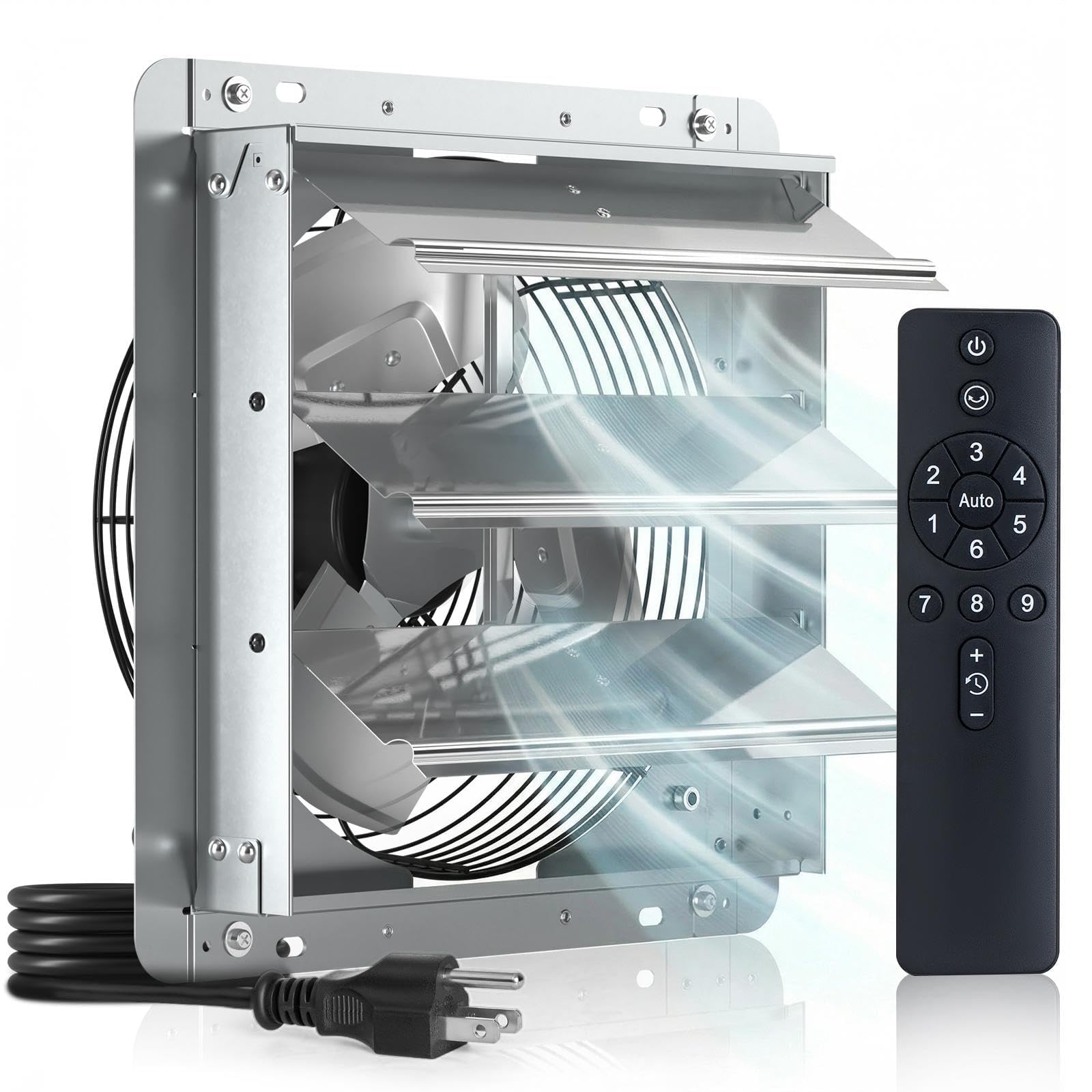
3. Amico 12″ Shutter Exhaust Fan
A whisper-quiet 1200 CFM fan that sips power and lets you change speed from your chair.
This is the fan for greenhouse owners who run ventilation constantly and want the electric bill to stay low. Its 25W DC motor draws dramatically less power than the 45W AC motor in the VEVOR 10-inch unit, yet it moves more air at 1200 CFM by spinning at 1750 RPM. Owners describe it as whisper quiet, and One owner noted it ran all night on just 89Wh at medium speed—impressive efficiency for continuous ventilation.
The 9-speed remote is the standout convenience feature. You can dial in anything from a gentle airflow to a turbo blast without reaching for a wall switch, and the 1-8 hour timer lets you set it to run and then shut off automatically. It even remembers your settings after a power outage, which is rare for remote-controlled fans. The gravity louvers seal tightly when off, blocking rain, dust, and insects while preventing cold air backflow.
Installation is genuinely plug-and-play with a cutting template, so you can avoid electrician costs. The trade-off is that the remote control drawf some mixed feedback — owners found it slightly confusing, with the top button acting as off-only and an unmarked button needed to activate the fan. It is a small learning curve for a fan that otherwise delivers quiet, energy-efficient ventilation.
The efficiency payoff
- 25W DC motor uses minimal electricity
- 1200 CFM airflow at 1750 RPM
- Quiet 50dB operation with 9-speed remote
The learning curve
- Remote controls take some getting used to
- Only brick and block anchors included
- No temperature or humidity sensors
Pick this if: you want energy-efficient, near-silent ventilation with the convenience of remote speed control.
skip it if: you would rather not fiddle with a remote — some owners found the button layout unintuitive at first.
4. KEN BROWN 12 Inch Shutter Exhaust Fan

A ready-to-run 1450 CFM fan that skips the wiring headache entirely with its pre-installed cord.
This fan solves the most annoying part of installing an exhaust fan: the wiring. It comes with a pre-installed 1.65 meter power cord, so you simply mount it on the wall, plug it in, and get instant ventilation. That convenience is why owners call it easy to install and versatile, using it in attics, sheds, garages, and greenhouses alike. It moves air at a strong 1450 CFM with 1650 RPM, and customers note it effectively drops indoor temperatures.
The construction is all high-grade aluminum — both the shutters and blades — which resists moisture and high temperatures without rusting. The automatic gravity shutters open and close with the fan’s operation, and owners describe the unit as quiet and sturdy, with one noting it should last many years. For a 12-inch unit, the airflow is impressive, and reviewers point out the value is tough to top at this price point.
The recurring observation is that the shutters do not always close completely, leaving small gaps that can let insects in when the fan is off. Some owners also note the airflow is more about circulation than raw power for larger spaces. If you need a dependable, no-fuss exhaust fan for a medium greenhouse, this is a strong candidate.
Plug-and-play appeal: A pre-wired 1450 CFM fan that installs in minutes with no electrical work — the easiest path to ventilation.
Watch the gaps: Shutters may leave small openings when closed, so consider a cover if insects are a problem.
5. addlon 12″ Shutter Exhaust Fan
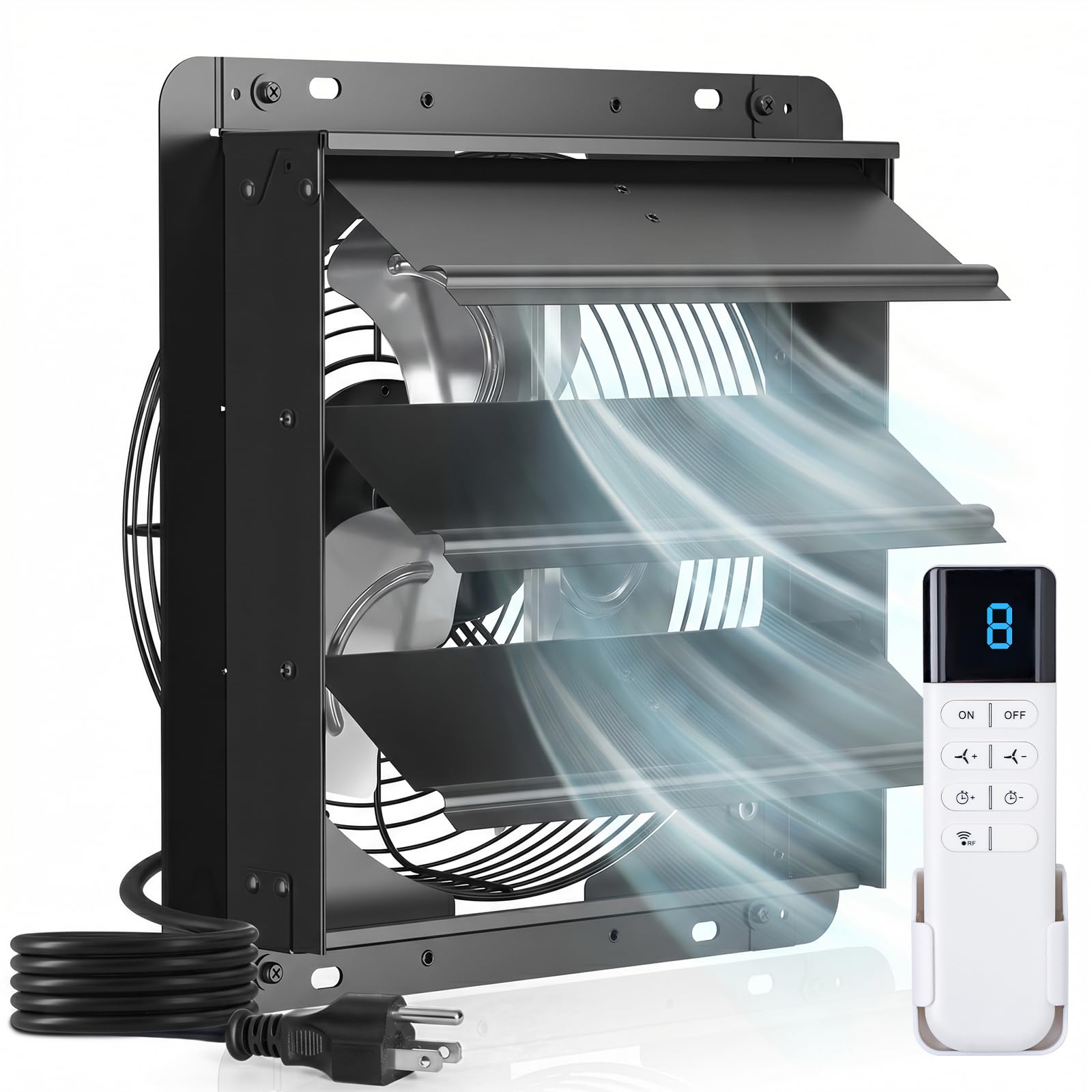
A smooth-running 1250 CFM fan with 8 speeds and a remote bracket that doubles as a wall switch.
This fan is a strong match for a greenhouse or chicken coop where you want both power and precision. Its sealed EC motor hits a top speed of 1948 RPM and delivers 1250 CFM while staying quiet at all speeds, which owners specifically praise. The wireless remote controls on/off, wind speed across 8 settings, and an auto shut-off timer from 1-8 hours, and the included bracket lets you mount the remote on the wall like a regular switch.
The build quality is reassuringly solid — the shutter, mesh cover, fan body, and even the connecting parts are all metal, which reduces the chance of deformation during shipping and gives it a durable, premium feel. It comes fully assembled and plugs straight into a 110V outlet, so installation is genuinely tool-light. Owners use it for smoke removal, workshop ventilation, and keeping coops fresh, and it excels at all of them.
The main setup note is that installation requires a precise 11.5-inch hole, and some owners found the instructions lacking for that step. The louvers also leave small gaps when closed, which a few buyers flagged as a possible entry point for insects. For a mid-range price, you get a lot of control and solid airflow, especially if you value quiet operation.
Why it stands out
- 8-speed remote with wall-mount bracket
- Quiet at all speeds with 1250 CFM airflow
- All-metal construction resists deformation
Setup notes
- Needs a precise 11.5″ hole for installation
- Shutters leave small gaps when off
- Instructions could be clearer
Best for: buyers who want quiet, remote-controlled ventilation with solid airflow in a mid-size space.
Consider the fit: if insect-proof sealing is critical, the small shutter gaps might bother you.
6. BILT HARD 4600 CFM 20″ Wall Mount Fan

A brute-force 4600 CFM circulator that drowns out dead spots in big greenhouses and barns.
Unlike the shutter exhaust fans above that pull air out, this 20-inch fan is a high-velocity circulator designed to keep air moving inside a large space. With a maximum airflow of 4600 CFM across three speeds — 4600, 3700, and 3000 — it creates serious breeze that owners use to cool three-car garages and barns. It is the right pick if your greenhouse is large and you need to push air across a wide area, not just vent one wall.
The 180-degree adjustable tilt is genuinely useful, letting you aim the airflow exactly where plants need it most. It runs on a fully enclosed ball-bearing motor with powder-coated steel construction and aluminum blades, plus OSHA-compliant grilles for safety. Mounting is flexible too — install it on a wall or ceiling with the provided hardware, and control it with a pull chain. Owners describe it as easy to assemble and say it moves a tremendous amount of air.
The trade-off is that this is not an exhaust fan, so it won’t remove hot air from your greenhouse on its own — it circulates what’s already inside. Noise is also a mixed point, with some owners finding it acceptable and others calling it loud. It is guaranteed for 1 year with free exchange for quality issues within the warranty.
Circulation power: A 4600 CFM air mover with 180° tilt that keeps large greenhouses from developing hot zones.
Pair it for best results: Use this alongside an exhaust fan to both circulate and vent — on its own it won’t lower temperature.
7. HG Power Upgraded 10 Inch Shutter Exhaust Fan
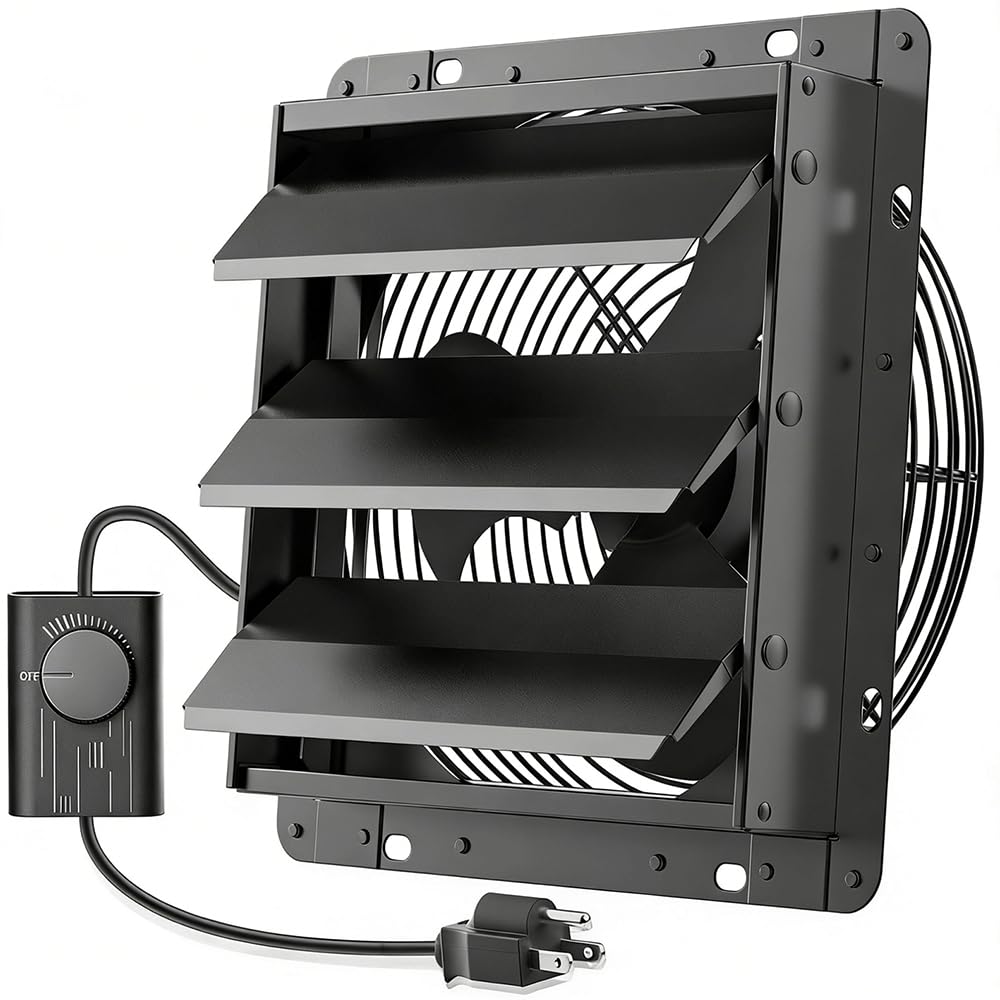
A small but mighty 647 CFM fan with an infinity speed dial for perfect airflow tuning.
Greenhouse owners with compact spaces should look at this 10-inch fan, which delivers 647 CFM at 1400 RPM while drawing only 42 watts. It is designed for smaller structures and performs excellently there — owners have used it in 8×12 foot coops and small greenhouses with strong results. The upgraded motor and thicker louvers are built to be sturdier than older versions, reducing the chance of damage during shipping.
The standout feature is the infinity speed controller, which gives you continuous speed adjustment rather than fixed steps. You can dial in a gentle breeze or a powerful gust depending on the weather, which is more flexible than a simple on/off switch. It also includes a built-in mesh screen for safety, protecting children and pets while keeping debris out.
Owners describe it as relatively quiet and easy to install, with good value for the price. The durability is a bit of a mixed report, so it is best suited to someone who wants a dependable small fan without paying for premium features. It is ideal right now for a small greenhouse, window, or shed vent.
Tunable airflow: A 647 CFM fan with an infinity speed dial that lets you fine-tune airflow for small greenhouses.
Size it right: This is a compact unit for small spaces — a larger greenhouse will need a higher-CFM fan.
8. CAMMOO 20 Inch Wall Mount Fan
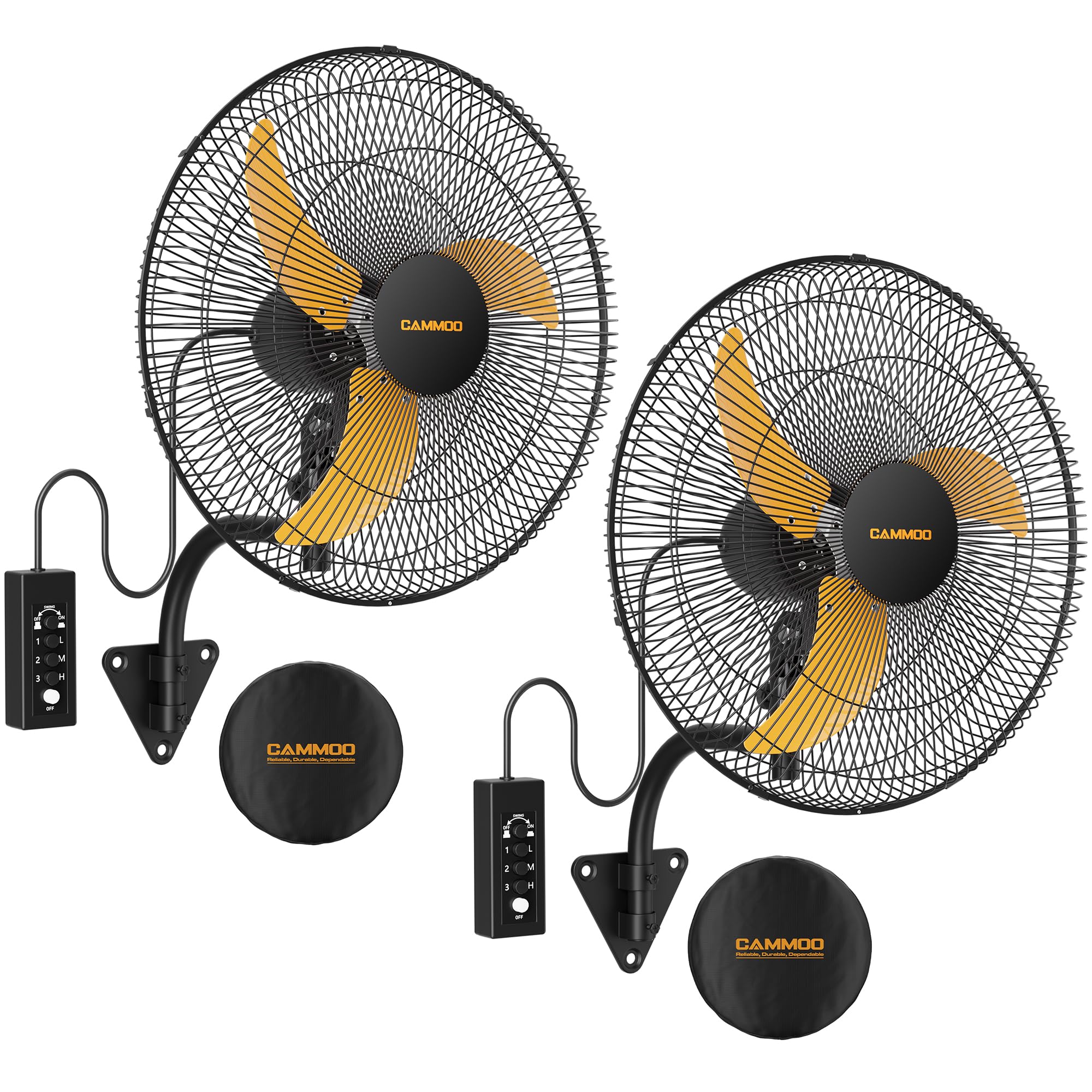
A 3.3ft wired-remote wall fan that adds oscillation for wider, more even airflow coverage.
This fan is aimed at anyone who wants to move air across a wide area without dead spots. It delivers 90° horizontal oscillation plus 30° manual vertical tilt, with a 30 ft airflow range that owners confirm provides a nice breeze from a distance. The 20-inch aluminum blades push serious air, making it a great fit for garages, covered porches, and barns rather than a sealed greenhouse needing exhaust.
The key upgrade over pull-cord fans is the 3.3 ft wired remote, which lets you switch speeds with one click instead of tugging a cord repeatedly. It also comes with a 6.6 ft power cord for flexible placement, plus a 600D Oxford dust cover — a rare add-on that keeps the fan clean when not in use. The dual-ball bearing copper motor and reinforced wall bracket are built to reduce vibration and last.
Owners praise the strong airflow and relatively quiet operation, with One owner noted it provides a nice breeze up to 15 feet away. The recurring complaint is that the fan ships with concrete anchor bolts but no wood-mounting hardware, so you may need extra screws for a wooden greenhouse frame, and the cover is thin. It is a solid choice for circulating air in workshops and covered outdoor spaces.
The appeal
- 90° oscillation covers wide areas
- Wired remote vs. pull cord convenience
- Aluminum blades with dual-ball bearing motor
What to watch
- Ships with concrete anchors only
- Dust cover is thin and small
- Limited tilt range per owner feedback
Reach for it if: you need wide oscillation across a garage, porch, or barn and want remote control without pull cords.
Look elsewhere if: you need a sealed exhaust fan for a greenhouse — this is a circulator, not a venting fan.
Understanding the Specs
CFM (Cubic Feet per Minute)
CFM (cubic feet per minute) is the single most important number on any greenhouse fan — it tells you how much air the fan moves each minute. For a greenhouse, you want a fan that can exchange the total air volume of your space about once per minute, so measure length × width × height to find your cubic footage, and match a fan that roughly hits that number. Small structures need around 600-800 CFM, medium ones 1200-1500 CFM, and large spaces 3000 CFM or more.
Shutter vs. Open Fan Design
Shutter exhaust fans have louvers that open when the fan runs and close when it stops, sealing the opening against rain, dust, and insects while preventing your heated or cooled air from escaping. Open circulating fans, by contrast, just push air around inside the space and do not vent anything out. For a greenhouse, choose a shutter exhaust fan to remove hot, humid air, then add a circulating fan to even out air movement.
Wattage and Motor Type
Wattage tells you how much electricity the fan draws. A 25W DC motor fan like the Amico or addlon uses far less power than a 45W AC motor fan like the VEVOR, yet can move more air, so it costs less to run continuously — a big deal if your fan runs all day. DC motors also tend to run quieter and cooler. AC motors are more common and often cheaper upfront but use more energy over time.
Thermostat and Speed Control
A thermostat lets the fan turn on and off automatically based on temperature, which is extremely handy in a greenhouse that heats up while you are away. Variable speed control lets you dial airflow up or down instead of running at full power all the time. If a fan lacks these, you can add an external thermostatic switch, but fans with built-in control are more convenient and often include a remote or wall controller as well.
FAQ
What size fan do I need for my greenhouse?
Is a shutter exhaust fan better than a regular wall fan for a greenhouse?
Does a greenhouse fan need a thermostat?
How many CFM do I really need for summer heat?
Will a greenhouse fan work in high humidity and rain?
Can I leave a greenhouse exhaust fan running 24/7?
Do I need a plug or wiring for these greenhouse fans?
What is the difference between an exhaust fan and a circulation fan?
Final Thoughts: The Verdict
For the majority of shoppers, the fan for greenhouse winner is the iLIVING 20″ Shutter Exhaust Fan because its 3368 CFM airflow and built-in thermostat handle large spaces with minimal babysitting. If you want budget-friendly efficiency for a small greenhouse, grab the VEVOR 10″ fan. And for energy-saving, quiet operation with remote convenience, the Amico 12″ DC fan is the one to reach for.
How We Picked
We do not accept paid placement. Every pick is matched to a real buyer and a real use-case; we do not hands-on test units.
Sources & Methodology
Specifications: manufacturer listings and product documentation. Review insights: verified customer reviews, as of August 2026. Pricing: not shown on this page (it changes often); check the current price via the retailer link.
As an Amazon Associate, WellFizz earns from qualifying purchases. This does not affect which products we feature.
Related Guides

Mo Maruf
I created WellFizz to bridge the gap between vague wellness advice and actionable solutions. My mission is simple: to decode the research and give you practical tools you can actually use.
Beyond the data, I am a passionate traveler. I believe that stepping away from the screen to explore new environments is essential for mental clarity and physical vitality.