Our readers keep the lights on and my smoothie glass nicely filled. As an Amazon Associate, I earn from qualifying purchases.
Specs are compiled from manufacturer listings and verified buyer reviews and can change over time — please confirm the key details on the product page before buying.
Enduro riding punishes brakes harder than almost any other discipline — long, steep descents build heat that turns weak stoppers into mushy levers right when you need them most. The picks here are all hydraulic disc brakes with four-piston calipers (the part that clamps the rotor), because that extra piston pair is what delivers the consistent, fade-resistant power enduro demands. This guide breaks down the real-world strengths and honest trade-offs of each set so you can match one to your riding style, weight, and bike setup.
I’m Mohammad Maruf — the founder and writer behind WellFizz. This guide is built by comparing the manufacturers’ published specifications and the patterns across verified customer reviews, so you get each pick’s real strengths and trade-offs instead of marketing spin.
One note before diving in: this list uses flexible, human-like matching for rotor size — accepting 203mm and 220mm options alongside the exact 200mm search — so a few picks serve the same purpose with a slightly different disc diameter. Here is how to choose the enduro mountain bike brakes that actually suit your bike and your riding.
Our Picks at a Glance
How To Choose The Best Enduro Mountain Bike Brakes
Enduro brakes need to survive repeated hard stops without turning spongy, and they need enough power that a single finger can control the rear wheel on a technical descent. The four most important decisions are piston count, rotor size, lever adjustability, and hose length — and getting any of them wrong can ruin an otherwise great set.
Piston count and caliper design
Four-piston calipers squeeze the rotor from both sides with two pistons per side, spreading the clamping force across a wider pad area than a two-piston design. That translates to stronger stopping power and better heat management — A four-piston set can deliver around 41% more braking force than a standard two-piston system.. For enduro, skip two-piston brakes entirely; the extra piston pair is the whole point.
Rotor size and mount type
Bigger rotors (200mm and up) give the pads more surface to grip and dissipate heat faster, which directly fights brake fade on long descents. Your fork and frame use a specific mount standard — post mount is the most common — and the caliper may need an adapter to fit your rotor size. Some budget sets only bolt directly to 160mm rotors, so check your bike’s mount type before ordering.
Lever feel and adjustability
Tool-free reach adjustment lets you pull the lever closer to your fingers, which matters for one-finger braking control. A bite-point adjustment changes where in the lever travel the pads actually grab the rotor, letting you tune for either a quick, sharp grab or a more progressive, modulated squeeze. Riders who dislike an on/off feel should prioritize levers with real modulation adjustment.
Quick Comparison
| Model | Best For | Caliper | Fluid | Weight | Amazon |
|---|---|---|---|---|---|
| Magura MT7 HC3★ Best Overall | One-finger modulation | 4-piston monoblock | Mineral oil | — | Amazon |
| BUCKLOS HB-CP4Best Value | Budget four-piston value | 4-piston | Mineral oil | 0.91 kg | Amazon |
| IIIPRO E4Lightweight Pick | Lightweight entry option | 4-piston | Mineral oil | 230g front / 245g rear | Amazon |
| Shimano SLX M7120 | Reliable all-round power | 4-piston | Mineral oil | 1.4 pounds | Amazon |
| SRAM Code RSC | Big riders, steep descents | 4-piston | DOT fluid | 1.2 pounds | Amazon |
| Hope Tech 4 E4 | Trail confidence and looks | 4-piston | Mineral oil | 1.1 pounds | Amazon |
| Hope Tech 4 V4 | Gravity-focused power | 4-piston | Mineral oil | — | Amazon |
| Shimano Saint M820 | Downhill-grade durability | 4-piston dual diameter | Mineral oil | 13.76 ounces | Amazon |
| TRP DH-R EVO | E-bike and heavy setups | 4-piston | Mineral oil | 16 ounces | Amazon |
In‑Depth Reviews
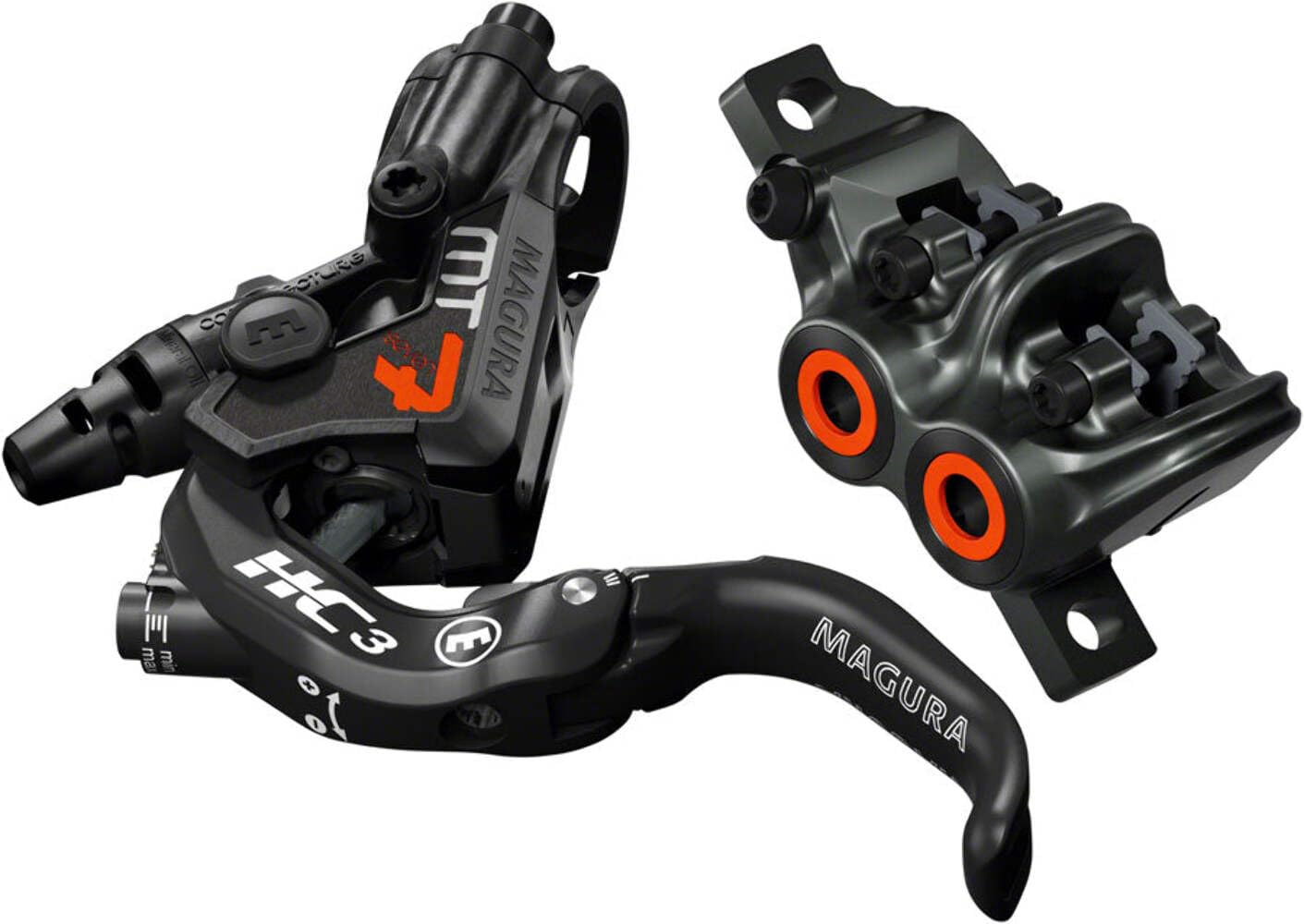
1. Magura MT7 HC3 Disc Brake
Our pick — over 4★ from 70+ verified ratings; the strongest balance of quality and price.
The crowd favorite for riders who want one-finger modulation over a hard on/off switch.
What wins people over here is the stopping power married to genuine control — buyers report being able to slow gradually or completely lock the rear wheel using just one finger, which is exactly what dirt jumpers and park riders need for tricks. That precision comes from the HC3 alloy one-finger lever blade, co-designed with trials legend Danny MacAskill, offering adjustable reach and leverage ratio so you can tune the feel precisely. The four-piston monoblock triple arch caliper packs anti-heat, anti-drag, and anti-squeal tech, so a hard day of park laps keeps the power consistent rather than letting it fade.
Maintenance is a real selling point here: the Easy Bleed Technology (EBT) port and flip-flop design mean pad swaps and bleeds are fast, and the brake ships with mineral oil already in the hoses so you can skip the first bleed entirely. The Carbotecture SL body keeps weight down while staying leakproof, all backed by a 5-year warranty. For a heavier rider around 240 lbs, the strong stopping and minimal fade on park days hold up well, and the adjustability means you can dial the lever to hook your pointer finger for easy braking.
The honest trade-off is installation: the tight pad-to-caliper clearance makes setup time-consuming the first time, so budget some patience or a shop visit. On the value front, feedback splits — some call it worth every dollar for the modulation, while others find it expensive. It beats the SRAM G2 R brakes it often replaces with noticeably more bite, making it a worthy step up.
What riders rave about
- One-finger stopping power with real modulation, not an on/off grab
- Tool-free reach and leverage adjustments via the HC3 blade
- Ships pre-bled with mineral oil in the hoses
- 5-year warranty on a leakproof Carbotecture SL body
What to plan for
- Tight pad/caliper clearance makes first install time-consuming
- Value-for-money opinions split between “worth it” and “pricey”
- One heavier eMTB rider found it softer and less powerful than Shimano XT
Grab it if: you want precise, adjustable one-finger modulation and easy bleeding for park or dirt-jump riding.
Think twice if: you want a quick, simple install — the tight tolerances demand care and patience.
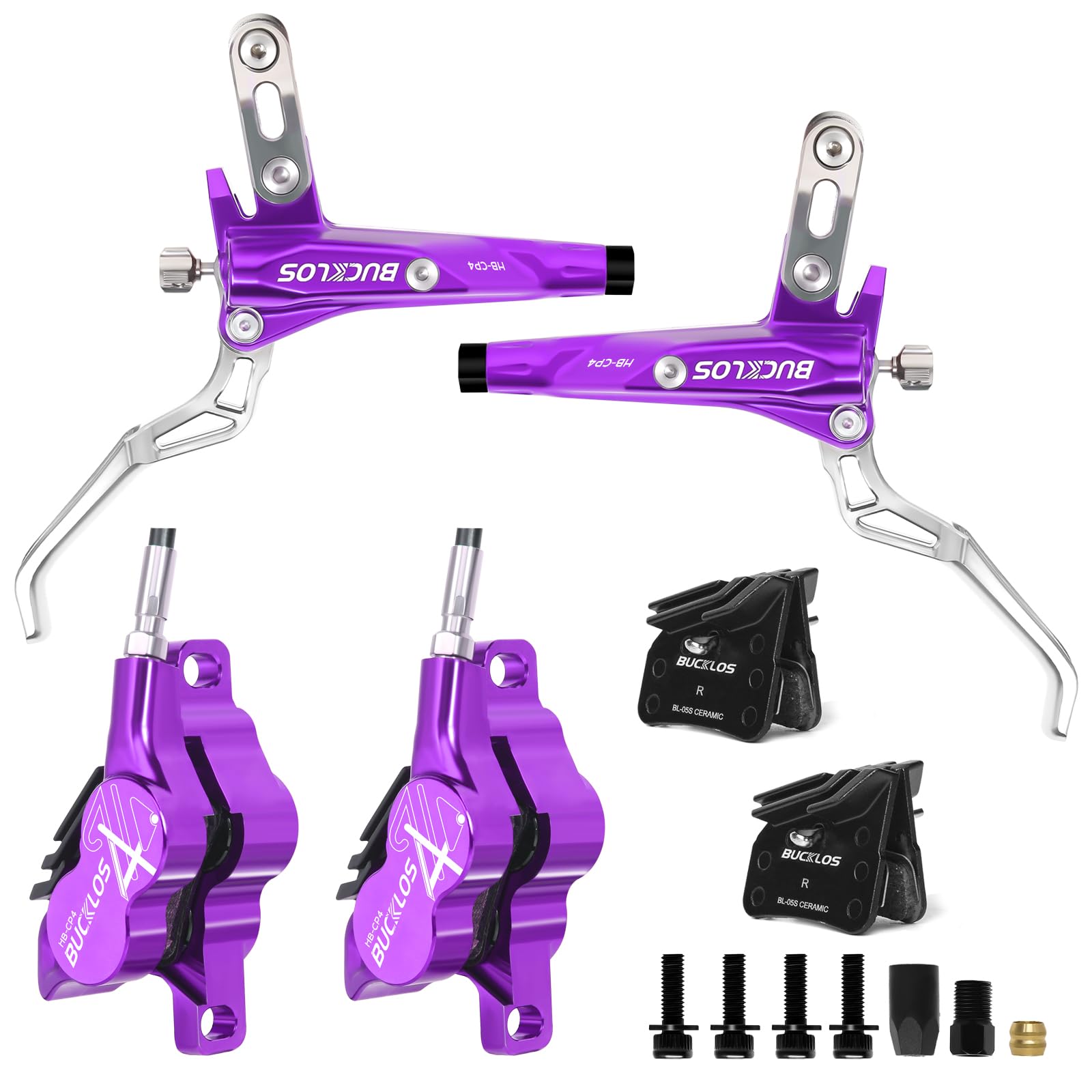
2. BUCKLOS MTB Hydraulic Disc Brake Set
The budget four-piston set that delivers real stopping force without the premium price tag.
The thing everyone raves about is the quality relative to the cost — owners rebuilding bikes like a Trek 3500D found these stop very well and fast, with no slippage on the discs, once they made sure the rotors were free of oils. The four-piston calipers evenly distribute braking force for balanced, stable performance with instant response, upgrading the feel of a traditional two-piston setup. A CNC-machined aluminum alloy lever and caliper keep weight down while improving handling and flexibility.
Installation is genuinely friendly: the front and rear brakes come split for free assembly, with a front hose of 31.5 inches (850 mm) and a rear hose of 55.1 inches (1550 mm), both pre-filled with mineral oil so no bleeding is needed before first use. The BL-05S ceramic brake pads promise silent operation with a short break-in cycle and fast heat dissipation, which suits a wide range of bikes including mountain, e-bike, fat, folding, trail, and downhill models.
The durability picture is the honest catch here — while quality earns strong praise, several owners reported the brakes broke easily, and one had the set start screeching about a week after install, with the lever adjuster coming loose repeatedly. For a first-time four-piston upgrade on a budget, the value is hard to argue with, but this is a set for riders who are comfortable doing their own maintenance and adjustments.
Budget pick verdict: A genuinely strong entry into four-piston power at a friendly price, backed by pre-bled hoses and ceramic pads.
Reality check: Durability feedback is mixed — some buyers saw failures fast, so manage expectations on long-term toughness.
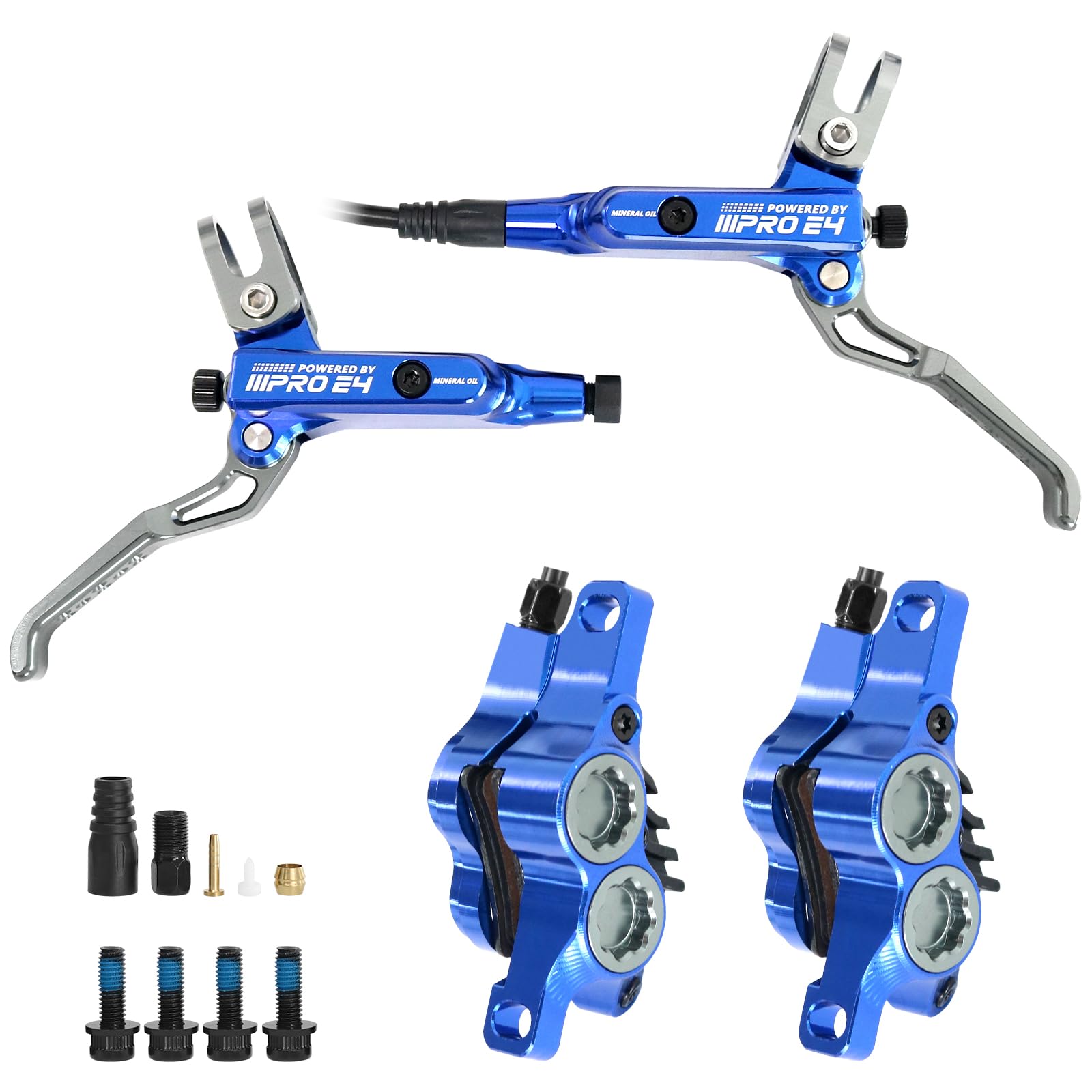
3. IIIPRO E4 MTB Hydraulic Disc Brake Set
A featherweight four-piston kit that undercuts heavier rivals on the scales.
At just 230g for the front and 245g for the rear, these are remarkably light for four-piston brakes — the kind of number that matters when you are shaving grams off a build. The four-piston design uses synchronized oil pressure to deliver 641N of braking force, which the maker claims outperforms standard two-piston systems by 41% with 7.2ft shorter stops at 30km/h.. The ceramic metal pads add an aluminum alloy heat dissipation layer that can cut braking surface temperature by up to 30%, with over 95% noise reduction versus traditional resin pads..
Owners running these for about three months on a single-speed MTB call them a great budget option for hydraulic brakes, and the value-for-money verdict is strong. The package includes an integrated left front brake hose at 800mm (31.5″) and a rear split-style internal routing hose at 1550mm (61.0″), both pre-bled — though you should double-check your frame’s routing and size before buying. The catch is that this set does not include mounting adapters; if your fork and frame use a Post Mount (A-pillar) design, the calipers bolt directly with 160mm rotors, but IS or Flat Mount setups need a separate adapter.
Two real-world notes: some owners found the brake pressure a little weak until they bled the system themselves, and the front brake line arrived short for one rider (a fixable issue if you have spare hose). Pads also wear fast on high-powered e-bikes, so match this set to a standard MTB rather than a heavy electric build for best life.
Why it stands out
- Ultralight 230g front / 245g rear four-piston build
- Claims 641N braking force and 41% more than two-piston
- Ceramic pads reduce heat and noise significantly
- Strong budget value for hydraulic braking
Before you buy
- No mounting adapters included — check your mount type
- May need a self-bleed to reach full pressure
- Pads wear quickly on high-powered e-bikes
Best for: weight-conscious riders building or upgrading a standard mountain bike on a budget.
Not ideal for: heavy e-bikes that will chew through the pads, or frames needing IS/Flat Mount adapters.
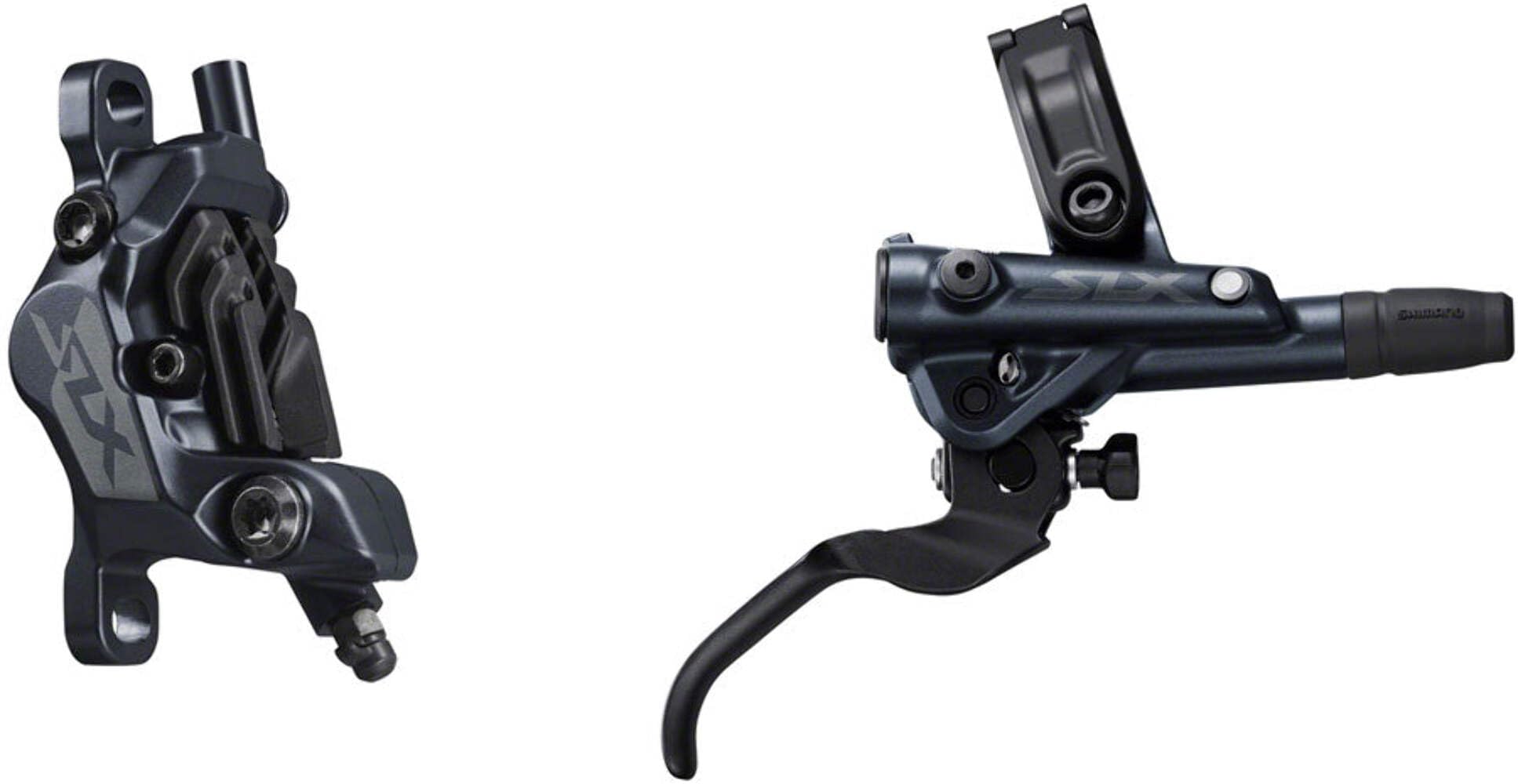
4. Shimano SLX BR-M7120 Disc Brake
Shimano’s workhorse four-piston stopper that riders call the best brake you can mount.
The defining feature is the Servo Wave lever action — a cam that pulls the pads to the rotor faster at the start of the stroke, then delivers increased power as you squeeze deeper, giving reliable stopping power you can drag all day.. One owner replaced a 7-year-old XT model with this SLX and found it works better, while another called these the best brakes you can put on a mountain bike, citing real stopping power. The four-piston caliper with a post mount design fits most modern frames directly.
Tool-free reach adjustment means you can dial the lever position on the trail without any tools, and the hydraulic actuation delivers that predictable, modulated feel Shimano is known for. Taken downhill, it provides reliable and predictable stopping power every run — the kind of consistent performance that inspires confidence on repeated descents. As a single right/rear unit, it’s ideal for riders replacing just the rear brake or building up a set one end at a time.
At 1.4 pounds for the caliper and lever together, it sits in the expected range for a four-piston brake, and the quality reputation means most owners simply never look back. This is the safe, proven choice for riders who want Shimano reliability without stepping up to the XT or XTR price brackets.
Why it wins trust: Servo Wave cam action plus four-piston power equals predictable, drag-all-day stopping on descents.
Value read: Shimano quality at a mid-range price point, with tool-free reach and a post mount that fits most bikes.
5. SRAM Code RSC Disc Brake
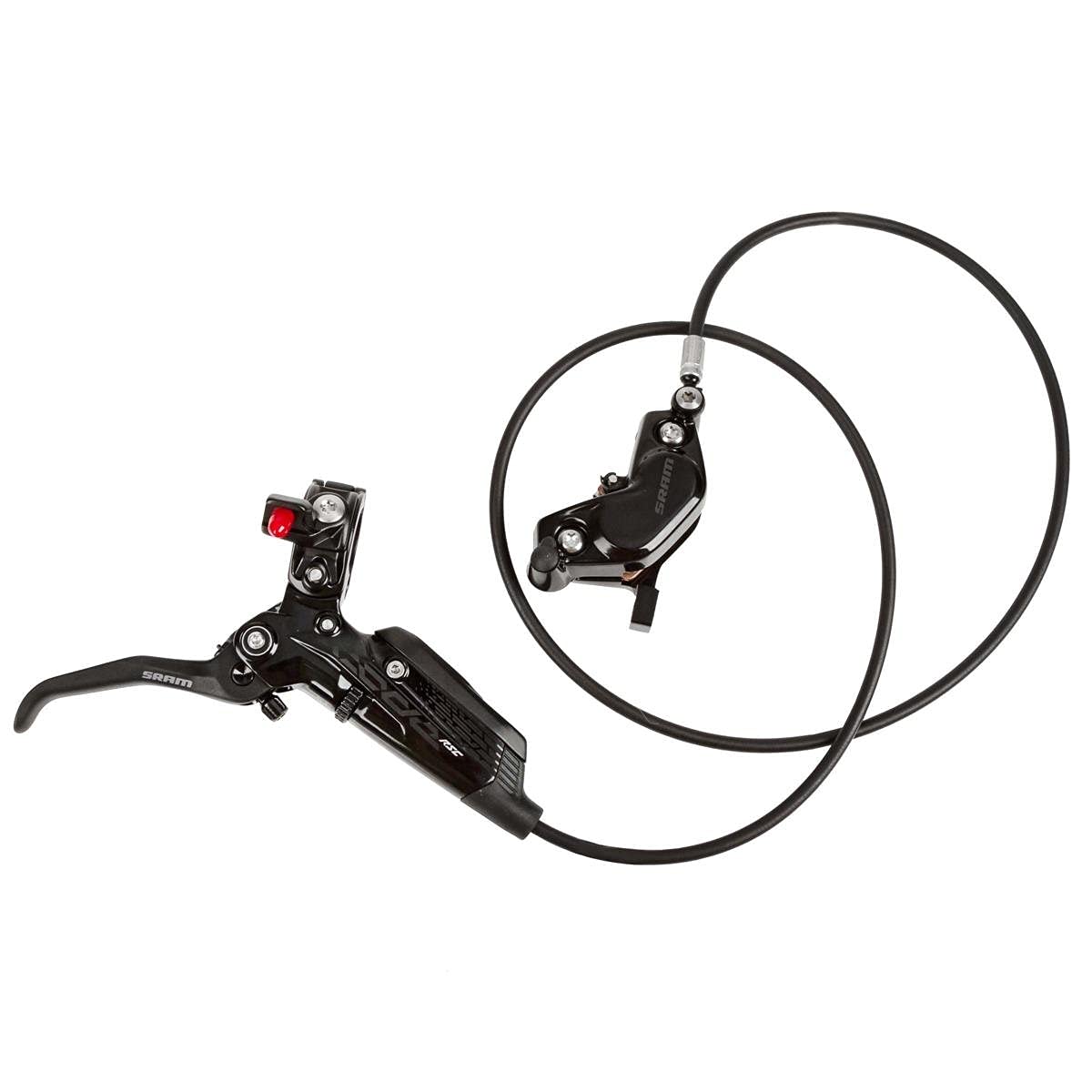
The upgrade path for big riders on long, steep descents who outgrew their stock brakes.
The story riders tell about the Code RSC is almost always the same: it fixed the fade problem. One large Santa Cruz owner upgraded from Guide RSCs that faded on longer descents, and the Codes — with larger volume fluid reservoirs and bigger calipers — transformed into “awesome stoppers.” The 2-piece forged aluminum caliper houses four phenolic composite pistons for exceptional stopping power and superior heat dissipation, while the advanced SwingLink technology and Lever Pivot Bearings deliver smooth, progressive modulation that stays fatigue-free under heavy loads.
Owners pair this with rotors like a 205mm Hope and report surprising gains in both stopping power and modulation over what they ran before. The large-volume forged aluminum lever reservoir and Bleeding Edge design make maintenance easier and keep the brake feel consistent across all ride conditions. It’s also proven on electric trials bikes, where powerful, adjustable braking is essential — riders call it very powerful with good modulation and lots of adjustments. The stainless steel heat shields and sintered metallic pads provide long-lasting performance and strong power output for aggressive trail or e-bike use.
At 1.2 pounds, it’s a slightly heavier build than some rivals, but that weight buys the thermal mass that resists fade on long descents. For heavier riders or anyone pushing big, steep lines, this is the brake that keeps working when others go soft.
What makes it great
- Bigger fluid reservoirs and calipers fight fade on long descents
- SwingLink tech gives smooth, progressive modulation
- Sintered metallic pads and steel heat shields last
- Bleeding Edge design simplifies maintenance
Who it suits
- Made for larger bikes and heavier riders
- Best on long, steep descents where fade is the enemy
Reach for this if: you ride long, steep descents or a heavier bike and your current brakes fade mid-run.
Look elsewhere if: you want the lightest possible setup — the thermal mass here adds a bit of weight.
6. Hope Tech 4 E4 Disc Brake and Lever Set
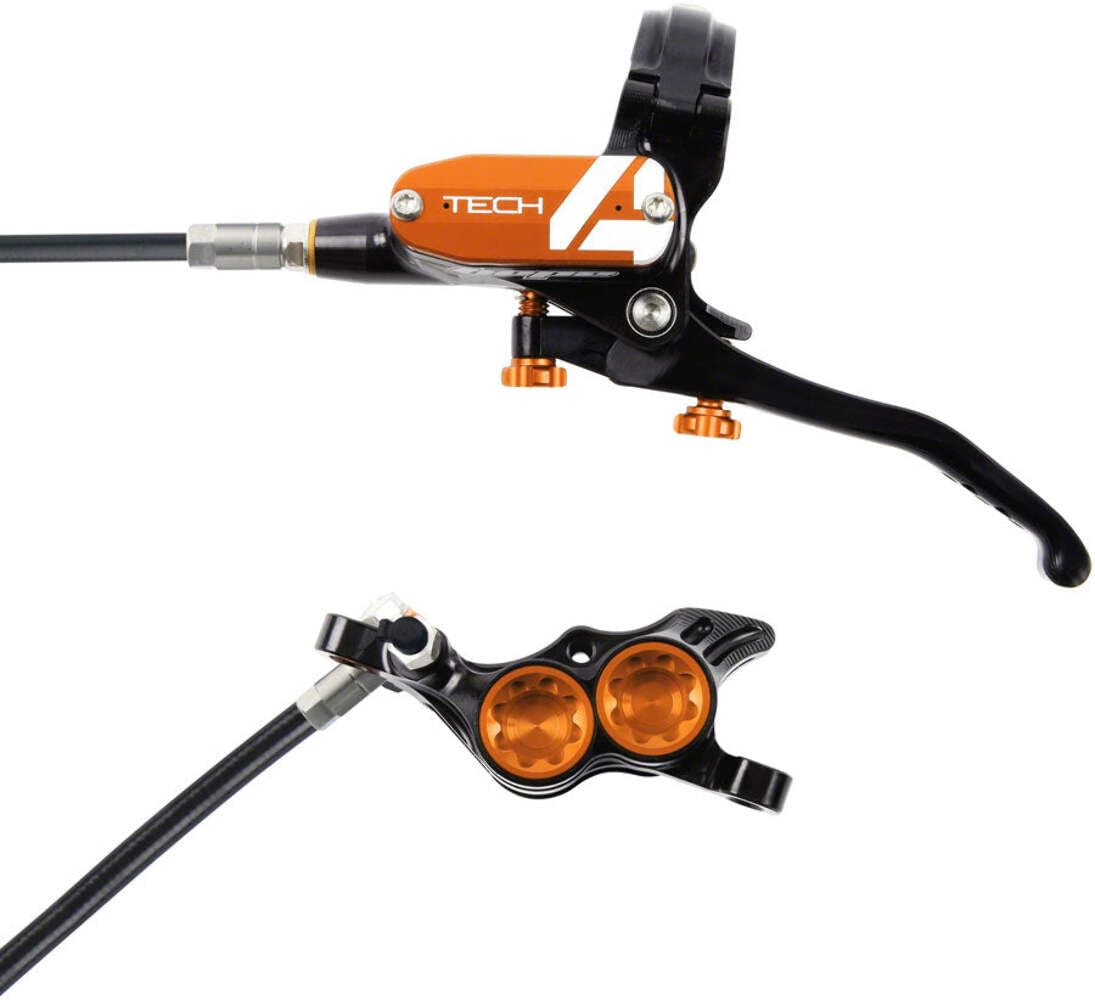
The trail and enduro brake that pairs four-piston confidence with a premium aluminum feel.
Hope’s reputation for machining quality shows here — owners describe the quality aluminum lever with exceptional pad bite and hard stopping power, with no lever mush, and some rate it above Magura and Shimano SLX for feel. The improved lever design is more ergonomic, and the tool-free reach and bite point adjustments let you fine-tune exactly where the pads grab and how close the lever sits to your fingers. A phenolic insert in the caliper helps dissipate heat on long descents, keeping performance consistent.
Owner experiences range from genuinely enthusiastic — one calls these the bee’s knees, noting that with a bit of YouTube time, bleeding them becomes easy — to a practical note on installation for a Super 73 with extra pads included in the box and exceptional pad bite. The set is designed as a rear/right and front/left mountain bike configuration, so check your lever orientation before buying; it’s not set up for left-hand rear brakes. It also beats the previous Hope V3 model with definitely better stopping power, making it a meaningful upgrade within the Hope family.
The honest limits: at 1.1 pounds it’s light, and the brake looks great on any build, but it’s aimed at mountain bike setups — not Surron or e-bike configurations where the lever orientation likely won’t match. Riders who want a distinctive, well-made brake with real adjustment range will find a lot to like here.
Why it wins admirers: Premium aluminum build, tool-free reach and bite adjustment, and pad bite that owners rank above bigger-name rivals.
Setup note: Confirm you want the standard MTB rear/right, front/left orientation before ordering — it won’t suit every bike.
7. Hope Tech 4 V4 Disc Brake and Lever Set

The gravity-focused Hope with 30% more power than the previous Tech 3 generation.
This is the harder-hitting sibling in Hope’s lineup, It delivers enhanced braking power with a 30% increase over previous Tech 3 models., built for reliable, high-performance stopping in all trail and downhill scenarios. The precision CNC-machined aluminum forged billet construction blends lightweight performance with exceptional durability for aggressive riding. Internal sealing and a roller bearing pivot design reduce friction, while hybrid-style stainless steel pistons with phenolic inserts ensure smooth operation and excellent heat management on long, technical descents.
Riders who love it call it the best modulation and power of any brake they’ve used, and the tool-free bite point and reach adjustments allow genuine customization at the lever. The hinged clamps work with both SRAM and EV shifters for easy installation, and the post-mount design is compatible with 3.3mm thick rotors (sold separately), making it ideal for enduro and gravity-focused riding.
The honest counterweight: this model draws the most polarized feedback in this list. Several owners hit real frustration — a squishy lever that persisted after multiple bleeds, a hose bolt that snapped off during removal, and rear brakes that needed constant bleeding and went noisy. Some long-time Hope users say the front brake was fine while the rear repeatedly lost pressure. It’s a brake with stunning potential and some quality-control inconsistency — ideal if you love the power and feel, but be ready to wrench on it.
The high points
- 30% more power than Tech 3 models
- top-tier modulation, per one owner
- Tool-free bite point and reach adjustment
- Fits SRAM and EV shifters via hinged clamps
The risk
- Multiple owners mention rear brakes going squishy and needing re-bleeds
- A hose bolt snapped during removal for one owner
- Some quality-control inconsistency between units
Choose it for: class-leading modulation and power if you’re comfortable doing your own bleeding and maintenance.
skip it if: you want set-and-forget reliability — the rear-brake bleeding complaints are too common to ignore.
8. Shimano Saint M820 Disc Brake
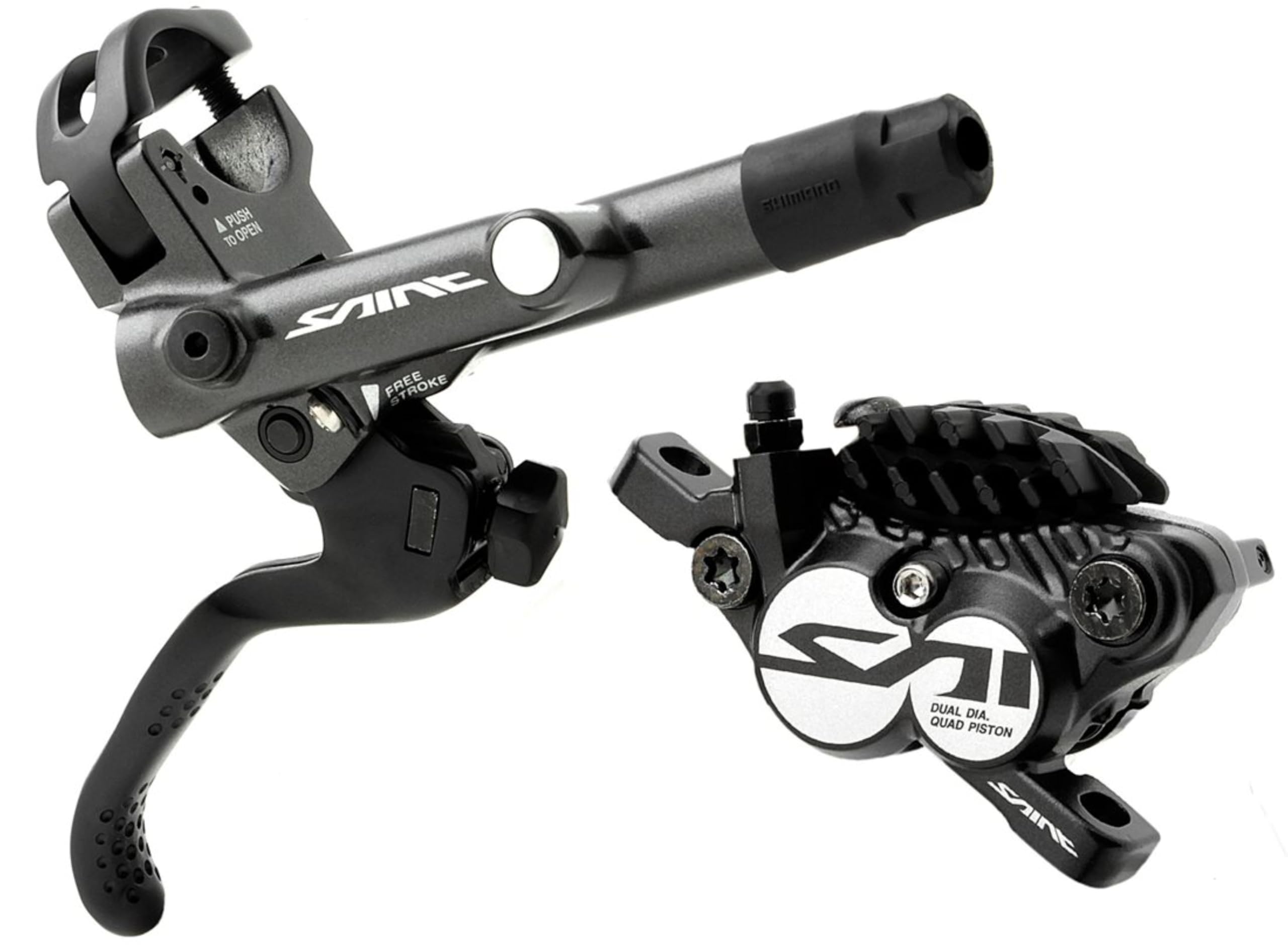
Shimano’s downhill-grade stopper that riders call one of the best brakes ever made.
The number that defines this brake is its 4-piston dual diameter caliper — a design borrowed from Shimano’s downhill racing program that delivers the kind of power that “will stop you dead on 45° slick rock” with the right tires, as one owner put it. The Servo Wave hydraulic actuation gives that familiar Shimano cam-assisted power curve, and the lever offers both tool-free reach and free stroke adjustment so you can dial the bite point exactly where you want it. Owners rate the quality top-tier, calling it well worth the money for the quality and style.
Real-world reports highlight a softer lever pull than XT with a SRAM-like feel, but genuine power and control with good modulation on long descents and no fade. One owner replaced a SRAM G2 rear brake and found this delivers real stopping confidence. The I-Spec B compatible lever integrates cleanly with Shimano shifters, and the metal pads with fins (heat-dissipating metal wings) handle hard braking without complaining. At 13.76 ounces, it’s heavier than some rivals — a direct result of the downhill-focused design that prioritizes thermal capacity over weight savings.
The quality is widely praised, though durability feedback is mixed, and installation can be a pain: the pre-filled mineral oil can hinder internal cable routing, and one unit had a broken olive that was hard to remove. Once installed and bedded in, the performance is worth the effort — but this is a brake that rewards patience during setup.
What earns the price
- DH-grade 4-piston dual diameter caliper with metal finned pads
- Servo Wave power curve with tool-free reach and free stroke
- Owners call it one of the best brakes available
- Good modulation on long descents with no fade
What to expect
- Installation is a pain, especially internal routing with pre-filled hoses
- Heavier than XT or XTR due to downhill design
- Durability feedback is mixed
Worth it for: riders who want genuine downhill-grade power and don’t mind a heavier, more involved installation.
Reconsider if: you’re chasing the lightest build or want a quick, simple bolt-on setup.
9. TRP DH-R EVO HD-M846 Disc Brake
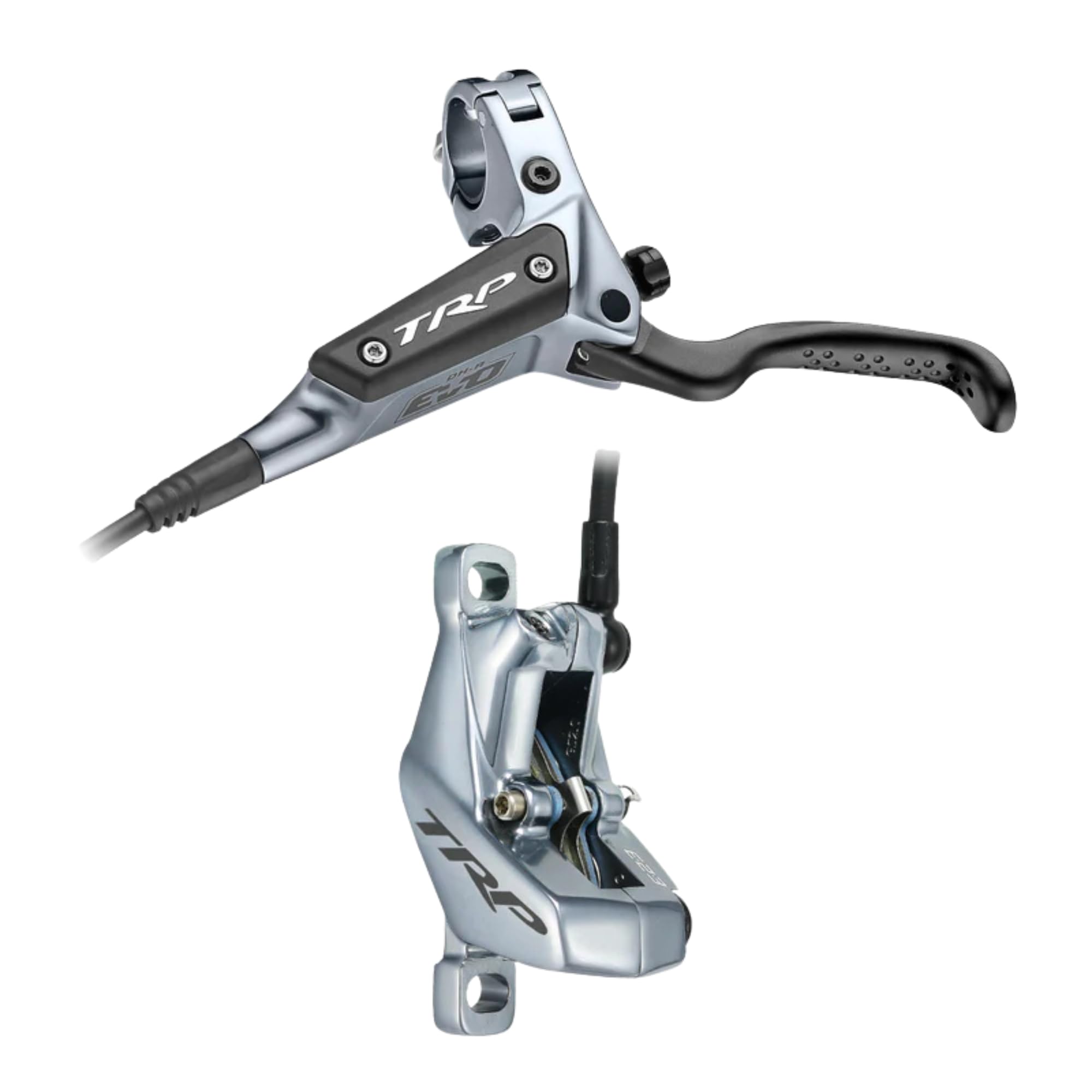
The e-brake rated stopper built for heavy bikes and the heat they generate.
The defining spec here is the E-brake rated performance, designed for maximum stopping power with 2.33mm brake discs — thicker than standard rotors — providing improved heat resistance and increased lateral stiffness., with compatibility for 223mm and 220mm rotors. That makes it a strong fit for heavier bikes and extreme riding conditions where standard brakes struggle. The high-performance mineral oil is tune for lower viscosity, allowing higher flow rates and enhanced braking consistency, with heat resistance up to 230°C for improved thermal stability..
The 5mm hydraulic brake line enhances rigidity for greater hydraulic pressure and is tune for internal routing, keeping the cockpit clean.. It’s engineered to integrate with I-Spec II, MMX/TRP shifters, and I-Spec EV for a streamlined setup, and comes with the latest Blue Organic Compound brake pads that promise reduced bedding-in time, lower noise, and smooth power right from the start. One long-term owner — 8 months in — praised its progressive braking as much better than other high-end brands and was surprised by its performance under the highest demands.
The counterweight is the pads: one owner found the included pads wore out completely in just 5 rides, describing them as “made of cardboard” — so budget for an immediate pad upgrade. A couple of other owners hit bigger issues with bleeding difficulty and overheating after a couple of days, though those are balanced against genuinely enthusiastic long-term reports. At 16 ounces, it’s not the lightest, but the heat-handling design targets exactly what enduro and e-bike riding demand.
Why it’s built for heavy duty
- E-brake rated for 2.33mm discs and 220/223mm rotors
- Mineral oil resists heat up to 230°C
- Integrates with I-Spec II, MMX/TRP, and I-Spec EV
- Progressive braking praised over other high-end brands
The trade-offs
- Stock pads wore out in 5 rides for one owner — plan a swap
- A few owners hit bleeding difficulty and overheating
- Heavier build at 16 ounces
Best for: e-bikes and heavy rigs running thick rotors on extreme descents who want that extra heat headroom.
Not for: riders who want to keep the stock pads long-term — have replacements ready.
Understanding the Specs
Piston count
A four-piston caliper squeezes the rotor with two pistons on each side, spreading the clamping force over a wider pad area than a two-piston design. For enduro, that means stronger stopping power and better heat management — the extra piston pair is the main reason these brakes cost more and stop harder. If a brake is described as 4-piston, you’re getting the enduro-grade power delivery.
Brake fade
Fade is what happens when heat builds up in the brake fluid and pads during a long descent, and the lever starts feeling spongy or the stopping power drops. Brakes fight fade with bigger calipers, larger fluid reservoirs, heat-dissipating pad materials, and phenolic inserts in the caliper. If you ride long, steep descents, fade resistance matters more than raw power — a brake that fades is useless on the second half of the run.
Lever adjustability
Tool-free reach adjustment moves the lever closer to or farther from your handlebar grip, which is essential for one-finger braking control. Bite-point adjustment changes where in the lever stroke the pads actually contact the rotor — a shorter bite gives a quick, sharp grab, while a longer bite allows more progressive modulation. Riders who dislike an on/off feel should prioritize brakes with real modulation adjustment rather than just reach.
Hose length and mounting
Brake hoses come in set lengths — front hoses around 31.5 inches (800-850mm) and rear hoses from 55 to 61 inches (1400-1550mm) — and you need to match these to your frame’s internal routing and size. The caliper mount type must also match your fork and frame: post mount is most common, but IS and flat mount need adapters. Some budget sets only bolt directly to 160mm rotors, so check both your mount and rotor size before ordering.
FAQ
Do I need four-piston brakes for enduro riding?
Will these brakes fit my bike’s mount standard?
What is brake fade and how do I avoid it?
How long does a set of enduro brake pads last?
Do these brakes come pre-bled and ready to install?
What’s the difference between mineral oil and DOT fluid brakes?
Is the lever orientation the same on all these brakes?
Do I need a bleed kit to install these brakes?
Which brake is best for a heavier rider?
Can I use these brakes on an e-bike?
Final Thoughts: The Verdict
For most riders, the enduro mountain bike brakes winner is the Magura MT7 HC3 because it pairs one-finger modulation with genuine stopping power, backed by easy bleeding and a 5-year warranty. If you want a proven, reliable workhorse at a more accessible level, grab the Shimano SLX M7120 for its Servo Wave predictability. And for big riders or heavy e-bikes pushing long, steep descents, the SRAM Code RSC is the fade-resistant stopper to reach for.
How We Picked
We do not accept paid placement. Every pick is matched to a real buyer and a real use-case; we do not hands-on test units.
Sources & Methodology
Specifications: manufacturer listings and product documentation. Review insights: verified customer reviews, as of August 2026. Pricing: not shown on this page (it changes often); check the current price via the retailer link.
As an Amazon Associate, WellFizz earns from qualifying purchases. This does not affect which products we feature.
Related Guides

Mo Maruf
I created WellFizz to bridge the gap between vague wellness advice and actionable solutions. My mission is simple: to decode the research and give you practical tools you can actually use.
Beyond the data, I am a passionate traveler. I believe that stepping away from the screen to explore new environments is essential for mental clarity and physical vitality.