Our readers keep the lights on and my smoothie glass nicely filled. As an Amazon Associate, I earn from qualifying purchases.
Specs are compiled from manufacturer listings and verified buyer reviews and can change over time — please confirm the key details on the product page before buying.
If your PC’s built-in sound leaves your games feeling flat and your music lifeless, a compact external box plugged into a USB port can transform everything you hear. These little devices take over all the audio duties your motherboard handles poorly, letting you finally use good headphones and speakers to their full potential. The best one for you depends on whether you chase competitive gaming cues, studio-style recording, or just want louder, cleaner sound for everyday listening.
I’m Mohammad Maruf — the founder and writer behind WellFizz. This guide is built by comparing the manufacturers’ published specifications and the patterns across verified customer reviews, so you get each pick’s real strengths and trade-offs instead of marketing spin.
Plug a external sound card into your PC’s USB port and you can hear game footsteps and music details your built-in audio simply misses.
Our Picks at a Glance


How To Choose The Best External Sound Card
What you plug into the card decides which one you need. Basic gaming headsets only need a simple USB adapter. But high-end headphones or studio monitors demand a built-in amplifier and support for higher-resolution audio (a digital format that carries more detail than standard CD quality).
Match the Device to Your Headphones
Headphones with higher impedance, measured in ohms, need more power to sound their best. A sound card with a headphone amplifier drives these demanding sets properly. A basic adapter without amplification will leave them quiet and weak, no matter how good the DAC chip is.
Consider Your Platform and Inputs
Most external sound cards are plug-and-play on Windows and macOS, but console support varies. Check that your pick works with your PS5, Switch, or laptop if you plan to use it beyond your PC. Also look for the right inputs, like separate mic and line-in jacks, for recording or connecting instruments.
Quick Comparison
| Model | Best For | Max Sample Rate | Surround Sound | Headphone Amp | Amazon |
|---|---|---|---|---|---|
| Sound BlasterX G6★ Best Overall | Gaming and Hi-Res Music | 384 KHz | 7.1 Virtual | Yes | Amazon |
| EPOS GSX 1000Audiophile Pick | Competitive FPS Gaming | 48 KHz | 7.1 Surround | Yes | Amazon |
| Fosi Audio C3 | FPS Footstep Clarity | 384 KHz | 7.1 Surround | Yes | Amazon |
| Cubilux CB5 | Recording and Podcasting | 192 KHz | — | Yes | Amazon |
| Cubilux 7.1 USB | Multi-Channel Speaker Setups | 384 KHz | 7.1 Virtual | No | Amazon |
| Andrea USB-SA-1 | Voice Dictation and Clarity | 48 KHz | Stereo | No | Amazon |
| VANTEC 7.1 Adapter | Adding Optical Audio Output | 48 KHz | 7.1 Virtual | No | Amazon |
In‑Depth Reviews
1. Sound BlasterX G6
Our pick — over 4★ from 6,500+ verified ratings; the strongest balance of quality and price.
This DAC (a digital-to-analog converter that turns your PC’s digital audio into sound) drives quiet headphones to full volume and adds spatial depth to flat game audio.
The defining spec here is the 32-bit/384kHz DAC, which has a maximum sample rate of 384 KHz, compared to the 48 KHz of the next pick, making it a genuine high-resolution audio powerhouse for music lovers and editors alike. But this box is built for gaming first, packing 7.1 virtual surround sound and Dolby Digital decoding so you get positional cues without needing a multi-speaker setup. Owners repeatedly call out the huge volume boost, which makes even hard-to-drive headphones sound vibrant.
You can fine-tune nearly every parameter on the G6, from individual EQ bands to profile buttons you can reach mid-game. It connects via USB and is compatible with PS4, Xbox One, Nintendo Switch, and PC, so it travels easily between your console and desktop. Buyers report it works with Android devices through a USB-C adapter, a laptop, and even a PS5, though it relies on a microUSB cable for power.
Hundreds of buyers praise its crisp audio and the ability to fine-tune surround effects (virtual multi-speaker sound from headphones). The trade-off: reliability gets mixed feedback, so expect to run firmware updates as routine upkeep. It also drives studio headphones well, so you can use it for both gaming and critical listening without a second device.
Why It Wins
- Exceptional clarity and detail from a 32-bit/384kHz DAC
- Dolby Digital and 7.1 virtual surround for cinematic immersion
- Drives high-impedance headphones with a powerful built-in amp
- Works across PC, PS4, Xbox One, and Nintendo Switch
Trade-Offs
- Mic chat requires extra cables on some consoles
- Plastic body feels hollow despite premium performance
- Occasional reboots reported during heavy use
Your best fit: This is the pick for anyone upgrading from a headset’s built-in audio who wants one box for PC gaming, console play, and Hi-Res music.
Think twice if: You only need a cheap way to add a headphone jack — the G6’s depth and price are wasted on basic setups.
2. EPOS GSX 1000 2nd Edition
A sleek desktop hub that swaps between speakers and headphones with one touch.
What sets the GSX 1000 apart is its ease of use, letting you switch between your headphone DAC sound and your speakers without unplugging a single cable. It runs an EPOS-engineered 7.1 surround engine that owners describe as excellent for open-world games and directional audio in FPS titles. The built-in sidetone lets you hear your own voice in real time at a level you set, which helps stop you from shouting during team chat.
You get precision control with a dedicated USB-C DAC chip, four EQ presets for story and music modes, and a smooth aluminum volume wheel built to last. Dual wheels separate game audio from chat volume, so you can balance your teammates against the action. The rotating knob to adjust sidetone is a favorite feature, and the clear display shows your current settings at a glance.
The thing everyone raves about is the virtual surround, which owners say beats Dolby Atmos for positional accuracy with lower impedance headsets. The honest limit is power: it shines with gaming headsets around 50 to 100 ohms, but high-impedance audiophile cans like 300-ohm models need an external amp to reach full volume.
Standout Strengths
- smooth speaker-to-headphone switching without cable swaps
- Precise 7.1 virtualization praised for FPS directionality
- Adjustable sidetone and separate game/chat volume wheels
- Aluminum volume wheel and durable build quality
Real Limits
- Not enough power for 300-ohm audiophile headphones
- Chat mixer wheel doesn’t fully mute at zero
- Occasional reliability concerns after extended use
Reach for it if: You game with a quality low-impedance headset and want clean switching between speakers and cans.
Look elsewhere if: You own demanding high-impedance headphones that need serious amplification to sound right.
3. Fosi Audio C3
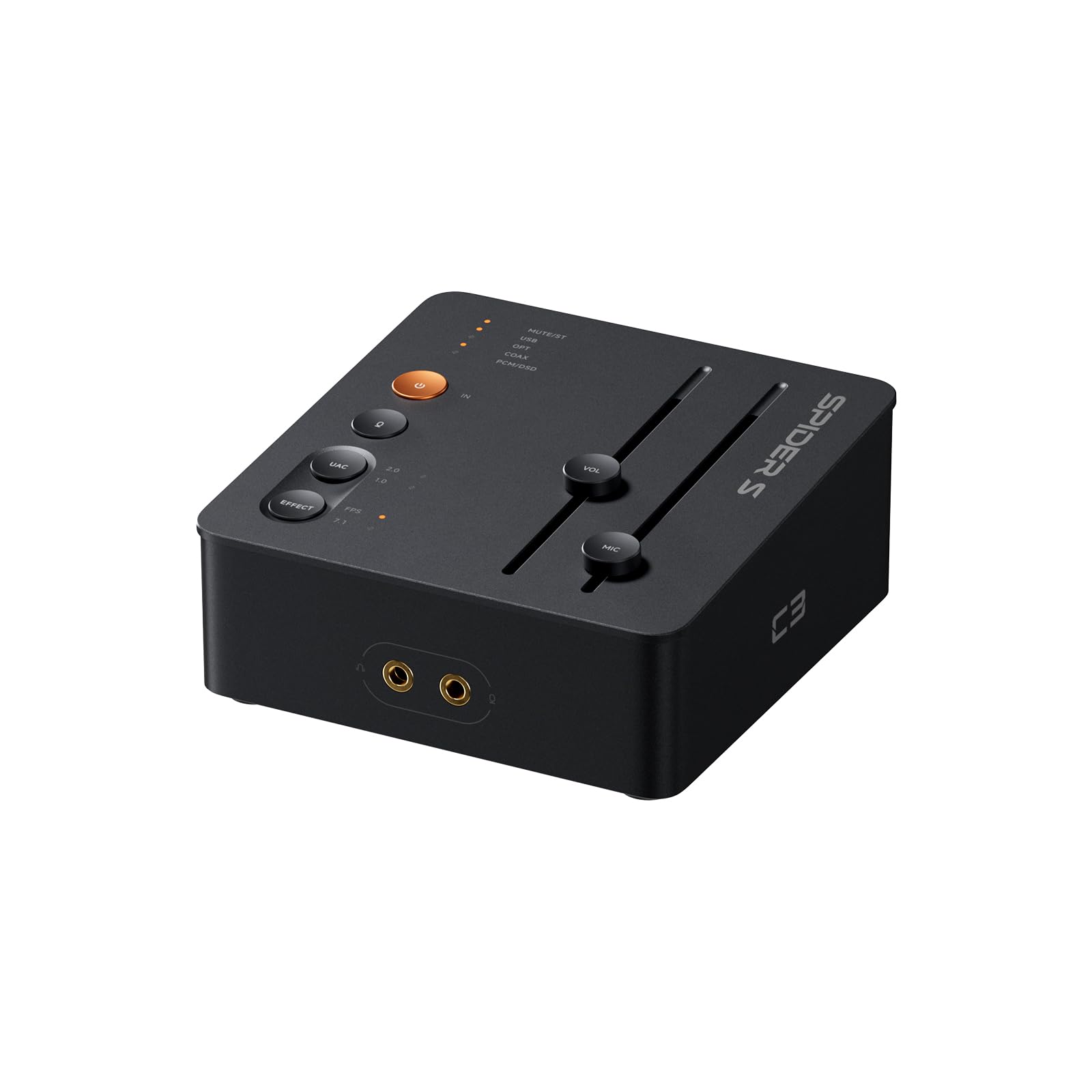
The compact FPS weapon that highlights footsteps while balancing explosions.
Fosi Audio built the C3 around its StepSense Footstep Radar, a feature that enhances enemy movement sounds while keeping gunfire and explosions balanced, giving you a clear competitive edge in shooters. It uses a flagship CS43131 DAC supporting 32-bit/384kHz PCM with a strong 320mW output to drive headphones from 16 to 300 ohms. Owners say it powers planar headsets with no problem and delivers a superior soundstage for pinpointing enemy locations.
The CNC aluminum body is compact and powered by a single USB-C cable, perfect for tidy small desks. You can switch between UAC 1.0 for plug-and-play console support on PS5 and Switch, and UAC 2.0 for full HiFi decoding on PC and Mac. Browser-based controls give you presets and custom EQ profiles for gaming, music, and streaming without installing bulky software.
What wins people over is the footstep clarity, with owners reporting they can hear enemy steps easily and win more games because of it. The honest caveat is that the FPS mode can sometimes hurt positional accuracy for distance and direction, so leaving it off and relying on the 7.1 surround might serve competitive players better. The AI voice noise reduction for your microphone is also a standout, keeping your voice crisp and undistorted.
Built for Victory
- StepSense highlights footsteps over gunfire for FPS advantage
- CS43131 DAC with 320mW output drives demanding headphones
- Compact CNC aluminum body with single USB-C power
- Works on PC, PS5, and Switch with UAC mode switching
Fine Print
- FPS mode can reduce positional accuracy for direction cues
- Plastic body feels lighter than other Fosi Audio amps
- Best results require experimenting with your headphones
Grab it for: Competitive FPS players who want footstep enhancement and a powerful amp in a small desktop footprint.
skip it if: You prefer a simple plug-and-play box with no tweaking, since the C3 rewards some experimentation.
4. Cubilux CB5 USB Audio Interface
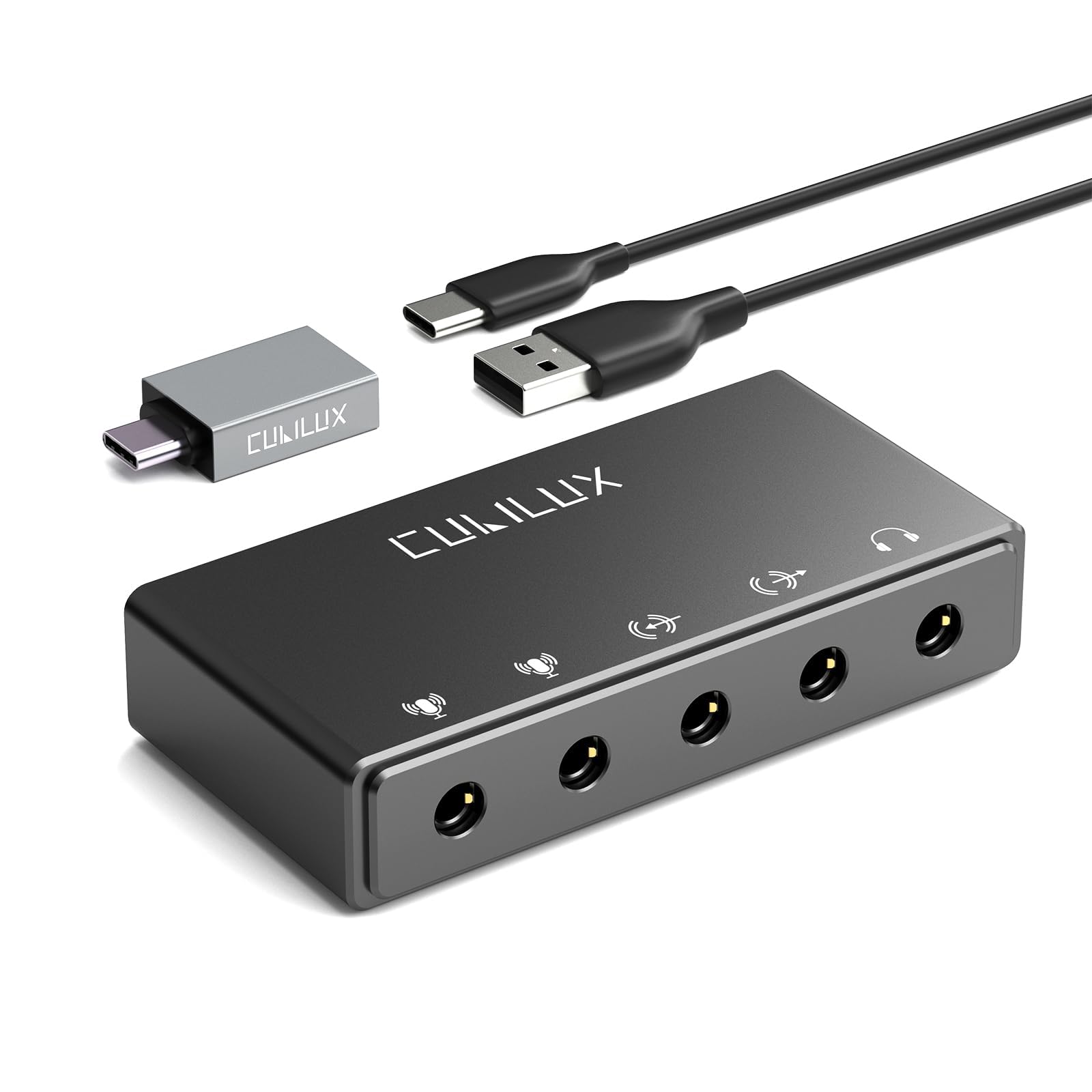
A pocket-sized 5-in-1 hub that turns any USB port into a mini recording studio.
The CB5 is less a gaming card and more a portable audio interface, converting one USB port into two stereo microphone jacks, a line-in, a line-out, and a headphone jack. It captures clean audio up to 96 KHz/24-bit through its built-in chip, making it a solid partner for podcasting or recording instruments on the go. The integrated Hi-Res DAC delivers pristine sound up to 192 KHz/32-bit, enough to drive studio monitors rated up to 250 ohms.
Owners love the line-in ports, with one using it to interface a ham radio with a computer precisely because it offers line-level connections instead of just mic and headphone jacks. It works with Windows 11 immediately and even functions with a phone despite the listing not promising it. The compact, powered-by-USB design means you can record wherever inspiration strikes without hunting for a wall outlet.
The compatibility across Windows and macOS is the top praised feature, and the build quality earns repeated positive mentions. The catch is that the line-out jack and the headphone output cannot be used simultaneously, so you must pick one output at a time. A reviewer also notes it can be finicky with some apps on Linux, so stick to Windows or Mac for the smoothest experience.
Creator Perks
- Two separate mic jacks plus line-in and line-out for flexible setups
- Captures crisp audio at 96 KHz/24-bit for clean recordings
- Compact, bus-powered design for truly portable use
- Drives studio monitors up to 250 ohms without external power
Watch Out For
- Line-out and headphone jacks cannot run at the same time
- Can be buggy with Linux depending on the app
- Keep expectations modest for demanding studio work
Best for: Podcasters, streamers, and home recorders who need multiple inputs in a tiny, affordable box.
Not ideal if: You’re chasing competitive gaming surround cues, since this interface focuses on recording, not virtual positioning.
5. Cubilux 7.1 USB Sound Card

The rugged aluminum box that fires up a full 5.1 speaker system without drivers.
If you have a dedicated 5.1 or 7.1 speaker setup like a Logitech Z-5500, this Cubilux card is the bridge your PC needs, supporting full surround output through four 3.5mm audio interfaces. It handles headphone output up to 384 KHz/24-bit for Hi-Res music from Spotify or Apple Music, while the surround channels top out at 48 KHz. The full aluminum alloy housing isolates electronic interference, which owners say keeps the audio free of static and ground noise.
The plug-and-play design needs no drivers and works with Windows 11 and Macs, and it even includes a USB to USB-C adapter for modern laptops. Owners describe it as a solid option for 5.1 setups, working flawlessly once configured with sound quality on par with a dead sound card it replaced. Setup takes some effort for advanced users, with manual channel configuration required.
Sound quality earns the most praise by a wide margin, followed by ease of setup and compatibility with a range of speaker systems. The recurring minor gripe is a loud startup speaker pop before boot, which a few owners fixed by powering speakers down first. One buyer received a defective unit with bad output jacks, so check your connections early in the return window.
Surround Setup
- Full aluminum housing eliminates static and ground noise
- True 5.1 and 7.1 output for multi-speaker systems
- Plug-and-play with no drivers on Windows and Mac
- Hi-Res headphone output up to 384 KHz/24-bit
Setup Cautions
- Requires manual channel configuration, not truly automatic
- Loud startup speaker pop before boot
- No support for Windows XP, 7, or 8
Choose it if: You have a 5.1 or 7.1 speaker system and want a cheap, sturdy USB card to drive it.
Pass if: You only use headphones and want a compact dongle, since this is built for multi-channel speaker setups.
6. Andrea Electronics USB-SA-1

The thumb-drive-sized card that cleans up voice dictation for professionals.
This Andrea adapter is about the size of a thumb drive, making it the most portable option here for professionals who need reliable audio on the move. Its claim to fame is the bundled PureAudio noise reduction software, which owners say delivers excellent clarity for voice dictation with minimal background hiss. It connects via USB 2.0 and works as a CD-quality digital audio device at a 48 KHz maximum sample rate.
Long-time users are fiercely loyal, with one court reporter noting nearly 20 years of use across these adapters. For dictation work with Dragon software, owners mention superior clarity compared to built-in laptop cards, with high accuracy and no instability. The included software suite also supports Andrea’s hardware peripherals, making it a complete voice solution rather than just a sound adapter.
Compatibility is the most-praised trait, working with Windows systems from Win98 through Vista and Mac OS 9 or 10 without the software. The noise performance is more mixed, so manage expectations if your mic environment is very noisy. It can also serve as a decent headphone amp for light listening, though a few units have arrived defective, so verify functionality soon after arrival.
Voice-First Design
- Compact thumb-drive size for true portability
- PureAudio software reduces background hiss for clear dictation
- Works with older Windows and Mac systems
- Superb clarity with Dragon dictation software
Honest Limits
- Noise reduction performance gets mixed owner feedback
- Maximum 48 KHz sample rate limits Hi-Res music appeal
- Stereo-only output, no surround sound support
Best for: Court reporters, medical transcriptionists, and anyone whose work revolves around voice dictation clarity.
Not for: Gamers or music lovers wanting surround sound and high-resolution playback from a single box.
7. VANTEC USB External 7.1 Channel Audio Adapter

The budget adapter that open up optical audio output for your PC or HTPC.
The VANTEC earns its place as a budget-friendly workhorse, with its standout feature being the SPDIF optical digital input and output that lets you bridge a PC to a receiver’s DAC over a single cable. Customers note it works flawlessly as a USB-to-optical bridge, delivering better sound than internal sound cards with a completely silent background. It supports 48/44.1 KHz sampling rates for both playback and recording.
You get separate left and right microphone inputs for true stereo recordings, plus 7.1 channel surround sound over a simple USB 2.0 connection. It’s plug-and-play on Windows 11 and works via a USB switch between a PC and a Mac Pro M4 without drivers, according to owners. The adapter also plays nicely with Linux, which is a rare treat for open-source users.
The most-praised aspect is functionality, with owners relying on it for years as an affordable multichannel solution, even preferring it over expensive high-end systems for daily use. The honest limit is that it supports PCM 2.0 and compressed Dolby Digital 2.0-5.1, but not 5.1 or 7.1 PCM, Dolby TrueHD, Atmos, or DTS-HD. One owner notes the bright blue LED needs taping over in a dark room.
Budget Wins
- Optical SPDIF input and output for clean receiver connection
- Separate stereo mic inputs for true stereo recording
- Plug-and-play on Windows, Mac, and even Linux
- Reliable budget 7.1 solution praised for years of use
Know Before You Buy
- No support for high-bitrate formats like Dolby TrueHD or Atmos
- Analog outputs are unimpressive next to the optical path
- Bright blue LED can be distracting in dark rooms
Pick it for: Adding an optical audio output to a PC or HTPC on a tight budget, especially if you use Linux.
Leave it if: You need uncompressed multi-channel PCM or object-based Atmos pass-through, which this adapter cannot do.
Understanding the Specs
Sample Rate
Measured in KHz, this tells you how many times per second the audio signal is captured. A higher number like 384 KHz means more detail is preserved, which matters for Hi-Res music and precise audio editing. For most gaming and everyday listening, 48 KHz is perfectly fine, so don’t overpay for rates you cannot hear.
Headphone Amplifier
An amp inside the sound card boosts the signal to drive headphones that need more power, measured in ohms. High-impedance headphones, like 300-ohm studio models, stay quiet and weak without one. If you own demanding headphones, look for a card with a built-in amp and check its power output in milliwatts.
FAQ
Will an external sound card work with my PS5 or Switch console?
What is virtual 7.1 surround sound and do I need it?
Do I need a high sample rate like 384 KHz for gaming?
What is a DAC and why does it matter in a sound card?
Will a sound card make my cheap gaming headset sound better?
What does impedance mean when choosing a headphone amp?
Can I connect a microphone to an external sound card?
What is the difference between an external sound card and an audio interface for recording?
Final Thoughts: The Verdict
Across the board, the external sound card winner is the Sound BlasterX G6 because it balances a high-resolution 384 KHz DAC, console support, and a powerful headphone amp in a single proven box. If you want footstep clarity for competitive shooters, grab the Fosi Audio C3. And for a budget-friendly way to add optical audio output to your PC, the VANTEC adapter is the one to reach for.
How We Picked
We do not accept paid placement. Every pick is matched to a real buyer and a real use-case; we do not hands-on test units.
Sources & Methodology
Specifications: manufacturer listings and product documentation. Review insights: verified customer reviews, as of August 2026. Pricing: not shown on this page (it changes often); check the current price via the retailer link.
As an Amazon Associate, WellFizz earns from qualifying purchases. This does not affect which products we feature.
Related Guides

Mo Maruf
I created WellFizz to bridge the gap between vague wellness advice and actionable solutions. My mission is simple: to decode the research and give you practical tools you can actually use.
Beyond the data, I am a passionate traveler. I believe that stepping away from the screen to explore new environments is essential for mental clarity and physical vitality.