Our readers keep the lights on and my smoothie glass nicely filled. As an Amazon Associate, I earn from qualifying purchases.
Specs are compiled from manufacturer listings and verified buyer reviews and can change over time — please confirm the key details on the product page before buying.
Starting a lawn from seed or sod is a race against weeds, weather, and your own patience. The single biggest decision you will make is what you put down on day one — a starter fertilizer with a high middle number (phosphorus) is what pushes roots deep before the grass blades shoot up. This guide breaks down the six strongest starter blends, what the N-P-K numbers actually mean for your yard, and which one fits your lawn size and budget.
I’m Mohammad Maruf — the founder and writer behind WellFizz. This guide is built by comparing the manufacturers’ published specifications and the patterns across verified customer reviews, so you get each pick’s real strengths and trade-offs instead of marketing spin.
Whether you are seeding a bare patch or laying fresh sod, this breakdown of the best fertilizer for a new lawn pairs each blend’s phosphorus content with real owner results to help you choose with confidence.
Our Picks at a Glance
How To Choose The Best Fertilizer For A New Lawn
Your new grass seedlings cannot store much food, so they rely completely on the soil around them. A starter blend is built differently from the regular lawn food you would use on an established yard — it leads with phosphorus (the nutrient that drives root formation) to help young plants survive their first few weeks.
Decode the N-P-K numbers
Every fertilizer bag shows three numbers, like 20-27-5. The first is nitrogen (leaf growth), the second is phosphorus (root growth), and the third is potassium (overall hardiness). For a new lawn, you want that middle number to be the standout — it is what gets roots anchored before the top growth takes off.
Match the bag to your yard’s size
Coverage is listed right on the bag, and it varies wildly — some blends cover 2,500 square feet while others stretch to 15,000. Measure your project area before buying so you get a bag that finishes the job without forcing you to buy a second one mid-season.
Check the nitrogen release style
Quick-release nitrogen gives fast greening but can burn tender seedlings if you overdo it. Slow-release nitrogen feeds steadily over weeks. Many of the best starter blends combine both so you get an immediate boost plus a longer feeding window.
Quick Comparison
| Model | Best For | N-P-K Ratio | Coverage | Bag Weight | Amazon |
|---|---|---|---|---|---|
| The Andersons 20-27-5★ Best Overall | Balanced new lawn feeding | 20-27-5 | 5,000 sq ft | 18 lb | Amazon |
| Fertilome 9-13-7Gentle Starter | Gentle root development | 9-13-7 | 2,500 sq ft | 10 lb | Amazon |
| Jonathan Green 12-18-8 | Shaded new lawns | 12-18-8 | 5,000 sq ft | 15.2 lb | Amazon |
| Lawn Synergy 15-20-10 | Professional-grade results | 15-20-10 | 4,500 sq ft | 18 lb | Amazon |
| Jonathan Green Veri-Green | Large seeding projects | 12-18-8 | 15,000 sq ft | 45 lb | Amazon |
| The Andersons 18-24-12 | Bermuda & southern lawns | 18-24-12 | 12,500 sq ft | 50 lb | Amazon |
In‑Depth Reviews
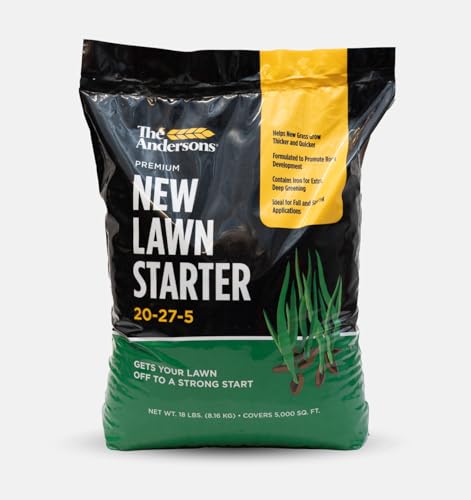
1. The Andersons Premium New Lawn Starter 20-27-5 (18 lb)
Our pick — over 4.5★ from 550+ verified ratings; the strongest balance of quality and price.
The crowd favorite that turns bare dirt into visible grass in just over a week.
The defining trait here is the 20-27-5 ratio — the highest phosphorus load in this lineup — and it shows in the results. Buyers report grass appearing in just over a week, with quick- and slow-release nitrogen giving seedlings an instant boost and then a steady feed. The 18-pound bag covers 5,000 square feet, and the blend includes 1% iron for a deeper green that makes the new growth look established faster.
What wins people over is the growth — it is the single most-praised aspect by a wide margin, followed closely by overall quality. The granules spread easily through a standard spreader, and the value-for-money feedback is strong for a premium-tier starter. One owner credited this blend, used alongside their regular routine, with producing their best lawn ever compared to other products alone.
It is safe for all turf types and designed for spring and fall application, so it fits most seeding schedules. The phosphorus content is notably higher than the Fertilome 9-13-7 option above, making it the more aggressive choice for getting roots moving fast.
What owners rave about
- Fast visible results — grass in just over a week
- 1% iron adds deep greening to new growth
- Dual nitrogen release feeds short and long term
The trade-offs
- Some wish the bag came in a larger size
- Premium-tier price for the 18 lb size
Reach for it if: you want the strongest phosphorus punch for a standard-size new lawn and value results in week one.
Note: at 18 pounds it is 8 pounds heavier than the Fertilome bag, but it also covers twice the ground.
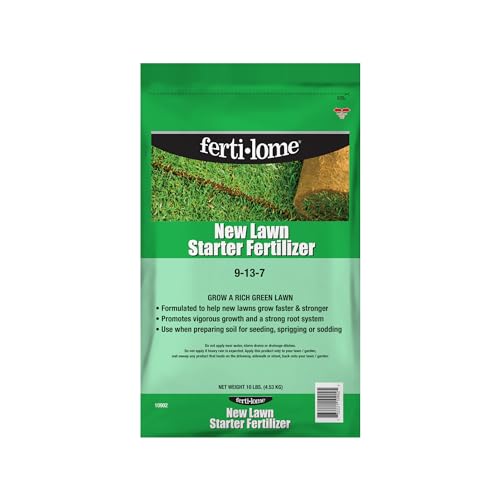
2. Fertilome New Lawn Starter Fertilizer 9-13-7 (10 lb)
The low-burn blend that gets sod and seed rooted before the rapid growth phase.
This one is built around a 9-13-7 analysis — 9% nitrogen, 13% phosphate, and 7% soluble potash — a noticeably gentler formula than the Andersons 20-27-5 above. That makes it a smart pick for tender new sod or seed where you want to encourage root formation without risking a burn. The 10-pound bag covers 2,500 square feet, and the recommended rate is 4 pounds per 1,000 square feet.
The thing everyone raves about is root growth — owners mention dark, rich green grass that fills in weak spots. One application on newly tilled soil before laying zoysia sod helped establish roots through the fall and again in spring. The granules are larger than some competing brands, which owners say feed longer and lower the burn risk.
It works with a drop or broadcast spreader, and the feedback highlights how well it pairs with annual rye seed. The lower nitrogen number means results may come a touch slower than the high-phosphorus leaders, but the margin for error is wider for a first-time lawn builder.
Why it wins
- Root growth is the most-praised aspect — exactly what new grass needs
- Low burn risk for tender seedlings and sod
- Larger granules feed longer than finer blends
Who should pass
- Smaller coverage means big yards need multiple bags
- Some note it needs repeat applications on poor soil
Best for: first-time seeders and sod layers who want a forgiving, low-risk start.
Look elsewhere if: your project is larger than a quarter acre — the 10-pound bag runs out fast.
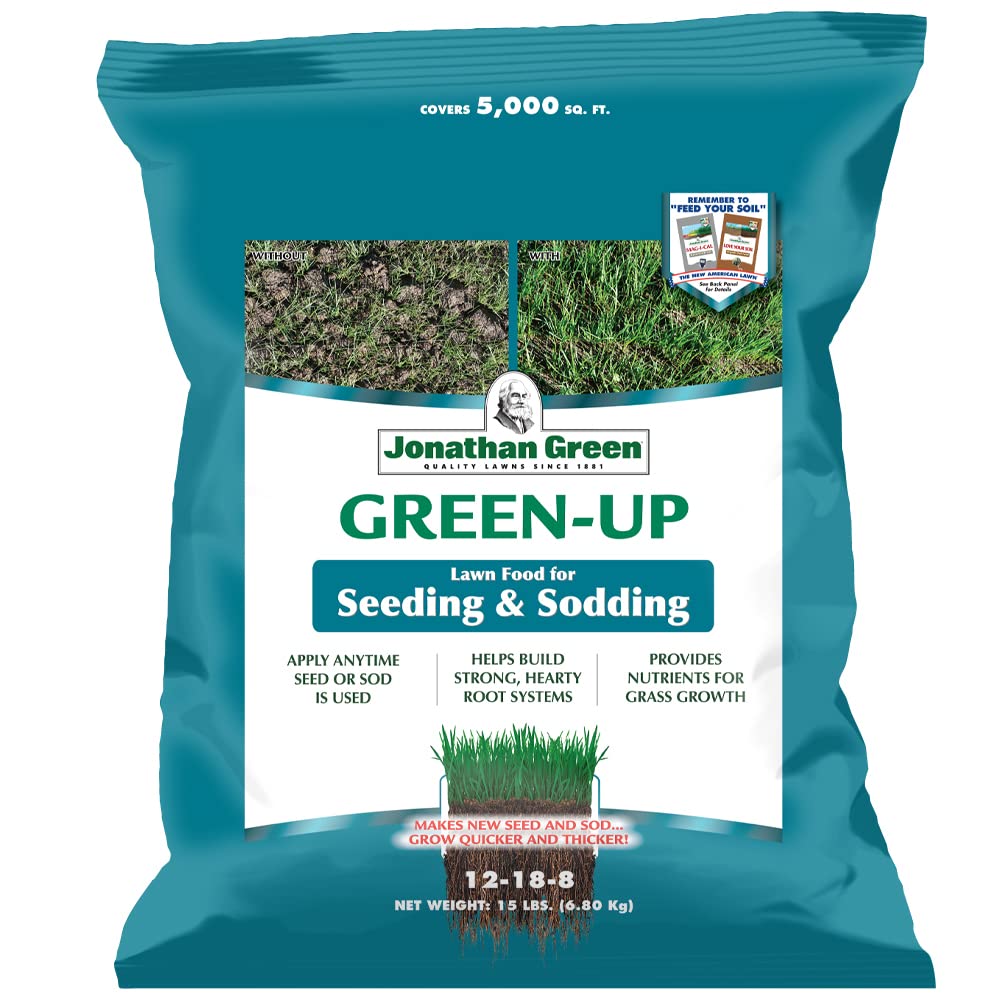
3. Jonathan Green Green-Up Lawn Food 12-18-8 (15.2 lb)
The phosphorus-rich formula that delivered 90% new lawn coverage in 4 weeks, even in full shade.
The 12-18-8 analysis puts phosphorus front and center, and the real-world results back it up. A Minnesota owner saw 90% new lawn coverage in 4 weeks using Black Beauty Original seed across 5,000 square feet, with grass visible in 1 week and mowable by week four, all in full shade. That shade performance is the standout story here, since most starter blends struggle without direct sun.
It also contains humates, which improve how efficiently the soil exchanges nutrients with the plant, and iron for deep greening. The formula feeds for up to 2 months, so you get sustained nutrition without constant reapplication. At 15.2 pounds, it is 2.8 pounds lighter than the Andersons 20-27-5 but covers the same 5,000 square feet.
Feedback shows it outperforming a major competitor applied the same day, with the best spring lawn in the neighborhood after just 7 days. A Kansas owner credits it with strengthening grass against swings from excessive rain to hot, dry spells. The honest counterpoint is that some owners find it pricey compared to cheaper iron supplements, so weigh the shade performance against your budget.
The big wins
- Proven results in full shade — a rare claim in this category
- Humates improve nutrient uptake from the soil
- Feeds for up to 2 months from one application
The honest catch
- Premium price per pound compared to basic iron blends
- A few owners expected more dramatic results for the cost
Choose this if: your new lawn is shaded or you have had trouble getting grass to establish in tough spots.
skip it if: you are on a tight budget and have full-sun conditions where cheaper blends work fine.
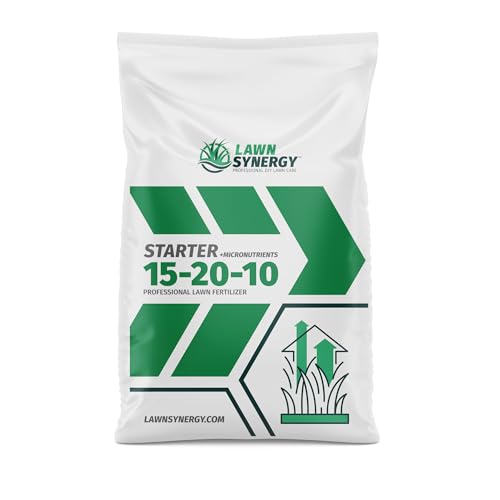
4. Lawn Synergy Starter Fertilizer 15-20-10 (18 lb)
A professional-grade blend that skips the fillers and feeds new seed with a 15-20-10 punch.
Lawn Synergy markets this as pro-grade turf food not sold in big-box stores, and the 15-20-10 ratio delivers one of the higher phosphorus loads here — 25% more phosphorus than the Jonathan Green 12-18-8 above. It includes slow-release XCU nitrogen, ammonium sulfate, and iron, which together provide steady feeding, early color, and longer-lasting growth with fewer fillers.
The 18-pound bag covers up to 4,500 square feet, and the prill (granule) design is engineered for smooth spreader flow and even coverage. Owners describe fast-working results with grass coming in strong, and the palisades grass color gets specific praise. The feedback is uniformly positive — everything is “exceptional” per the reviews — though the professional positioning carries a premium price.
It is formulated to be gentle on new seedlings while still pushing germination, so it suits fresh seed, fall overseeding, and spring repairs alike. If you want the closest thing to what lawn care pros use without the service call, this is the pick.
What stands out
- Slow-release XCU nitrogen feeds steadily over weeks
- High phosphorus ratio for aggressive root push
- Smooth-flowing prill granules for even spread
Worth noting
- Premium pricing reflecting the pro-grade claim
- Coverage slightly under the Andersons at 4,500 sq ft
Reach for this if: you want professional-grade results and are willing to pay for nutrient density over bag size.
Think twice if: your priority is maximum square footage per dollar — larger bags cover more ground for less.
5. Jonathan Green Veri-Green Starter Fertilizer 12-18-8 (45 lb)
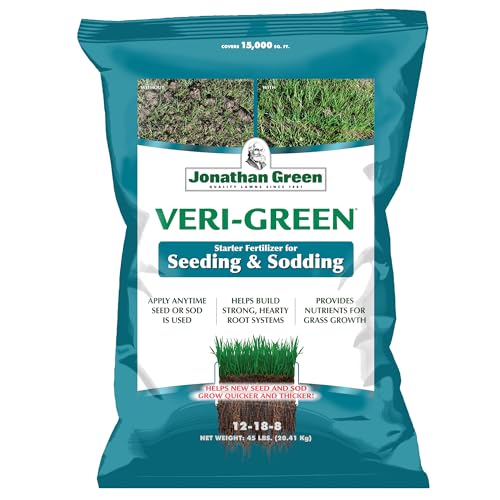
The 45-pound workhorse that covers 15,000 square feet in a single pass.
This is the same 12-18-8 phosphorus-rich formula as the Green-Up above, but scaled up dramatically — a 45-pound bag covering 15,000 square feet versus the 15.2-pound bag’s 5,000. For a large seeding project or a full-yard renovation, this is the efficiency play: one bag, one application, no mid-project runs to the store.
The effectiveness is the most-praised aspect by a wide margin, with owners reporting grass coming up green and full within two weeks. One detailed account describes combining it with a summer grass blend and seeing the yard transform over one month. The humates are present here too, improving nutrient exchange, and the formula feeds for up to 2 months.
The honest tension is value — owners are split, with many calling it a great deal for the coverage and others finding it costly. That split makes sense: if you need the full 15,000 square feet, it is excellent value; if your yard is a fraction of that, the smaller bags waste less. It should be applied the same day as seeding or sodding for best results.
The strength
- Single bag handles a 15,000 sq ft project
- Effectiveness is the most-praised aspect
- Feeds for up to 2 months with humates included
The consideration
- Value opinions are genuinely mixed — size your yard first
- Heavy 45 lb bag is a workout to haul and spread
Grab this if: you are covering half an acre or more and want one-and-done coverage.
Pass if: your lawn is under 5,000 square feet — the smaller Jonathan Green bag wastes less.
6. The Andersons 18-24-12 Starter Turf Fertilizer (50 lb)
The highest phosphorus ratio in the lineup, with a cult following among Bermuda grass owners.
At 18-24-12, this delivers the most aggressive phosphorus load of any pick here — 24% phosphorus — and it shows in the reviews. The standout praise comes from Bermuda grass owners who say it outperforms what their lawn service was using. It is made for newly seeded turf and also corrects phosphorus deficiencies in established lawns, so it pulls double duty.
The 50-pound bag covers 12,500 square feet at a medium rate, making it a strong large-yard option right behind the Veri-Green. Owners describe quick greening with a broadcast spreader and deep green results, with one noting their yard looked exactly how they wanted it. It also got praise from an unexpected corner — dwarf fruit trees — showing versatility beyond turf.
The Andersons is an established name in the turf industry, and this bag carries that pedigree with a no-frills, results-first pitch. The phosphorus-heavy ratio specifically targets root establishment, making it ideal for southern warm-season grasses that need deep anchoring before summer heat arrives.
Why it stands apart
- Highest phosphorus ratio in this guide at 24%
- Bermuda grass customers note better results than lawn services
- Also corrects phosphorus deficiencies in established turf
Who it misses
- Premium price for a 50 lb bag at the top of the range
- Aggressive ratio may be overkill for small, low-maintenance lawns
Best for: southern warm-season lawns, especially Bermuda, where deep roots beat the summer heat.
Not for: tiny patches or anyone wanting a lighter, more general-purpose starter.
Understanding the Specs
N-P-K Ratio
The three numbers on any fertilizer bag are nitrogen, phosphorus, and potassium. For a new lawn, the middle number is the one that matters most — phosphorus drives root formation, which is what young grass needs before it can push up strong blades. A starter blend like 20-27-5 puts that middle number high on purpose.
Coverage Area
Coverage tells you how many square feet a single bag can feed at the recommended rate. It ranges from 2,500 to 15,000 square feet across these picks. Measure your project area first, then match the bag — buying too small means a second trip, too large means wasted product and money.
FAQ
When should I apply starter fertilizer to a new lawn?
What does a 20-27-5 ratio actually mean for my lawn?
Can I use regular lawn fertilizer instead of a starter blend?
How do I know how many bags I need for my yard?
Will starter fertilizer burn my new grass seed?
How long until I see grass after applying starter fertilizer?
Is a high-phosphorus starter safe for sod, or just seed?
What is the difference between the two Jonathan Green starter fertilizers?
Which starter fertilizer works best for Bermuda grass?
How long does the feeding last after one application?
Final Thoughts: The Verdict
For most people, the fertilizer for a new lawn winner is the Andersons 20-27-5 because it pairs the highest phosphorus in the mid-tier with proven week-one results and a crowd-favorite reputation. If you want gentle, low-burn root development for sod or a small yard, grab the Fertilome 9-13-7. And for shaded lawns where most blends struggle, the Jonathan Green Green-Up delivered 90% coverage in 4 weeks even in full shade.
How We Picked
We do not accept paid placement. Every pick is matched to a real buyer and a real use-case; we do not hands-on test units.
Sources & Methodology
Specifications: manufacturer listings and product documentation. Review insights: verified customer reviews, as of August 2026. Pricing: not shown on this page (it changes often); check the current price via the retailer link.
As an Amazon Associate, WellFizz earns from qualifying purchases. This does not affect which products we feature.
Related Guides

Mo Maruf
I created WellFizz to bridge the gap between vague wellness advice and actionable solutions. My mission is simple: to decode the research and give you practical tools you can actually use.
Beyond the data, I am a passionate traveler. I believe that stepping away from the screen to explore new environments is essential for mental clarity and physical vitality.