Our readers keep the lights on and my smoothie glass nicely filled. As an Amazon Associate, I earn from qualifying purchases.
Specs are compiled from manufacturer listings and verified buyer reviews and can change over time — please confirm the key details on the product page before buying.
That puff of blue smoke when you start up or accelerate isn’t just embarrassing — it’s unburned oil slipping past worn seals and rings. The right additive thickens oil and swells seals to pass emissions or extend engine life. This list looks at six of the most talked-about smoke-stop formulas so you can pick the one that matches your engine’s real condition.
I’m Mohammad Maruf — the founder and writer behind WellFizz. This guide is built by comparing the manufacturers’ published specifications and the patterns across verified customer reviews, so you get each pick’s real strengths and trade-offs instead of marketing spin.
Finding the best engine stop smoke additive means matching the fix to your engine’s wear level and oil capacity, and knowing that a severe mechanical failure can’t be cured by chemistry alone. engine stop smoke additive choices range from entry-level bottles to premium heavy-duty blends for high-mileage workhorses, so the right pick depends on your vehicle’s age and oil capacity.
Our Picks at a Glance


How To Choose The Best Engine Stop Smoke Additive
Blue smoke means your engine is burning oil, but the reason matters. Worn valve stem seals leak oil into the combustion chamber when the car sits, producing smoke on start-up. Worn piston rings burn oil under acceleration and deceleration. An additive that swells seals helps the first, while a thick viscosity formula (like an SAE J300 grade 40) can mask the second by filling loose tolerances.
Match the Bottle to Your Oil Capacity
One 300 ml bottle treats a typical passenger car’s crankcase of around 4 to 5 quarts. If you drive a heavy-duty truck that holds 45 quarts, a small passenger-car bottle is nothing but a drop in the bucket — you need a formula sized for the whole sump, like a 950 ml heavy-duty blend.
Know That Chemistry Has Limits
These additives are designed to restore lost compression and seal worn internals, not to rebuild a catastrophically damaged engine. If a piston ring is broken or a head gasket is blown, no additive in a can is going to fix it — the honest move is a mechanic’s inspection first.
Quick Comparison
| Model | Best For | Volume | Pack Size | Best Suited Engine | Amazon |
|---|---|---|---|---|---|
| Liqui Moly Motor Oil Saver★ Best Overall | Preventive seal care | 300 ml | 2 packs | Gas & diesel cars | Amazon |
| Liqui Moly Oil Smoke StopHigh-Viscosity Pick | Older worn engines | 300 ml | 1 pack | Gas & diesel cars | Amazon |
| Wynn’s Stop Smoke | High temp protection | 325 ml | 1 pack | Cars | Amazon |
| Ametech Restore | Four-stroke restoration | 400 ml | 1 pack | Petrol, diesel, LPG | Amazon |
| XADO 1 Stage Maximum | Heavy-duty diesel | 950 ml | 1 pack | Diesel trucks & tractors | Amazon |
| Bardahl No Smoke | Fleet & multi-car use | 16 oz | 12 packs | Older cars | Amazon |
In‑Depth Reviews
1. Liqui Moly Motor Oil Saver (300 ML) – 2 Pack
Our pick — over 4.5★ from 800+ verified ratings; the strongest balance of quality and price.
The preventative-maintenance pick that keeps high-mileage seals soft and stops blue smoke before it starts.
You get a fix for the root cause, not just a smoke mask: this formula maintains and regenerates the rubber and plastic seals in the oil circuit of both gas and diesel engines. Over 800 owners rate it 4.6 stars, using it as a routine top-up rather than an emergency fix. A 2013 Nissan Xterra at 138k miles, burning 1 quart per 1,500 miles, showed zero oil loss at 1,300 miles after one additive fill.
You get two 300 ml bottles in this pack for a combined 20.28 fluid ounces, which is double the single-bottle value you’d get from the Oil Smoke Stop from the same brand. That’s a 2.0x gap in total volume, meaning you’re set for two treatments or one treatment on two vehicles. Buyers report that a large oil leak slowed significantly after just one bottle plus 500 miles, with the oil level holding steady — though some say a second bottle may be needed for a complete stop.
The honest trade-off is expectations. This is a seal conditioner, so a badly worn rear main seal might only be minimized, not sealed completely, and the delivery can take 2-3 weeks depending on stock. For preventive care and early-stage valve stem seal wear, it’s the most proactive choice on this list.
Why it wins
- Two 300 ml bottles treat two engines or two service intervals
- Works on both gas and diesel engines with a Universal Fit
- Dampens engine noise and reduces repair costs
- Proven on a 138k-mile engine that went to zero oil loss
The trade-offs
- Severe external leaks may only be minimized, not eliminated
- May need a second bottle for a full stop on heavy leaks
- Delivery delays of 2-3 weeks reported
the balance: If you drive a high-mileage car with early valve seal wear, start with this before the smoke gets heavy.
Look elsewhere if: You’ve got a gushing external leak and want a one-bottle miracle — this conditions, it doesn’t weld.
2. Liqui Moly Oil Smoke Stop 300 ml (2122) Designed to minimize Blue Exhaust Smoke
A high-viscosity formula that fills worn gaps and is built specifically for old, high-load engines.
This is the straight-talking sibling of the Motor Oil Saver. Where the Saver regenerates seals, this one relies on a very high viscosity — rated SAE J300 Viscosity Grade 40 — to seal the gaps caused by wear inside the engine. That’s an oil-thickening approach, which is why it’s recommended for old, worn engines subjected to high loads and high temperature. Owners mention it stopping start-up smoke caused by leakage past valve seals when the car sat for extended periods.
Customers note it’s effective, and 11 mentions call out that effectiveness as the standout trait, with quality close behind at 8 mentions. But smoke control itself gets mixed feedback: some report a reduction after about 1,000 miles, while others say the engine still smokes slightly. One owner added it over 300 miles ago and reports the smoke is just as bad — a reminder that this works best for moderate wear, not engines that are too far gone. The single 300 ml bottle weighs 0.26 kg, which is 19% lighter than Wynn’s 325 ml can, and that lighter weight means a smaller footprint in the garage.
The value question here is divided among buyers — some call the price good, others not worth it for the results they got. Because it’s a 1-pack at 10.14 fluid ounces, you get exactly half the volume of the Motor Oil Saver 2-pack, which is the 2.0x gap between the two. If your engine burns oil under hard acceleration and you want the thickest seal possible in a single pour, this is the dedicated smoke-stopper.
The viscosity play: This is the pick for engine wear, not seal maintenance — the SAE 40 thickness physically fills the gaps that cause blue smoke.
A fair caveat: It’s not a cure for major mechanical issues; owners say it won’t fix problems that are too far gone.
Reach for this if: Your engine has worn internals and you want a thick, gap-filling formula designed for high-temperature, high-load running.
Think twice if: You expect a single 300 ml bottle to silence a severely worn engine — moderate wear is the realistic balance.
3. Wynn’s Stop Smoke 325 ml
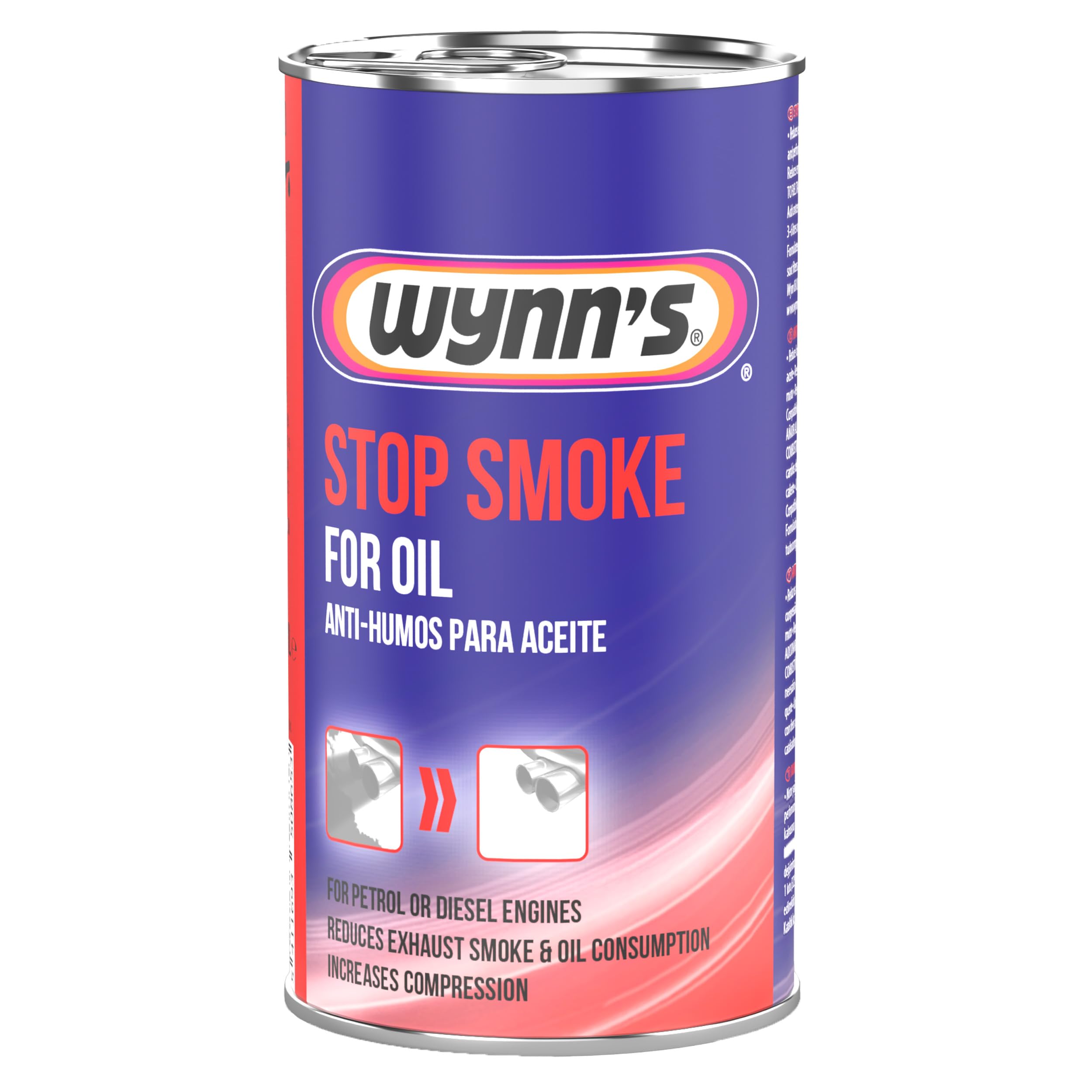
The compression-restoring can that keeps a strong oil film even when your engine runs hot.
Wynn’s takes a slightly different angle: it focuses on improving the oil’s viscosity properties at high oil temperatures and sealing the gaps between worn engine components. That high-temperature protection is backed by a 151 °C flash point, meaning the oil film stays protective even under severe heat without breaking down. Reviewers point out it works well so far with no smoke, and one buyer’s verdict is blunt enthusiasm: “Worked, stopped the car from smoking. Highly recommended!”
The 325 ml bottle weighs 0.31 kg, making it the heaviest of the single-bottle smoke stops here next to the Liqui Moly’s 0.26 kg can — that extra weight reflects the slightly larger volume and thicker formula. Beyond smoke reduction, it improves compression and engine performance and reduces engine noise, giving you a broader benefit than a pure smoke mask. The included components are just the single Stop Smoke 325ml bottle, and there’s no manufacturer warranty behind it.
A few owners found it only helped some, with one noting that pre-existing mechanical difficulty meant the product didn’t do the job — the recurring theme across every additive. If your car burns oil but you want to keep the engine’s protective film intact under heavy load, this is the one to reach for.
Strengths
- 151°C flash point means strong protection under high temperature
- Seals worn gaps while improving compression and performance
- Reduces engine noise alongside smoke
- 325 ml is the largest single passenger-car dose here
Watch-outs
- Vehicle Specific Fit limits it to cars, not trucks
- No manufacturer warranty included
- Pre-existing mechanical failure can defeat the formula
Who it suits: Car owners who run their engines hot and want a sealant that doubles as a high-temperature oil-film protector.
Who it doesn’t: Anyone with a blown head gasket or broken rings — no additive survives real mechanical failure.
4. Ametech- Restore Engine Restorer & Lubricant 400Ml

A compression-focused restorer that claims to bring back MPG and pass emissions, but draws sharply divided reviews.
This 400 ml formula is designed to restore compression, reduce oil consumption, cut blue smoke and exhaust emissions, and even restore MPG to help prevent MOT failures on emissions tests. It’s rated SAE J300 Viscosity Grade 30 (a standard for oil thickness), noticeably thinner than the Liqui Moly Oil Smoke Stop’s SAE 40, so it suits moderate wear where a light restoration, not a thick seal, is enough. The maker says it fits all four-stroke engines running petrol, diesel, or LPG.
Owner experiences split hard here. On the positive side, a 1992 Nissan Hardbody had its compression loss and valve noise fixed, running great until it was sold at 250k miles, and a 2005 Pontiac Grand Prix at 285k miles saw reduced oil consumption and an immediate quieting after a post-oil-change treatment. But the reviews are the most divided on this list, and the negative voices are fierce — one verified owner calls it “Pure garbage” and says it made things 100 times worse.
That split is the story. This isn’t a subtle seal conditioner; it’s a restoration product that some engines love and others reject. If you have a moderately worn four-stroke and want to try a compression approach rather than a viscosity approach, this is the experiment — but it’s the one pick here where you should weigh the mixed owner sentiment before pouring.
The compression angle: Unlike the thicker seal-fillers, this SAE 30 formula works by restoring compression, which suits moderately worn engines that still have decent ring health.
The honest split: Buyers are genuinely divided — some saw years of improvement, others report the opposite; treat it as a riskier bet than the Liqui Moly or Bardahl entries.
Best for: Owners of moderately worn four-stroke engines who want a compression-restoring approach and are willing to gamble on a formula with passionate fan and critical reviews.
skip it if: You want a predictable, widely-praised smoke stop — the other picks have far more consistent owner sentiment.
5. XADO 1 Stage Maximum for Diesel Trucks | Engine Oil Additive for Heavy Duty Machinery & Tractor Trailer Semi Truck | Oil Capacity Up to 45 Quarts (Bottle, 950 ml)
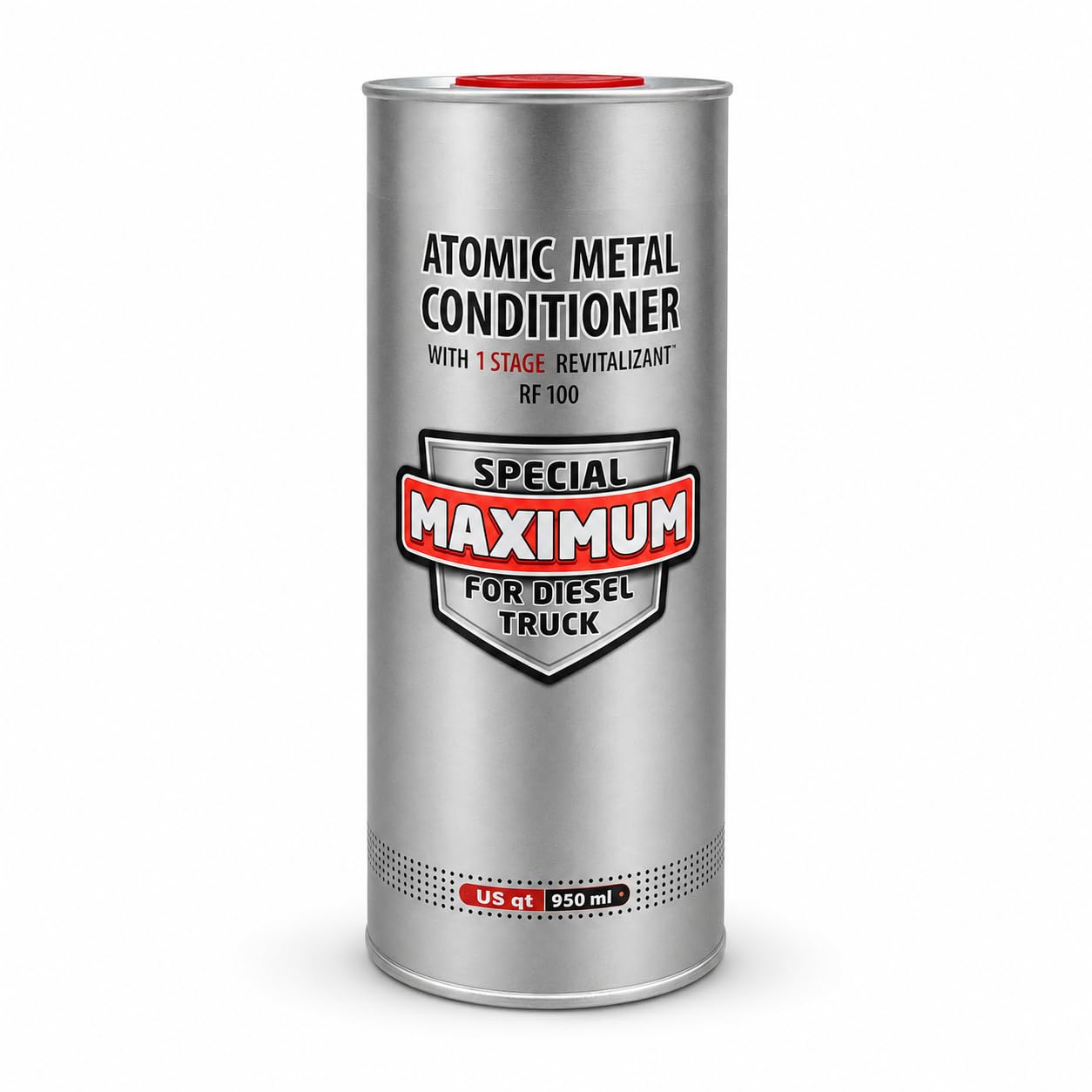
The 950 ml diesel giant that treats a 45-quart sump, plus a ceramic additive to smooth worn surfaces.
This is the only pick here sized for actual trucks, and the math is simple: at 950 ml, it’s a 3.2x larger volume than the Liqui Moly 300 ml bottles, with a specific use for lubricating diesel engines in heavy-duty vehicles holding up to 45 quarts of oil. It’s an engine restorer at heart, designed to revitalize worn parts, boost power, and condition the engine while reducing smoke levels. The formula includes a ceramic additive for smoother surfaces and a turbo booster for extra power.
The results from owners of million-mile rigs are remarkable. A near-million-mile semi gained +5 psi oil pressure, quieter operation, better fuel economy, and smoother cold starts, with the owner re-adding every 40k miles. A 2003 Ford Expedition at 290k miles regained compression and power after 1,000 miles., and a 2014 Freightliner Cascadia at 438k miles gained +0.5 MPG on the first tank and +0.7 MPG on the second. The flash point is rated at 120 °C, slightly lower than Wynn’s, but this is a friction-reducing, noise-quieting conditioner rather than a heat-shield.
The catch is versatility: it’s built for diesel engines in trucks, trailers, semis, tractors, and heavy machinery like Volvo, Freightliner, Peterbilt, Mack, and Kenworth, plus John Deere, New Holland, and Kubota tractors. If you drive a passenger car, this is overkill — but if you own a rig or a diesel tractor that smokes, this is the only option here actually sized for the job.
Built for the big rigs
- 950 ml treats up to a 45-quart capacity sump
- Ceramic additive smooths worn surfaces and reduces friction
- Real gains documented: +5 psi oil pressure, +0.5 to +0.7 MPG
- Universal fit across major truck and tractor brands
Not for cars
- Diesel-specific formula; wrong choice for a gas passenger car
- 120°C flash point is lower than Wynn’s high-temp protection
- Premium cost reflects the heavy-duty specialization
The truck stop hero: If you own a semi, diesel tractor, or heavy machinery that smokes, this is the only bottle on the list that can actually cover your oil capacity in one pour.
Not your pick if: You drive a gas sedan — pour this into a small crankcase and you’ll waste most of a very premium bottle.
6. Bardahl No Smoke Motor Oil Additive Oil Burning Exhaust 16 oz Pack of 12

A case of 12 thick 16 oz bottles for those who treat multiple old engines like a hobby — or a fleet.
Bardahl’s approach is the most physical on the list: an extra thick formula that “fills-in” loose tolerances inside the engine to reduce oil burning and excessive exhaust smoke. The maker frames it as both smoke control and a leak sealer, helping seal empty spaces that develop over the years to quiet noisy lifters and reduce engine noise. Owners confirm the thickness — one describes it as “thick as honey” — and note it works, It cut oil consumption by 50%+ in a 2005 SLK350 burning 1 quart per 200 miles.
What wins people over is the smoke control: it’s the most-praised aspect in the reviews, with functionality close behind. A 2007 Silverado 5.3L V8 stopped smoking entirely, and a Dodge Grand Caravan saw 75% less smoke in 2 days. Bardahl’s 85-year American manufacturing history backs its reputation for older-car maintenance.
The package math is the real story: 12 bottles of 16 oz each adds up to 12 pounds on your shelf, which is the biggest bulk purchase on this list. That’s a fleet maintenance buy, not a one-car fix — perfect for a shop, a multi-car household, or anyone who wants a decade’s supply. The trade-off is the thickness: it can trigger an engine code in some cars that prefer a thinner oil, and it’s not meant for external leaks. Use it at oil changes and between, and check with a mechanic if your engine responds poorly.
The bulk smoke stop: The 12-bottle case makes this the best per-use value for anyone maintaining several older vehicles or a small fleet.
The thickness caveat: “Thick as honey” is a real strength for sealing, but a real risk for engines that need thinner oil — watch for engine codes after the first fill.
Reach for it if: You maintain a fleet, a shop, or several high-mileage cars and want a proven smoke-stop formula in bulk, with smoke control as the most-praised trait.
Look elsewhere if: You only have one car — a single Liqui Moly bottle is cheaper and the 12-pack will gather dust.
Understanding the Specs
Viscosity Grade
The SAE J300 rating (like 30 or 40) tells you how thick the additive is. A higher grade like SAE 40 means thicker oil that can physically fill the gaps between worn parts to reduce smoke, but it also makes the engine work slightly harder. A lower grade like SAE 30 is thinner and acts more as a conditioner than a seal-filler. Match the thickness to how much wear your engine actually has.
Oz per Volume Capacity
The bottle size has to match your engine’s oil sump. A 300 ml bottle treats a typical passenger car’s crankcase of around 4-5 quarts. A heavy-duty diesel truck holding 45 quarts needs a 950 ml dose to get a meaningful concentration. Buying a small passenger-car bottle for a truck is like adding a drop to a swimming pool — read the oil capacity before you buy.
FAQ
Will a stop smoke additive fix a blown head gasket?
How long does it take to see reduced smoke?
Can I use a diesel truck additive in my gas car?
Will this stop blue smoke on start-up specifically?
How often should I add a smoke-stop additive?
Can the additive hurt my engine if my oil is already thick?
Why does the smoke sometimes come back?
Will a stop smoke additive help me pass an emissions test?
Is a thicker formula always better?
What if my smoke is white or black, not blue?
Final Thoughts: The Verdict
If you want one dependable pick, the best engine stop smoke additive winner is the Liqui Moly Motor Oil Saver 2-Pack because it treats the root cause — seal wear — rather than just masking symptoms, and the crowd favorite’s 4.6-star rating proves it works across thousands of real engines. If you want the highest-viscosity smoke mask for a seriously worn engine, grab the Liqui Moly Oil Smoke Stop. And for heavy-duty diesel trucks that hold 45 quarts of oil, the XADO 950 ml is the only bottle here actually sized for the job.
How We Picked
We do not accept paid placement. Every pick is matched to a real buyer and a real use-case; we do not hands-on test units.
Sources & Methodology
Specifications: manufacturer listings and product documentation. Review insights: verified customer reviews, as of August 2026. Pricing: not shown on this page (it changes often); check the current price via the retailer link.
As an Amazon Associate, WellFizz earns from qualifying purchases. This does not affect which products we feature.
Related Guides

Mo Maruf
I created WellFizz to bridge the gap between vague wellness advice and actionable solutions. My mission is simple: to decode the research and give you practical tools you can actually use.
Beyond the data, I am a passionate traveler. I believe that stepping away from the screen to explore new environments is essential for mental clarity and physical vitality.