Our readers keep the lights on and my smoothie glass nicely filled. As an Amazon Associate, I earn from qualifying purchases.
Specs are compiled from manufacturer listings and verified buyer reviews and can change over time — please confirm the key details on the product page before buying.
If your Green Giant arborvitae look thin or see-through, the fix often starts with what you feed them. The real choice is between spikes, granules, or a liquid — and the right pick depends on your soil, your patience, and how many trees you’re feeding. Here are the top fertilizers for arborvitae Green Giant, judged by what they actually do for the tree, not just what the label promises.
I’m Mohammad Maruf — the founder and writer behind WellFizz. This guide is built by comparing the manufacturers’ published specifications and the patterns across verified customer reviews, so you get each pick’s real strengths and trade-offs instead of marketing spin.
If you want a thriving, dense privacy hedge without the guesswork, this breakdown of the fertilizer for arborvitae green giant sorted by form, strength, and real owner results will point you to the right bag or bottle.
Our Picks at a Glance

How To Choose The Best Fertilizer For Arborvitae Green Giant
Green Giants tolerate a range of feeds, but a balanced NPK ratio keeps them dense and vigorous. The NPK ratio on the bag lists the percentages of nitrogen, phosphorus, and potassium. Nitrogen fuels the dense green top growth you want in a privacy hedge, so evergreen blends lead with it.
Match the form to your routine
Spikes are the set-and-forget option: hammer them into the soil at the drip line and they feed for months. Granular feed like Espoma’s Evergreen-tone is sprinkled on top and watered in, which suits larger plantings that would take forever to spike one by one. Liquids deliver the fastest visible response and suit reviving a struggling tree, but need repeat applications all season.
Read the burn warning carefully
Over-fertilizing a young arborvitae scorches the foliage, turning needles brown and crispy. Slow-release formulas are safer because they meter out nutrients gradually. If you have sandy soil that drains fast, or young saplings with delicate roots, a mild formula you can dilute is the safer starting point than a heavy-duty spike.
Quick Comparison
| Model | Best For | Form | NPK Ratio | Coverage | Amazon |
|---|---|---|---|---|---|
| Jobe’s Evergreen Spikes★ Best Overall | Set-and-forget feeding | Spikes | 11-3-4 | 9 spikes | Amazon |
| TreeHelp Premium FertilizerRecovery Pick | Browning tree recovery | Granular | Slow-release | ~3 lbs | Amazon |
| Leaves & Soul 6-4-6Fast-Absorbing | Fast root absorption | Liquid | 6-4-6 | 32 fl oz | Amazon |
| Power Spike 93309 | Established tree health | Spikes | Balanced | 10 spikes | Amazon |
| TPS Thuja Green Giant | Weekly liquid feeding | Liquid | Mild blend | 32 fl oz | Amazon |
| Old Farmer’s Almanac TruSpike | Long-lasting feeding | Spikes | 13-3-3 | 12 spikes | Amazon |
| Espoma Evergreen-tone | Organic large-scale feeding | Granules | 4-3-4 | 18 lb bag | Amazon |
| TPS Arborvitae 1 Gal | Long hedge recovery | Liquid | Balanced | 128 fl oz | Amazon |
In‑Depth Reviews
1. Jobe’s Slow Release Evergreen Fertilizer Spikes
Our pick — over 4.5★ from 6,500+ verified ratings; the strongest balance of quality and price.
The pre-measured spike that makes feeding your Green Giants a twice-a-year chore instead of a weekly ritual.
The crowd favorite here — and the pick with the deepest trust on the shelf — is the Jobe’s 11-3-4 spike. The 11% nitrogen is what drives that lush, dense top growth you want from a privacy hedge, and the slow-release design delivers it steadily below the surface where the active roots are. Owners describe it as the easiest way to feed bushes, especially after a rainstorm softens the ground so the spikes pound in clean.
What wins people over is the pre-measured convenience: there’s no mixing, no measuring cup, and no risk of over-fertilizing because each spike contains the right dose. For a row of Green Giants, you work out one spike per inch of trunk diameter, hammer it in, and walk away for months. Efficiency is the most-praised trait here by a wide margin, with tree health close behind — the “very happy” trees after two years of use are a common theme.
The honest trade-off shows up in the details: one owner who pushed the spikes on shrubs without researching the plant’s needs saw leaf burn on some varieties, so match the product to the plant. Another useful tip from the review pages: pre-drill a hole with a 1-inch auger bit to keep the spike from fragmenting and leaving dark spots on the grass.
Why it leads the list
- Pre-measured spikes eliminate guesswork and over-fertilizing risk
- Slow-release 11-3-4 feeds steadily at the root zone for months
- Twice-a-year application fits a busy routine
- Buyers report lush green, full growth on evergreens
Who should think twice
- Skip if you have many trees spread wide — spiking one by one gets tedious
- Research your specific shrub variety first to avoid leaf burn
Reach for these if: you want a low-effort, set-and-forget feed for a few established Green Giants.
Look elsewhere if: you’re feeding a long hedge and want to broadcast granular feed fast.
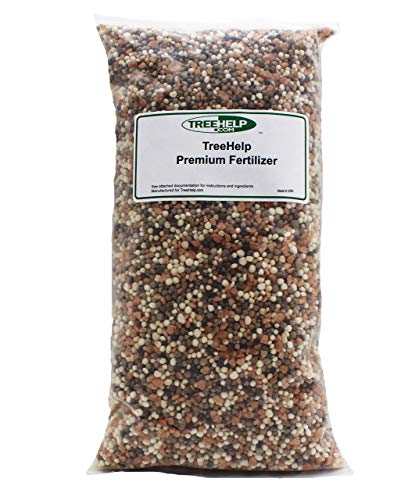
2. TreeHelp Premium Fertilizer for Arborvitae
A granular rescue feed for arborvitae that have gone brown and need a patient, steady correction.
This fertilizer is built for one job: feeding arborvitae through sturdy root development. The slow-release nitrogen (a form that feeds gradually over weeks) keeps working through the growing season, so you can sprinkle the granules under your trees just before a heavy rain and watch browned-out arborvitae turn green again over time. It’s not instant, but it’s persistent.
A ~3-pound bag treats one large tree or two to three smaller or newly planted ones, so it’s a surgical buy rather than a whole-hedge solution. It’s a granular feed, meaning it lands on the soil surface and works its way down — one owner with 50 arborvitae in a row confirmed it took a while to work into the ground but ultimately did the job.
The recurring discussion is about the label math: a full 3-pound bag for one grown tree sounds like a lot, and some owners balk at the volume. If you’re feeding a long privacy screen, you’d need several bags and a lot of sprinkling — this is better aimed at a few specimen trees that need attention.
Who it’s for: Arborvitae showing browning that need a slow, root-focused correction over a season.
The catch: The per-tree volume feels heavy, and results come slowly — patience is required.
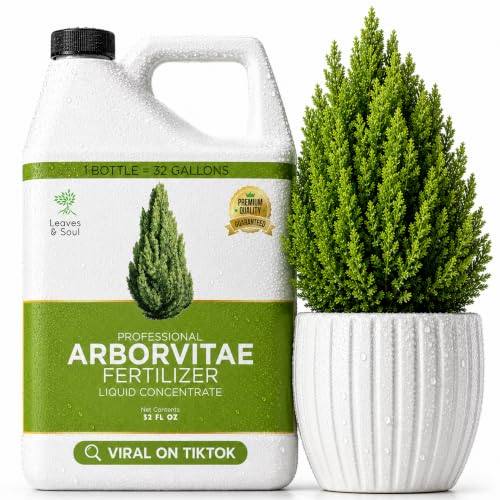
3. Leaves & Soul Arborvitae Fertilizer Liquid
A concentrated 6-4-6 liquid that sends nutrients straight to the root zone for the fastest visible turnaround.
The defining move here is fast-absorbing liquid delivery — you mix the 6-4-6 concentrate (6% nitrogen, 4% phosphorus, 6% potassium) with water and it goes directly to the roots, the quickest way to correct a nutrient shortage. One reviewer reports Austrian Pines growing from 2 feet to 6 feet-plus in about two years, even through hot, dry Northeast summers — a strong vote for how this form performs in tough clay soil.
The balanced 6-4-6 ratio makes it a versatile plant food beyond arborvitae, covering houseplants, flowers, vegetables, and container plants. Owners love the ease of a liquid — one noted it’s simpler to use than working with spikes, and that their trees responded after a single application. Because it’s concentrated, a little goes a long way, which keeps the cost per feeding down.
The trade-off is that liquids demand repeat applications through the season, unlike a spike you install once. And since it delivers nutrients fast, you control the dilution carefully on young trees to avoid a shock. It’s made in the USA, which is a perk for buyers who prefer domestic sourcing.
Strongest for: Clay soil where spikes struggle, and quick root-zone delivery.
Keep in mind: Plan for regular re-feeding — this is a routine, not a one-and-done.
4. Power Spike Fertilizer for Evergreens, Trees & Shrubs
Balanced spikes with special binders that release nutrients safely for steady, continuous tree health.
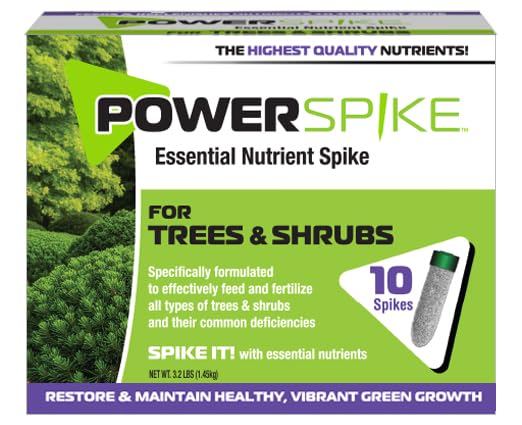
Power Spike uses special binders to meter out key elements and micronutrients (trace minerals like iron and manganese) safely. That means continuous feeding without the surge-and-crash that can stress a tree. Owners frame these as a health feed rather than a growth accelerator — “great for my new evergreen trees” is the typical response, and one dramatic review describes saving a dying 20-foot pine after placing spikes 6-7 feet from the trunk and soaking the ground.
You get 10 spikes plus a pounding cap, with dosing set at one spike per inch of trunk diameter. The recurring installation tip is to pre-drill holes and water the soil first — the spikes are dense and some owners found they needed a mallet to seat them, with one or two breaking in the process. Wet soil and a pilot hole make the job much easier.
Because the formula is balanced and moderate, it supports overall plant health rather than forcing explosive growth. That’s the right call for mature trees that just need to stay vibrant, but if your goal is pushing maximum vertical growth on young Green Giants for a quick privacy screen, a nitrogen-forward liquid would move faster.
Best used for: Established evergreens that need reliable maintenance feeding through spring and fall.
Expect: Dense spikes that need a pilot hole and a firm hand — not a soft-soil tap-in.
5. TPS Nutrients Thuja Green Giant Fertilizer
A mild weekly liquid that pushes vertical growth and denser hedge coverage without burning young roots.
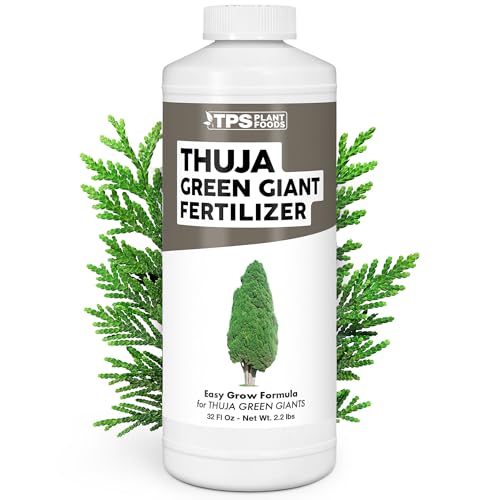
This is the growth-forward option: a 32-ounce liquid built to promote vigorous vertical growth and fuller privacy-screen coverage on arborvitae, cypress, and other evergreens. Reviewers describe feeding weekly at just 2 tablespoons per gallon, and the trees reacting extremely well — the mild formula is the key detail, since it feeds actively without the root-burn risk that heavier concentrates carry on saplings.
Owners pair it with a simple weekly watering routine and see saplings perk up noticeably. It’s also marketed for strengthening roots and long-term tree stability, which matters when you’re planting a row of Green Giants that will stand for decades. The low coverage rating on the spec sheet is a hint: this is a hands-on, weekly relationship with your trees, not a once-a-season treatment.
One owner noted that even with the mild formula, intense heat still stresses young saplings — no fertilizer overrides brutal summer sun, so pair feeding with a consistent watering schedule. If you want the fastest possible canopy and don’t mind a weekly mixing ritual, this delivers.
Pick this if: you want active weekly feeding for maximum growth on young trees.
skip it if: you want a set-and-forget schedule — this demands your attention.
6. The Old Farmer’s Almanac TruSpike Fertilizer Spikes

A patented 13-3-3 spike that feeds for up to 3 months and claims it will not break, crush, or smash.
The Old Farmer’s Almanac TruSpike takes a different engineering path. The 13-3-3 formula (13% nitrogen, 3% phosphorus, 3% potassium) carries the highest nitrogen load of any spike here — 13% — which drives vigorous, colorful growth, and the manufacturer claims these spikes will not break, crush, or smash when you hammer them in. Each 5-inch spike feeds continuously for up to 3 months, so two applications a year (early spring, late fall) covers the season.
Owner stories are vivid: a struggling dogwood got 6 spikes in a 10-foot ring last fall and exploded with white blooms come spring. Quality is the most-praised trait, with effectiveness close behind. The practical tip from the pages is to saturate the ground first — pound into soft, wet soil or sink the spikes with a digging bar to avoid breakage in hard-packed earth.
The honest split is on ease of use: some owners find the spikes simple to install, while others report difficulty driving them into firm ground. Pre-watering solves most of that. For a Green Giant row, the 12-count box with 3-month feeding per spike means solid coverage from one box.
Where it shines
- 13% nitrogen drives strong, visible growth
- Each spike feeds up to 3 months continuously
- Durable construction holds up during installation
- Owner results show dramatic seasonal improvement
Where it fights you
- Hard, dry soil makes driving the spikes difficult — water first
- Some owners saw no difference; results vary by soil and tree
Grab these if: you want maximum nitrogen punch per spike for fast, visible growth.
Pass them by if: your soil is rock-hard and you won’t commit to pre-watering.
7. Espoma Organic Evergreen-tone 4-3-4

The 18-pound organic granular feed with Espoma’s Bio-tone that owners swear by for rich color and growth.
For organic gardeners, this is the heavyweight: an 18-pound bag of 4-3-4 granules enhanced with Espoma’s exclusive Bio-tone formula, plus 5% sulfur for that deep evergreen green. It’s a registered Organic Input Material, meaning it meets requirements for organic production, and it’s ready to use with no mixing — you broadcast it and water it in. The spec sheet says it’s environmentally safe with no sludges or toxic ingredients.
Owner loyalty here is striking — “Don’t use anything else” is a recurring line, with reports of vibrant color and abundant growth across many evergreen types. The brand dates back to 1929, and the community that buys it tends to stay with it. Because it’s a granular, it’s the practical choice when you have many trees: an 18-pound bag goes much further than a box of spikes for a long hedge row.
The two honest caveats: the smell, which owners describe as barnyard-like during and after application (it’s organic, made from natural ingredients like composted manure), and a few reports of it damaging pines and thujas when over-applied. Follow the dosage on the bag and it’s a reliable, long-term organic feed.
Choose this if: you want an organic, large-format granular feed for a whole row of evergreens.
Be ready for: a strong natural odor during application and the need to follow dosage precisely.
8. TPS Nutrients Arborvitae Fertilizer 1 Gallon
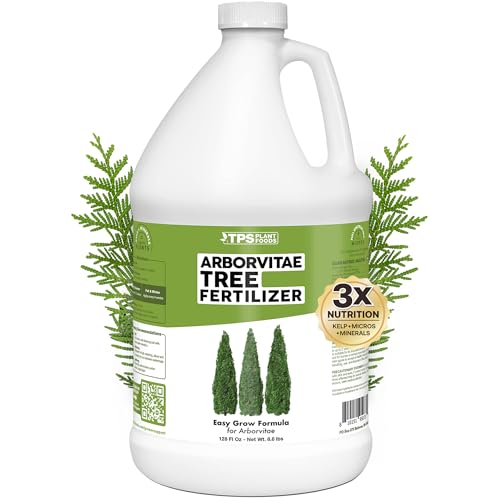
A full gallon of fast-absorbing liquid made for reviving long arborvitae hedges and supporting dense foliage.
This is the volume play for hedge owners: a full 128-fluid-ounce gallon of liquid fertilizer built specifically for arborvitae and evergreen hedges. The scale matters — when you have a long privacy screen to feed, a 32-ounce bottle runs out fast, but a gallon lets you treat the whole row in one session. The fast-absorbing formula is aimed at dense foliage and strong root systems.
Others describe bringing neglected hedges back to life and seeing visible growth within weeks. Plant growth is the trait owners praise most, with ease of use close behind.
The mixed note is value: some consider the gallon a solid investment for hedge recovery, while others find it pricey for what you get. A few owners also flagged shipping handling — the cap can break in transit if it’s mailed in a bubble envelope, though the safety seal held. For a serious hedge, this is the most efficient way to feed a lot of trees at once.
Why it stands out
- Full gallon covers long hedge rows in one session
- Fast-absorbing formula shows visible results in weeks
- Dramatic owner recovery stories on near-dead trees
- No mixing headaches — pour and water
What to watch
- Some owners question the cost per feeding
- Shipping can arrive with a damaged cap — check on delivery
Worth it for: anyone nursing a long, struggling hedge back to full health this season.
Think twice if: you only have one or two trees — a smaller bottle wastes less.
Understanding the Specs
The NPK Ratio
The three numbers on the bag show the percentage of nitrogen, phosphorus, and potassium. Nitrogen is the first number and the one that matters most for Green Giants — it drives the green top growth that makes a dense privacy hedge. A ratio like 11-3-4 is nitrogen-forward for growth, while a milder 6-4-6 balances growth with root and flower development. Because it appears in the product’s data, you can compare the nitrogen load directly between Jobe’s 11-3-4 and the Old Farmer’s Almanac 13-3-3 to gauge growth potential.
Slow-Release vs. Fast-Absorbing
Slow-release formulas (spikes and some granules) meter out nutrients gradually over months, which is safer for young trees and requires fewer applications. Fast-absorbing liquids deliver nutrients straight to the root zone for the quickest visible response, but they demand repeat feeding through the season. The trade-off is convenience versus speed: spikes like Jobe’s feed twice a year, while liquids like TPS recommend weekly feeding for maximum growth.
FAQ
When should I fertilize Green Giant arborvitae?
How much fertilizer does a single Green Giant tree need?
What does fertilizer burn look like and how do I avoid it?
Are spikes or liquid fertilizer better for Green Giants?
Can I use the same fertilizer for other evergreens and acid-loving plants?
How long does a box of fertilizer spikes last?
Is organic fertilizer as effective as synthetic for Green Giants?
Why are my arborvitae browning even after fertilizing?
How do I install fertilizer spikes without breaking them?
Which fertilizer gives the fastest visible growth on young trees?
Final Thoughts: The Verdict
For most people, the fertilizer for arborvitae green giant winner is the Jobe’s Evergreen Spikes because the pre-measured 11-3-4 slow-release delivery takes all the guesswork out of feeding. If you want the fastest possible growth on young trees, grab the TPS Thuja Green Giant liquid. And for a long, struggling hedge that needs a full-season revival, the TPS Arborvitae 1-gallon is the one to reach for.
How We Picked
We do not accept paid placement. Every pick is matched to a real buyer and a real use-case; we do not hands-on test units.
Sources & Methodology
Specifications: manufacturer listings and product documentation. Review insights: verified customer reviews. Pricing: not shown on this page (it changes often); check the current price via the retailer link.
As an Amazon Associate, WellFizz earns from qualifying purchases. This does not affect which products we feature.
Related Guides

Mo Maruf
I created WellFizz to bridge the gap between vague wellness advice and actionable solutions. My mission is simple: to decode the research and give you practical tools you can actually use.
Beyond the data, I am a passionate traveler. I believe that stepping away from the screen to explore new environments is essential for mental clarity and physical vitality.