Our readers keep the lights on and my smoothie glass nicely filled. As an Amazon Associate, I earn from qualifying purchases.
Specs are compiled from manufacturer listings and verified buyer reviews and can change over time — please confirm the key details on the product page before buying.
Getting an African violet to bloom isn’t about luck—it’s about feeding it the right ratio of nutrients at the right strength. The single biggest mistake new owners make is grabbing a generic plant food, which pushes leaf growth instead of those signature clusters of flowers. This guide breaks down the best fertilizer options by what they actually do for your plant, so you can stop guessing and start seeing blooms.
I’m Mohammad Maruf — the founder and writer behind WellFizz. This guide is built by comparing the manufacturers’ published specifications and the patterns across verified customer reviews, so you get each pick’s real strengths and trade-offs instead of marketing spin.
You’ll learn which N-P-K ratios trigger flowering, the difference between liquid and water-soluble options, and the exact feeding habits that keep violets thriving. Find the perfect match for your indoor garden with this guide to the fertilizer for african violets that cuts through the hype.
Our Picks at a Glance

How To Choose The Best Fertilizer For African Violets
African violets are picky eaters. They need a specific balance of nutrients that favors flower production over leafy growth. Understanding that balance is the difference between a plant that blooms for months and one that just sits there looking green.
Decode the N-P-K Ratio First
Every fertilizer label shows three numbers, like 12-36-14. The first is nitrogen (N) for leaves, the second is phosphorus (P) for roots and flowers, and the third is potassium (K) for overall health. For African violets, you want the middle number to be the highest—that’s the phosphorus that drives blooming.
Liquid Drops vs. Water-Soluble Powder
If you’re just starting out, liquid fertilizers are ready to use and simple to measure into your watering can, so you can feed your violets without guesswork. Water-soluble powders are concentrated, meaning a small container mixes into many gallons of water, which stretches your money further if you have a large collection. Both work well; your choice depends on how many plants you’re feeding.
Quick Comparison
| Model | Best For | Form | N-P-K Ratio | Mixing Ratio | Amazon |
|---|---|---|---|---|---|
| Jack’s Classic 12-36-14★ Best Overall | Heavy Blooming | Powder | 12-36-14 | 1/4 tsp per gallon | Amazon |
| Schultz African Violet PlusTop Performer | General Health | Liquid | 8-14-9 | 1:400 | Amazon |
| Miracle-Gro Blooming Duo | Violets & Orchids | Liquid | — | Apply weekly | Amazon |
| African Violet Fertilizer 8 oz | Continuous Blooms | Liquid | — | 1:128-1:256 | Amazon |
| Dyna-Gro Bloom 3-12-6 | Stubborn Non-Bloomers | Liquid | 3-12-6 | 1:15 | Amazon |
| Perfect Plants Drops | Gentle Feeding | Liquid Drops | 2-2-2 | 5-8 drops per 32 oz | Amazon |
| Bonide 106 | Budget Feeding | Liquid | — | 1/8 tsp per quart | Amazon |
In-Depth Reviews
1. Jack’s Classic 12-36-14 African Violet Water-Soluble Fertilizer
Our pick — over 4.5★ from 800+ verified ratings; the strongest balance of quality and price.
The bloom machine that turns stubborn leaf props into a cascade of purple.
The standout feature here is the 12-36-14 analysis—the high phosphorus (the middle 36) is what drives root and bud development. This is the exact ratio that tells your violet to focus on flowers instead of just leaves, and it delivers deep green foliage alongside those colorful blooms.
The water-soluble powder format is a serious value play because a little goes a long way. The included measuring spoon makes the 1/4 teaspoon per gallon mixing ratio simple to use, so you won’t overfeed your plants. The added micronutrients mean you don’t need a second product to keep plants healthy. As buyers report, the dye that tints the water blue is a handy touch for seeing how concentrated your mix is.
Rated 4.8 stars across 800+ owners, one grower saw the first bloom within a month after years of no flowers. Owners praise the consistent, year-round bloom output.
Why It Wins
- High-phosphorus 12-36-14 ratio pushes consistent blooming
- Powdered form stretches further than liquids—mixes into multiple gallons
- Urea-free formula helps prevent leaf burn
Who Should Pass
- Requires measuring and mixing, unlike grab-and-go liquid drops
- Best for those with several plants to justify the powder volume
The clear winner: For anyone serious about getting their violets to bloom profusely, this is the gold standard. The high-phosphorus analysis and long-lasting powder make it the most effective and economical choice.
One consideration: If you only have a single small violet and want zero measuring, a liquid dropper bottle might be more convenient.
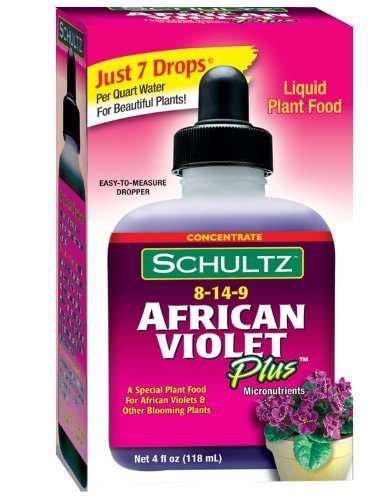
2. Schultz African Violet Plus Plant Food 8-14-9
The gentle liquid drops that make feeding a daily habit, not a chore.
This one earns its spot with a balanced 8-14-9 ratio that keeps the phosphorus high enough for flowering without being so strong that you worry about the roots. It’s formulated for African Violets and other plants in the Gesneriad family, so it’s a safe bet if you also grow streptocarpus or other relatives.
At a 1:400 mixing ratio, a 4 fluid ounce bottle goes surprisingly far. The liquid form is beginner-friendly—owners mention simply adding drops to the distilled water in a watering can and watching blooms appear. There’s no odor and no staining, which makes it a clean addition to your watering routine.
What wins people over is overall plant health, with owners describing violets growing beautifully and thriving after switching. It pairs well with bottom-watering techniques, and the gentle formula works steadily—one grower saw a plant blooming after six months of consistent use. This is the pick for those who want a no-fuss liquid that simply works.
Why It Works
- Easy drop-and-water application for daily feeding
- Safe for the whole Gesneriad family, not just violets
- No odor or staining—clean to handle
Who Should Pass
- Smaller 4 oz bottle won’t last as long as a powder
- Ratio is lower than the heavy-bloom specialists
Reach for this if: You want an easy liquid that keeps your violet collection healthy with minimal fuss. The gentle ratio is forgiving for beginners.
Look elsewhere if: You need maximum bloom pressure for a stubborn plant that refuses to flower; a higher-phosphorus formula is stronger.
3. Miracle-Gro Blooming Houseplant Food & Orchid Mist

A two-bottle kit that covers your blooming houseplants and your orchids in one order.
This is a combo deal that solves a specific problem: if your windowsill hosts both African violets and orchids, you don’t want to buy two separate feeding systems. The set includes an 8 oz Blooming Houseplant Food for flowering plants like your violets, plus an 8 oz Orchid Plant Food Mist for your phalaenopsis, all in one package.
The blooming food applies directly to the soil or mixes with water, with a simple weekly schedule. The orchid mist feeds instantly by spraying leaves, roots, and growing media once a week—just avoid the actual flowers. Customers note their orchids showing new growth within two weeks, and the convenience factor is a big win: no complex measuring, just spray or pour.
Its forgiving, no-mix formula appeals to those who’ve over-fertilized before. Having two ready-to-go formulas removes the guesswork.
Why It’s Handy
- Two separate feeds for violets and orchids in one order
- No mixing required—soil drench or spray mist
- Forgiving weekly schedule prevents over-feeding mistakes
Who Should Pass
- If you only grow violets, the orchid mist goes unused
- No N-P-K ratio listed on the label for precise control
Best for: Mixed houseplant households that want a simple, simple to use system for both violets and orchids without buying separate products.
Not ideal if: You’re a collector who wants exact N-P-K control; this duo is about convenience over precision.
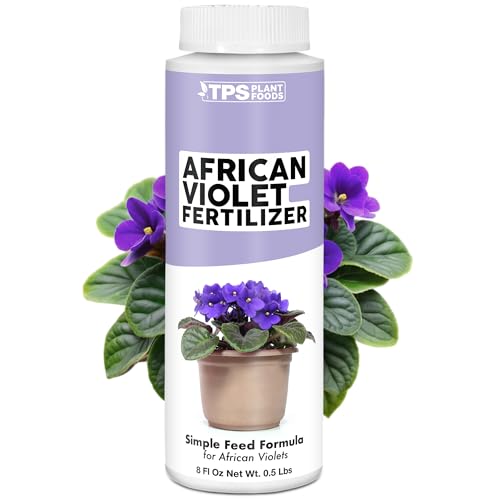
4. African Violet Fertilizer, Liquid Plant Food for More Blooms
The straightforward liquid that gets straight to the point: more flowers.
This is a no-nonsense liquid fertilizer designed specifically to encourage rebloom cycles by delivering even feeding without root stress. It’s formulated to support healthy growth and flowering in indoor African violets, with a flexible mixing ratio of 1:128-1:256 depending on how hungry your plant is.
At 8 fluid ounces, it’s a generous bottle that suits a medium-sized collection. The gentle nutrition angle is the key selling point—it supports strong roots without burning or overfeeding sensitive plants. Reviewers point out their plants perking up and looking deep green and healthy, with flowers growing profusely on first use.
Owners highlight its effectiveness on other violet varieties in the same family. The praise centers on quality and the ability to produce great blooms while keeping plants healthier overall. For a simple, well-priced liquid that delivers, this is a solid mid-range choice.
Why It Delivers
- Flexible dilution ratio suits different plant needs
- Gentle on sensitive roots—no burning risk
- Effective on other violet varieties, not just African violets
Who Should Pass
- Lacks a detailed N-P-K breakdown on the label
- Requires careful reading—too much can be a problem
Reach for this if: You want a gentle liquid that re-ignites stubborn rebloom cycles. The forgiving formula keeps roots safe while pushing flowers.
Think twice if: You prefer knowing exact N-P-K numbers to dial in your feeding; this one skips that detail.
5. Dyna-Gro Bloom 3-12-6 Fertilizer

The scientific fix for plants that grow fine but just won’t flower.
This is the specialist’s tool. The Dyna-Gro Bloom 3-12-6 formula is low nitrogen, high phosphorus, designed for one job: encouraging large, vibrant blooms. It contains all 6 essential macronutrients, making it a complete feed for roses, orchids, African violets, and other flowering plants.
what separates it is the timing guidance—apply it before flower buds appear to help initiate flowering, so you can time your feeding for more blooms. The mixing ratio is a strong 1:15, which means it’s concentrated, so you use a little per gallon. Growers recommend it for coaxing stubborn streps (African violet relatives) into bloom.
A friend’s recommendation got stubborn plants to flower for the first time. Buyers describe immediate results and extremely lush flowers across a range of plants. It’s not just for violets—it’s a versatile bloom booster that earns its place for anyone who has a green plant that just won’t produce flowers.
Why It Stands Out
- Very low nitrogen (3) prevents excessive leafy growth
- Complete micronutrient package in every dose
- Ideal for forcing blooms on stubborn plants
Who Should Pass
- Strong concentration demands careful measuring
- High-phosphorus focus isn’t needed for everyday maintenance
Best for: The grower who does everything right but still has plants that won’t flower. This is the targeted nudge that gets them over the line.
Not for: Casual owners who just want a simple all-rounder; this is a purpose-built bloom trigger.
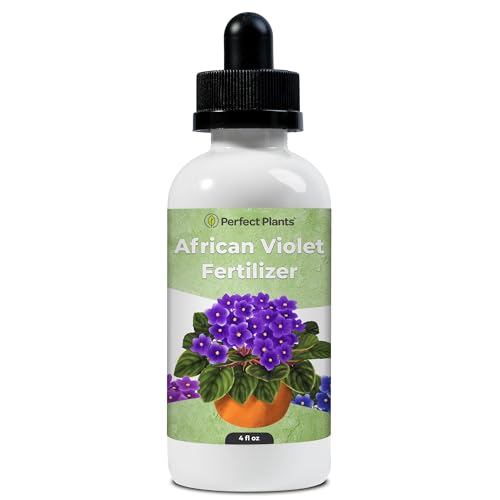
6. Perfect Plants African Violet Fertilizer, Liquid Bloom Food Drops
The featherlight 2-2-2 drops that are impossible to mess up.
This one is for the anxious feeder. The gentle 2-2-2 formula is explicitly designed not to burn sensitive roots—a frequent worry with spikes and sticks. Instead of a strong phosphorus punch, it delivers a balanced, mild meal that’s perfect for regular maintenance on a single plant or two.
The pipette bottle makes it incredibly easy: simply dilute 5-8 drops per 32 ounces of water. The 4 fluid ounce bottle is small, but shoppers say it goes a long way because you use so little each time. Perfect Plants Nursery, with 45+ years of experience, formulated these drops specifically for finicky violets.
What wins people over is the effectiveness and ease of use. Buyers report their new violets perking up immediately after the first dose, with droppers that work every time. The bottle size is also praised as a convenient reminder to feed—it’s small enough to sit on the windowsill so you don’t forget.
Why It’s Forgiving
- Ultra-gentle 2-2-2 ratio won’t stress delicate roots
- Pipette drops make measuring nearly impossible to get wrong
- Small bottle fits nicely on a windowsill as a feeding reminder
Who Should Skip
- Low phosphorus means slower, less dramatic bloom results
- 4 oz bottle needs replacing more often with heavy use
Reach for this if: You’ve burned a plant before or you’re new to fertilizing. The gentle formula is the safest way to learn to feed.
Look elsewhere if: Your violet is healthy but refuses to bloom; it needs the higher-phosphorus formula like the Jack’s Classic above.
7. Bonide 106 Liquid African Violet Plant Food

The simple, cheap liquid that keeps plants continually blooming on a schedule.
Don’t let the low-key branding fool you—this is a workhorse. The Bonide 106 is specifically formulated for African violets to promote beautiful blooms, and the mixing ratio is a very weak 1/8 tsp per quart of water. That’s designed for the “feed every time you water” method, which is a proven way to keep violets flowering constantly.
At 8 fluid ounces, it’s a bigger bottle than the mid-range options and it’s priced to be the entry-level choice. The logic is simple: use a tiny amount two times a week when you water, and your violets stay in bloom. Owners mention exactly that—continually blooming plants that obviously love the product.
One grower notes it can even restore variegation in leaves. It’s very easy to use, though the pull-up lid can clog; owners recommend removing it and pouring instead. An occasional bottle has arrived leaking in transit, so it’s worth checking the seal on delivery.
Why It’s Reliable
- Ultra-weak mix ratio makes overfeeding nearly impossible
- Large 8 oz bottle is great value for the price
- Real-world results: continually blooming violets
Who Should Spend More
- Lid design can clog—pour instead of using the pull-up top
- Lacks the high-phosphorus punch of bloom specialists
Best for: Budget-conscious owners who want a dependable liquid that won’t burn roots, even with frequent feeding.
Consider upgrading if: You want maximum bloom output from a single feeding, not a constant weekly schedule.
Understanding the Specs
N-P-K Ratio
These three numbers tell you the percentage of nitrogen, phosphorus, and potassium in the mix. For African violets, a higher middle number (phosphorus) is what encourages flower bud development and root growth. Look for ratios like 12-36-14 or 8-14-9 where the phosphorus clearly leads.
Mixing Ratio
This tells you how much to dilute the concentrate. A ratio like 1:128 means one part fertilizer to 128 parts water. A weak mix (like Bonide’s 1/8 tsp per quart) is designed for feeding every time you water, while a stronger mix (like Dyna-Gro’s 1:15) is for occasional feeding. Always follow the label to avoid burning roots.
FAQ
Why is the middle N-P-K number the most important for African violets?
Should I use liquid drops or water-soluble powder?
How often should I feed my African violet?
Can I use a generic houseplant fertilizer on my violets?
What happens if I use too much fertilizer?
Is the Miracle-Gro Blooming duo good if I only have violets?
Can Dyna-Gro Bloom help other plants in my house?
How do I revive a violet that has stopped blooming?
Final Thoughts: The Verdict
For the majority of shoppers, the fertilizer for african violets winner is the Jack’s Classic 12-36-14 because its high-phosphorus formula and economical powder form deliver the most dramatic bloom results. If you want easy liquid drops for a single plant, grab the Perfect Plants Drops. And for a stubborn plant that just won’t flower, the Dyna-Gro Bloom is the targeted fix to reach for.
How We Picked
We do not accept paid placement. Every pick is matched to a real buyer and a real use-case; we do not hands-on test units.
Sources & Methodology
Specifications: manufacturer listings and product documentation. Review insights: verified customer reviews, as of August 2026. Pricing: not shown on this page (it changes often); check the current price via the retailer link.
As an Amazon Associate, WellFizz earns from qualifying purchases. This does not affect which products we feature.
Related Guides

Mo Maruf
I created WellFizz to bridge the gap between vague wellness advice and actionable solutions. My mission is simple: to decode the research and give you practical tools you can actually use.
Beyond the data, I am a passionate traveler. I believe that stepping away from the screen to explore new environments is essential for mental clarity and physical vitality.